
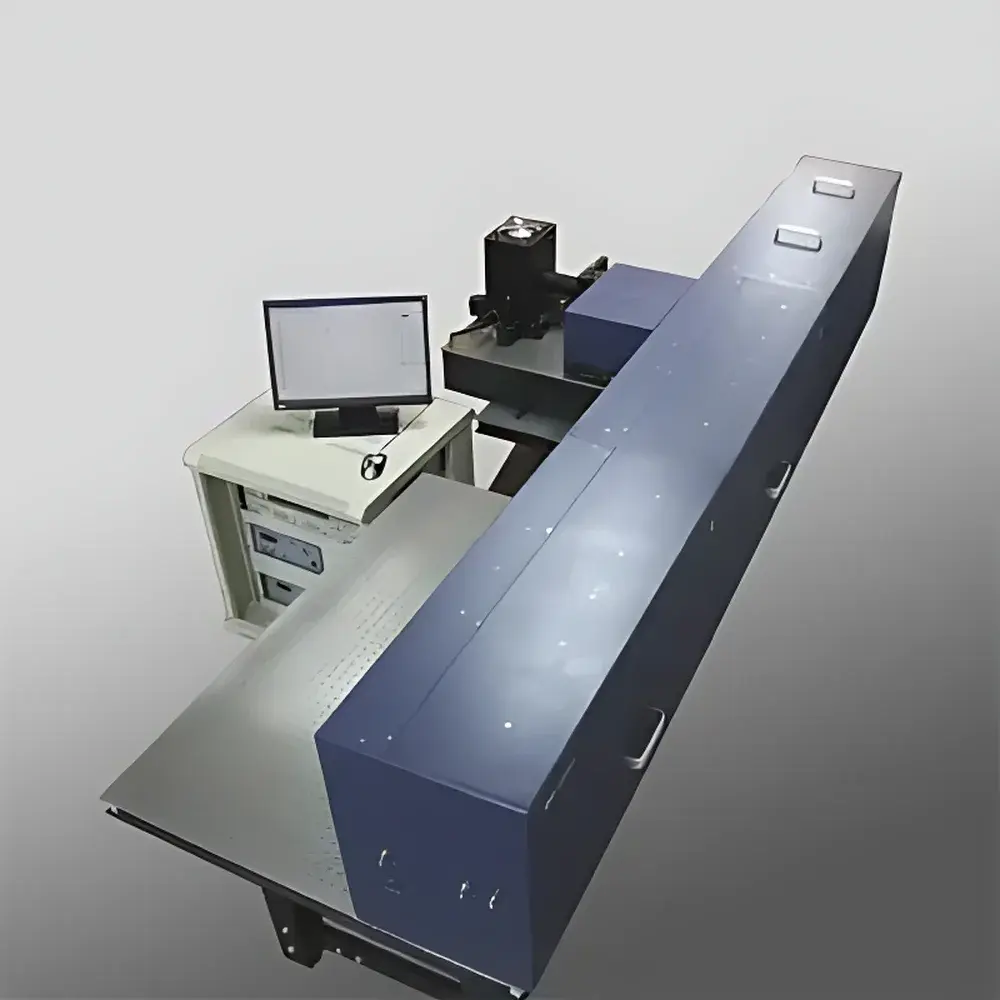
ZOLIX GX Optical Lens Spectral Transmittance Measurement System
| Brand | ZOLIX |
|---|---|
| Origin | Beijing, China |
| Manufacturer Type | Original Equipment Manufacturer (OEM) |
| Product Origin | Domestic (China) |
| Model | GX |
| Pricing | Available Upon Request |
Overview
The ZOLIX GX Optical Lens Spectral Transmittance Measurement System is a precision-engineered benchtop instrument designed for quantitative spectral transmittance characterization of optical lenses and multi-element optical assemblies. It operates on the principle of double-beam spectrophotometry with real-time reference compensation, enabling high-fidelity measurement of absolute transmittance across the ultraviolet–visible–near-infrared (UV-VIS-NIR) spectrum. The system integrates a stabilized tungsten-halogen broadband light source, a 300 mm focal length triple-grating monochromator with motorized grating selection, and synchronized optical path alignment to ensure minimal stray light and optimal signal-to-noise ratio. Engineered for metrological traceability in optical manufacturing and R&D laboratories, it supports compliance-driven workflows where lens performance must be validated against ISO 9022 (optics and photonics — environmental test methods), ISO 10110 (optical drawing standards), and internal quality control specifications for imaging systems.
Key Features
- Triple-grating monochromator (300 mm focal length) with automatic grating switching and wavelength scanning—enabling seamless coverage from 380 nm to 2500 nm with resolution configurable via slit width selection
- Motorized iris diaphragm system supporting continuous aperture adjustment from Φ8 mm to Φ150 mm, accommodating plano-convex, biconvex, aspheric, and telecentric lenses up to 600 mm in axial length
- High-stability tungsten-halogen lamp with integrated chopper and constant-current power supply, delivering <0.1% RMS intensity drift over 4-hour continuous operation
- Automated XYZ translation stage with sub-micron repeatability, enabling precise axial positioning of the lens under test relative to the collimated beam waist
- Real-time dual-channel detection architecture: sample beam routed through the lens under test; reference beam maintained via fixed-path compensation optics
- Transmittance accuracy of ±2% (for lenses with transmittance >10%) verified against NIST-traceable neutral density filters at key wavelengths (e.g., 550 nm, 1000 nm, 1550 nm)
Sample Compatibility & Compliance
The GX system accommodates uncoated, single-layer AR-coated, and multi-layer broadband anti-reflection coated lenses without requiring disassembly or mounting fixtures beyond standard kinematic lens holders. Its modular optical layout permits integration with optional accessories—including integrating spheres for diffuse transmittance evaluation, polarization analyzers for angular-dependent transmission analysis, and temperature-controlled lens stages for thermal stability testing. All measurement protocols align with ASTM E308 (Standard Practice for Computing the Colors of Objects by Using the CIE System) and support GLP/GMP documentation requirements via audit-trail-enabled software logging. Raw spectral data files are exportable in CSV and ASTM E131-compliant .spc formats, facilitating third-party validation and regulatory submission.
Software & Data Management
The proprietary ZOLIX SpectraControl Suite provides unified control of monochromator, filter wheel, translation stages, and detector acquisition. Key software capabilities include: automated wavelength calibration using Hg/Ne spectral lines; dynamic baseline correction with dark-current subtraction and reference-beam normalization; batch-mode measurement scheduling with parameter templating; and real-time transmittance curve overlay for comparative analysis across multiple lenses. All measurement metadata—including date/time stamp, operator ID, lens serial number, aperture setting, and environmental conditions (optional sensor input)—are embedded in output files. Software complies with FDA 21 CFR Part 11 requirements for electronic records and signatures when deployed with role-based access control and digital signature modules.
Applications
- Quality assurance of camera lens assemblies for smartphone, automotive ADAS, and machine vision applications
- Development and validation of AR/HR coatings for laser optics and projection systems
- Characterization of infrared-transmitting materials (e.g., Ge, ZnSe, CaF₂) used in thermal imaging optics
- Verification of spectral cutoff behavior in bandpass and edge filters integrated into lens barrels
- Correlation of measured transmittance spectra with Zemax/OpticStudio ray-trace predictions during optical design iteration
- Environmental aging studies—tracking transmittance degradation after humidity cycling, UV exposure, or abrasion testing
FAQ
What is the minimum measurable transmittance value for this system?
The system is optimized for lenses with transmittance ≥10%. Below this threshold, signal-to-noise limitations may affect repeatability; users requiring sub-1% transmittance quantification should consider integrating an integrating sphere accessory.
Can the GX system measure lenses with non-circular apertures or irregular mounting flanges?
Yes—the adjustable iris diaphragm and modular lens holder design accommodate rectangular, elliptical, or custom-mount lenses, provided the optical clear aperture falls within the Φ8–Φ150 mm range and mechanical constraints allow stable centering.
Is spectral calibration traceable to national standards?
All factory calibrations are performed using NIST-traceable mercury-neon emission lamps and certified neutral density filters; calibration certificates include uncertainty budgets per ISO/IEC 17025 guidelines.
Does the software support automated pass/fail reporting against user-defined spectral limits?
Yes—custom spectral mask templates can be defined, and the software generates annotated reports highlighting deviations from specified upper/lower transmittance thresholds at designated wavelength bands.
What maintenance is required for long-term accuracy stability?
Annual verification of wavelength accuracy and photometric linearity is recommended; no routine optical alignment is needed due to the monolithic optomechanical baseplate and kinematic mount design.





