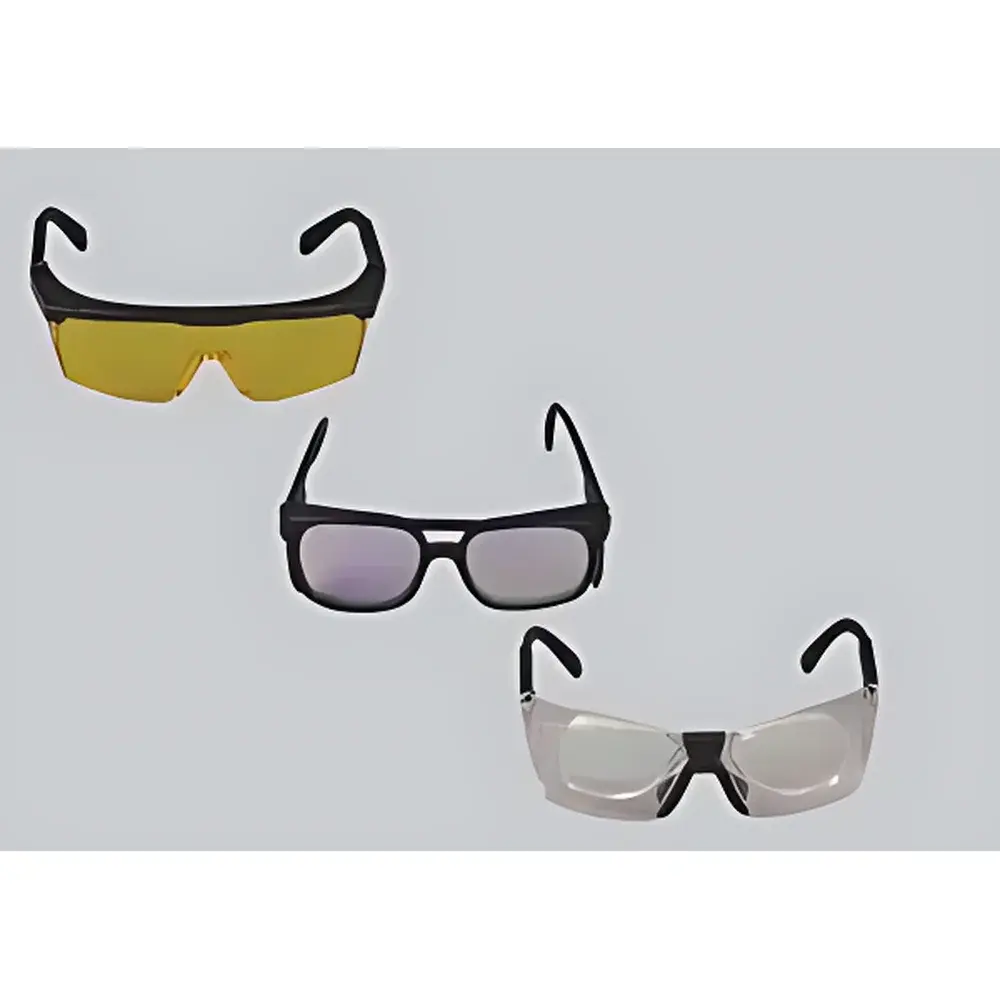
ZOLIX HMJ Series Laser Safety Goggles
| Brand | ZOLIX |
|---|---|
| Model | HMJ Series |
| Origin | Beijing, China |
| Manufacturer Type | OEM/ODM Manufacturer |
| Country of Origin | China |
| Optical Filter Technology | Interference Coating / Colored Glass Substrate |
| OD Rating | 4 (per specified wavelength) |
| Visible Light Transmission (VLT) | 45–85% (model-dependent) |
| Compliance | Meets ANSI Z136.1-2022 & EN 207:2017 requirements for laser eye protection |
Overview
The ZOLIX HMJ Series Laser Safety Goggles are engineered for reliable ocular protection in laboratory, industrial, and clinical laser environments. Designed in accordance with internationally recognized laser safety standards—including ANSI Z136.1-2022 (American National Standard for Safe Use of Lasers) and EN 207:2017 (European standard for personal eye protection against laser radiation)—these goggles utilize precision-deposited interference filters or absorption-based colored glass substrates to attenuate hazardous laser wavelengths while maintaining adequate visible light transmission (VLT) for operational visibility. Each model is wavelength-specific and calibrated to deliver a minimum optical density (OD) of 4 at its designated protection band—corresponding to an attenuation factor of ≥10⁴ (i.e., reduction of incident laser irradiance by four orders of magnitude). This level of attenuation is suitable for Class 3B and Class 4 laser operations where direct or reflected beam exposure poses significant retinal or corneal injury risk.
Key Features
- Wavelength-specific optical design: 15 distinct models covering UV (248 nm, 266 nm), visible (473 nm, 514–532 nm, 632.8 nm), NIR (808–1064 nm), and mid-IR (1510–10600 nm) laser lines.
- Consistent OD ≥4 across all models: Ensures compliance with occupational exposure limits (ELs) defined in IEC 60825-1 and ANSI Z136.1 for continuous-wave (CW) and pulsed laser sources.
- High VLT performance: Ranging from 45% to 85%, optimized per spectral band to preserve visual acuity and color recognition during alignment, diagnostics, and maintenance tasks.
- Durable frame architecture: Lightweight, adjustable temple arms and nose bridge accommodate diverse facial anatomies; compatible with prescription eyewear wearers via over-goggle fit.
- Robust optical substrate: Interference-coated lenses resist degradation under repeated exposure to moderate-power laser beams; absorption-type variants maintain thermal stability under extended use.
- No proprietary electronics or power requirements: Fully passive design ensures zero failure modes related to battery life, firmware, or sensor drift.
Sample Compatibility & Compliance
The HMJ Series is validated for use with common CW and pulsed lasers employed in spectroscopy, material processing, biomedical instrumentation, and quantum optics laboratories—including Nd:YAG (1064 nm, 532 nm, 355 nm, 266 nm), HeNe (632.8 nm), diode lasers (808 nm, 980 nm, 1550 nm), Ti:sapphire (700–1000 nm), and CO₂ (10.6 µm). All models are CE-marked and conform to EN 207:2017 test protocols for resistance to laser-induced damage (LIDT), including testing under specified pulse duration, repetition rate, and beam diameter conditions. Documentation includes full test reports traceable to accredited third-party laboratories. While not certified to FDA 21 CFR Part 11, the goggle’s passive mechanical/optical nature renders it inherently compliant with GLP/GMP documentation requirements for controlled environments when integrated into site-specific laser safety programs.
Software & Data Management
As a passive optical safety device, the HMJ Series does not incorporate embedded software, firmware, or digital interfaces. No data acquisition, logging, or connectivity features are present—eliminating cybersecurity concerns, calibration drift, or software validation burdens. Users receive comprehensive printed technical datasheets specifying exact spectral attenuation curves, OD vs. wavelength plots, VLT measurements per ISO 13666, and compatibility matrices aligned with common laser systems. Optional integration support is available for inclusion in institutional laser safety management platforms (e.g., LIA LASERTRAC™ or LaserSafe®), where HMJ model selection can be mapped to facility-wide hazard assessments and training records.
Applications
- Laser alignment and beam profiling in optical tables and interferometric setups
- Operation of Nd:YAG, excimer, diode-pumped solid-state (DPSS), and fiber lasers in materials ablation, welding, and marking stations
- Biomedical laser applications including dermatology (IPL, fractional resurfacing), ophthalmology (SLT, YAG capsulotomy), and surgical guidance systems
- Academic and industrial R&D involving ultrafast lasers (Ti:sapphire oscillators/amplifiers), OPOs, and quantum cascade lasers
- Field service and maintenance of laser-based analytical instruments (LIBS, Raman spectrometers, LIDAR transceivers)
FAQ
What does OD 4 mean in practical terms?
An optical density of 4 indicates that the lens reduces incident laser irradiance by a factor of 10⁴ (10,000×); for example, a 1 W/cm² beam is attenuated to ≤0.0001 W/cm² at the retina.
Can one HMJ model protect against multiple wavelengths simultaneously?
No—each HMJ model is optimized for discrete laser lines or narrow bands; dual-wavelength protection (e.g., 532 nm + 1064 nm) requires verification of simultaneous OD ≥4 at both wavelengths, which is only guaranteed for HMJ-5 and HMJ-12 as specified.
Are these goggles suitable for ultrashort pulse lasers (e.g., femtosecond Ti:sapphire)?
HMJ models are rated for nanosecond-to-millisecond pulses per EN 207; for sub-nanosecond pulses, users must consult the manufacturer’s LIDT data sheet and perform site-specific hazard analysis per ANSI Z136.1 Annex D.
Do HMJ goggles meet military-grade impact resistance standards?
They comply with ANSI Z87.1-2020 high-impact requirements for non-prescription safety eyewear but are not certified to MIL-PRF-32432 or STANAG 2920 ballistic specifications.
Is VLT measured under standardized illumination conditions?
Yes—visible light transmission is reported per ISO 13666:2021 using CIE Illuminant A (2856 K) and the CIE 1931 2° standard observer function, ensuring comparability across international laboratories.