
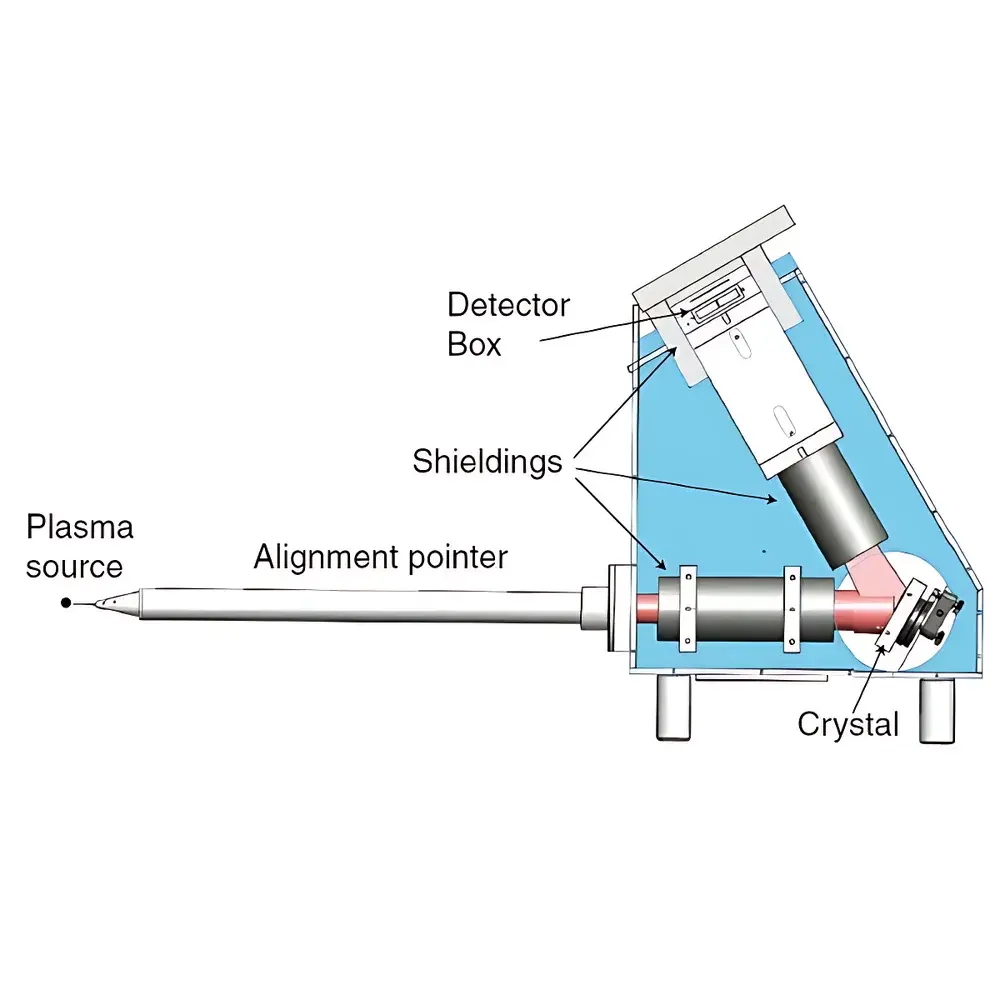
ZOLIX iKon-M SO / iKon-L SO / DO920 / DO940 Bent-Crystal X-ray Spectrometer
| Brand | ZOLIX |
|---|---|
| Origin | Beijing, China |
| Manufacturer Type | OEM Manufacturer |
| Product Origin | Domestic (China) |
| Models | iKon-M SO |
| Pricing | Upon Request |
Overview
The ZOLIX Bent-Crystal X-ray Spectrometer is a high-precision diagnostic instrument engineered for wavelength-dispersive X-ray spectroscopy in high-energy plasma environments. It operates on the fundamental principle of Bragg diffraction from curved crystalline optics—where a single bent crystal serves simultaneously as dispersive element and focusing optic. Unlike flat-crystal spectrometers, which suffer from low collection efficiency and spatially degraded spectral resolution due to source size limitations, bent-crystal configurations—particularly spherically bent crystals—enable intrinsic line or point focusing without slits or vacuum beamlines. This architecture delivers both spectral and spatial resolution in a single 2D measurement, making it indispensable for time-resolved, high-flux X-ray diagnostics in magnetic confinement fusion devices such as tokamaks and stellarators. The system is optimized for measuring Doppler-shifted and Doppler-broadened impurity emission lines (e.g., He-like or H-like argon, iron, or calcium) to derive core ion temperature (Ti) and toroidal rotation velocity—key parameters in fusion plasma physics. Its operational independence from neutral-beam injection allows robust performance under pure RF heating regimes, fulfilling critical requirements for ITER-relevant diagnostic strategies.
Key Features
- Engineered bent-crystal optics with configurable geometry (Johann, Johansson, von Hamos, logarithmic spiral, or ellipsoidal bending) to match specific spectral range and focal properties
- Integrated vacuum-compatible optical train with precise crystal alignment stages and collimation options
- Modular detector interface supporting both back-illuminated deep-depletion CCDs (Andor iKon series) and single-photon-counting hybrid pixel detectors (DECTRIS PILATUS3/EIGER2/MYTHEN2)
- Wide operational X-ray wavelength coverage: 0.1–10 nm (corresponding to ~0.12–12.4 keV), scalable via crystal lattice selection (e.g., quartz 1011, PET, RAP, InSb)
- High spectral resolving power: R = λ/Δλ ≥ 1000 for line-shape analysis; ≥ 100 for broadband survey mode
- Full vacuum compatibility (CF-150/DN100 flanges standard); optional bake-out capability up to 120 °C
- Thermoelectrically cooled detectors with stable operation down to –100 °C (iKon-M SO) or ambient-cooled high-frame-rate operation (PILATUS3 X)
Sample Compatibility & Compliance
The spectrometer is designed for non-contact, in-vacuum X-ray emission diagnostics from high-temperature plasmas (Te, Ti > 1 keV), laser-produced plasmas (LPP), and pulsed-power sources. It complies with ISO 17025-aligned calibration traceability protocols for energy-scale verification using reference emission lines (e.g., Cu Kα at 8.04 keV). All mechanical and vacuum components meet ASME BPVC Section VIII and ISO 286-2 tolerance standards. Detector firmware supports audit-trail logging per FDA 21 CFR Part 11 requirements when deployed in regulated research infrastructure. System design adheres to IEC 61000-6-2/6-4 for electromagnetic compatibility in tokamak control rooms and satisfies GLP-compliant data acquisition workflows through timestamp-synchronized trigger interfaces.
Software & Data Management
ZOLIX provides a cross-platform software suite (Windows/Linux/macOS) built on Qt and Python 3.9+, featuring real-time spectral visualization, line-fitting with Voigt profile decomposition, and automated Doppler shift/broadening extraction. Raw data are stored in HDF5 format compliant with NeXus conventions (NXxray, NXspectroscopy), enabling direct ingestion into PlasmaPy, IDL, or MATLAB-based analysis pipelines. Detector drivers support EPICS IOC integration for seamless incorporation into EPICS-based control systems (e.g., at EAST, KSTAR, or DIII-D). Time-stamped metadata—including crystal angle, detector gain, exposure duration, and vacuum pressure—is embedded in every dataset. Optional LabVIEW API and RESTful HTTP endpoints allow remote orchestration in distributed experimental campaigns.
Applications
- Fusion plasma diagnostics: Ion temperature and rotation velocity profiling in tokamaks (e.g., EAST, HL-2M, JET) and stellarators (W7-X)
- Laser-plasma interaction studies: Time-resolved K-shell spectroscopy of warm dense matter
- Materials science: High-resolution soft X-ray emission spectroscopy (SXES) of transition-metal oxides and catalysts
- ICF implosion symmetry analysis: Spatially resolved X-ray self-emission imaging from cryogenic DT targets
- Industrial plasma monitoring: Real-time elemental composition tracking in reactive sputtering and plasma etching chambers
- Calibration transfer standards: Reference-grade line-shape characterization for synchrotron beamline monochromators
FAQ
What X-ray energy ranges does this spectrometer cover?
The system supports 0.12–12.4 keV (0.1–10 nm), selectable via crystal choice and bending radius. Soft X-ray configurations (0.1–2 keV) use Si(111), PET, or RAP; hard X-ray modes (2–12 keV) employ Ge(111), InSb(111), or quartz(1011).
Can it operate in ultra-high vacuum (UHV) environments?
Yes—optical mounts and detector flanges conform to UHV standards (≤10⁻⁹ mbar); all O-rings are Viton or metal-sealed; detectors feature CF-150/DN100 vacuum feedthroughs.
Is spectral calibration traceable to NIST standards?
Calibration uses certified reference lines (e.g., Cu Kα, Mo Kα, Ag Kα) with uncertainty ≤ ±0.1 eV; full calibration reports include uncertainty budgets aligned with ISO/IEC 17025 Annex A.
How is detector synchronization achieved during pulsed experiments?
Hardware TTL triggering with <1 ns jitter; external gate input supports pump-probe delays down to 100 ps; DECTRIS detectors offer retriggerable readout for multi-pulse burst acquisition.
Does the system support automated alignment routines?
Yes—the software includes motorized crystal stage control with auto-alignment algorithms based on centroid tracking of reference lines and intensity optimization across detector ROI.
Related Products






