
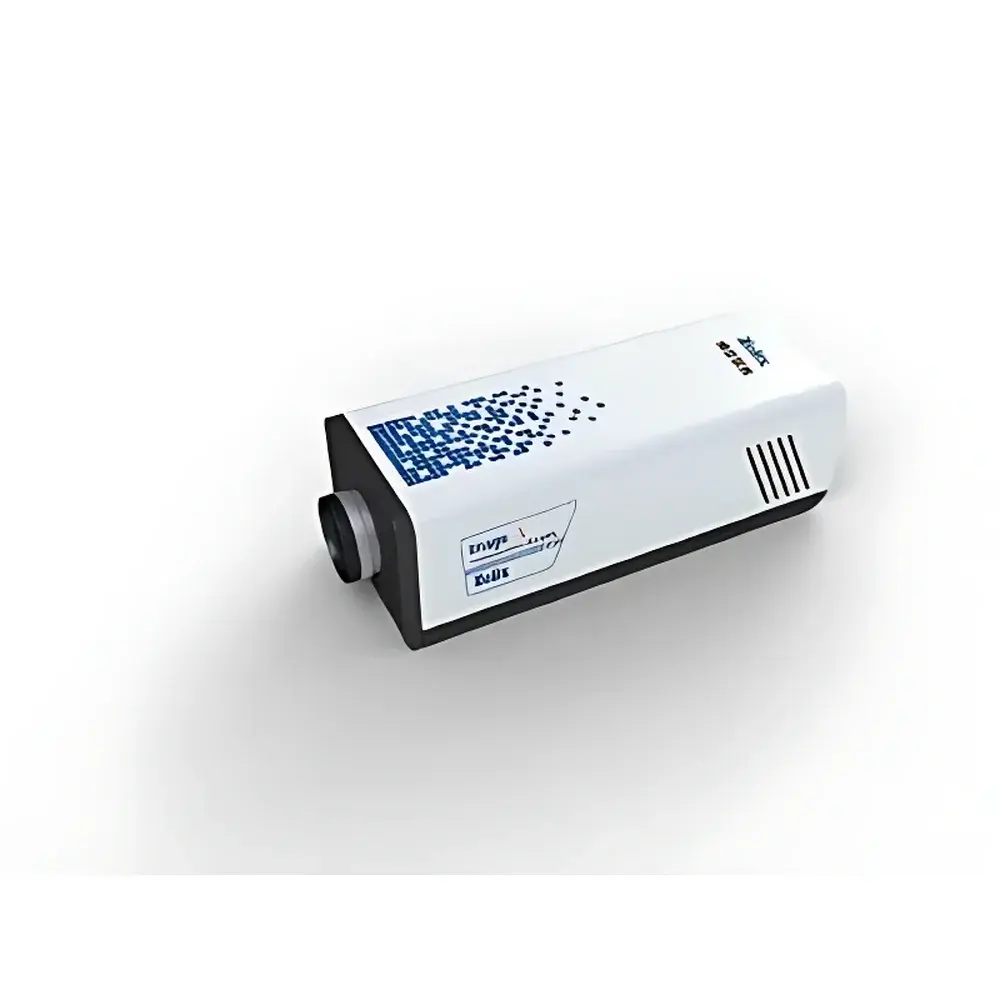
ZOLIX Image-λ Series Hyperspectral Imaging Camera (UV/VIS/NIR/SWIR)
| Brand | ZOLIX |
|---|---|
| Origin | Finland |
| Manufacturer | Specim, Oy (distributed by ZOLIX) |
| Type | Imported Hyperspectral Imager |
| Model Range | UV/HS/QE/PFH/NIR / Image-λ V8/V10/N17E/N25E |
| Spectral Range | 380–2500 nm |
| Spectral Resolution | 2–10 nm |
| Detector Types | CCD, Cooled CCD, CMOS, InGaAs, MCT |
| Spatial Resolution | Up to 1600 × 1200 pixels |
| Frame Rate | 11–180 fps |
| Interface | Ethernet, USB, Camera Link (CL), FireWire (FW), LVDS |
Overview
The ZOLIX Image-λ Series Hyperspectral Imaging Camera is a high-performance, laboratory- and industrial-grade hyperspectral imager engineered for simultaneous acquisition of spatial and spectral data across ultraviolet, visible, near-infrared (NIR), short-wave infrared (SWIR), and mid-wave infrared (MWIR) spectral domains. Built upon Specim’s proven ImSpector optical engine architecture and integrated with scientific-grade detectors—including silicon-based CCD/CMOS for UV–VIS–NIR and InGaAs or MCT for SWIR–MWIR—the system operates on the principle of push-broom scanning. This method ensures pixel-aligned spectral cubes (x, y, λ) with high radiometric fidelity, minimal spatial distortion, and robust signal-to-noise ratio (SNR) across diverse illumination and integration conditions. Designed for quantitative reflectance, transmittance, and fluorescence analysis, the Image-λ platform supports both research-grade spectral characterization and real-time process monitoring in regulated environments.
Key Features
- Precision push-broom optical design with calibrated f/2.0–f/2.4 fore-optics and diffraction-limited imaging performance across all spectral bands.
- Modular detector compatibility: Uncooled and thermoelectrically cooled CCD (380–1000 nm), CMOS (400–1000 nm), InGaAs (900–1700 nm), and liquid-nitrogen-cooled MCT (1000–2500 nm) options—each factory-aligned and wavelength-calibrated.
- Spectral resolution from 2 nm (UV–VIS) to 10 nm (MWIR), enabling discrimination of narrow absorption features in organic compounds, mineralogical signatures, and biological pigments.
- High-speed acquisition up to 180 fps (V8E-PS model) with hardware-triggered synchronization, suitable for dynamic sample inspection and conveyor-based inline quality control.
- Multi-interface support: Gigabit Ethernet (for remote operation and integration into LabVIEW or Python-based control systems), USB 3.0 (plug-and-play deployment), Camera Link (for high-throughput OEM integration), and LVDS (for embedded vision applications).
- Factory-installed spectral calibration using NIST-traceable tungsten-halogen and deuterium lamps; optional radiometric calibration available per ISO 15739 and ASTM E275.
Sample Compatibility & Compliance
The Image-λ series accommodates reflective, transmissive, and fluorescent samples ranging from microscopic tissue sections to meter-scale agricultural fields or industrial web materials. Sample mounting is flexible—compatible with motorized XYZ stages, rotary holders, and custom illumination geometries (e.g., 0°/45°, diffuse d/0, or collimated beam). All models comply with CE marking requirements and meet electromagnetic compatibility (EMC) standards per EN 61326-1. For pharmaceutical and food safety applications, the system supports audit-ready metadata logging (timestamp, exposure, gain, lamp status) required under FDA 21 CFR Part 11 when paired with compliant third-party software. Optional GLP/GMP-compliant validation packages include IQ/OQ documentation and traceable calibration certificates.
Software & Data Management
The ZOLIX Hyperspectral Suite (v5.x) provides native acquisition, real-time preview, spectral cube export (ENVI .hdr/.raw, HDF5, TIFF), and basic chemometric tools (PCA, PLS-DA, spectral library matching). APIs are provided for MATLAB, Python (via PySpecim), and C/C++ to enable custom algorithm development and integration into MES or SCADA platforms. Raw data conforms to the open Spatiospectral Data Interchange Format (SDIF) specification. All spectral cubes embed EXIF-like metadata—including detector temperature, slit width, grating position, and irradiance reference—ensuring full traceability. Data encryption, user-role access control, and automated backup to network-attached storage (NAS) are configurable for secure enterprise deployment.
Applications
- Pharmaceutical QC: Tablet coating uniformity assessment, counterfeit drug detection via spectral fingerprinting (USP ), and API crystallinity mapping.
- Agricultural Science: Crop stress phenotyping (chlorophyll, anthocyanin, water index), soil organic matter quantification, and precision harvest timing prediction.
- Materials Science: Polymer degradation monitoring, thin-film thickness measurement (via interference fringes), and semiconductor wafer defect classification.
- Environmental Monitoring: Hyperspectral remote sensing simulation, microplastic identification in water samples, and wetland vegetation species mapping.
- Forensics & Art Conservation: Non-invasive pigment identification, ink differentiation, and underdrawing visualization beneath aged paint layers.
FAQ
What spectral ranges are supported by the Image-λ series, and how are they physically implemented?
The series spans 380–2500 nm through five dedicated optical/detector configurations: UV–VIS (CCD), VIS–NIR (CCD/CMOS), NIR (InGaAs), SWIR (InGaAs), and MWIR (MCT). Each variant uses a discrete grating, optimized fore-optic, and detector cooling strategy matched to its spectral band.
Is radiometric calibration included, and can it be performed in-house?
Factory radiometric calibration is standard for all models. Field recalibration requires NIST-traceable reference sources and is supported via optional calibration kits (e.g., integrating sphere + tungsten lamp). Full recalibration services are available through ZOLIX-certified labs.
How does the system handle data throughput during high-frame-rate acquisition?
At maximum frame rates (e.g., 180 fps at 1392×1040), raw data streams exceed 1.2 GB/s. Systems are configured with onboard FPGA preprocessing (binning, ROI extraction) and 10 GbE or dual-Camera Link interfaces to sustain lossless transfer to RAID-6 storage arrays.
Can the Image-λ be integrated into an existing automation line with PLC control?
Yes—hardware trigger I/O (TTL/RS-422) enables synchronization with encoders, strobes, and PLCs. SDKs include Modbus TCP and OPC UA wrappers for seamless MES-level integration.
What is the typical delivery lead time for customized configurations (e.g., specific fore-optic FOV or cooling interface)?
Standard models ship within 4–6 weeks. Custom optical or mechanical configurations require 12–16 weeks, including optical alignment verification and final system-level testing per ISO 10110-5.





