
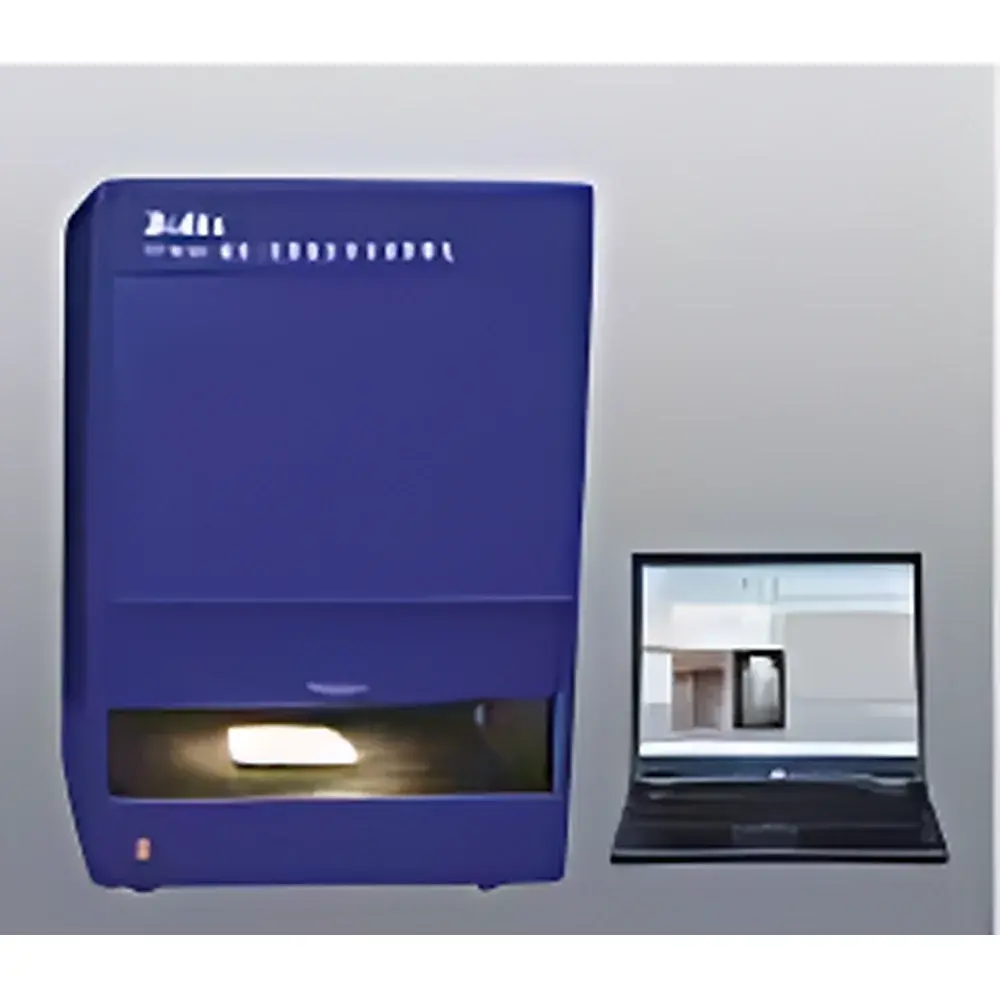
ZOLIX iTracer Hyperspectral Imaging Instrument for Forensic Fingerprint and Handwriting Analysis
| Brand | ZOLIX |
|---|---|
| Model | iTracer |
| Origin | Beijing, China |
| Manufacturer Type | Direct Manufacturer |
| Regional Classification | Domestic (China) |
| Operating Principle | Whiskbroom Scanning |
| Imaging Modality | 3D Hyperspectral Cubes |
| Deployment Flexibility | Ground-based and Airborne Compatible |
| Spectral Ranges | 200–400 nm, 380–800 nm, 400–1000 nm, 900–1700 nm, 1000–2500 nm |
| Spectral Resolution | 0.01 nm |
| Spatial Resolution | 1280 × 1024 pixels |
| Total Field of View (TFOV) | 5° |
| Instantaneous Field of View (IFOV) | 0.1 mrad |
| Frame Rate | 5 fps |
Overview
The ZOLIX iTracer Hyperspectral Imaging Instrument is a purpose-engineered optical diagnostic platform designed specifically for non-destructive, label-free forensic material characterization. It operates on the whiskbroom scanning principle—where a single-point spectrometer is spatially scanned across a target using precision galvanometric mirrors—enabling synchronized acquisition of high-fidelity spectral signatures at every resolved spatial pixel. Unlike pushbroom or snapshot systems, the whiskbroom architecture delivers exceptional signal-to-noise ratio (SNR) and spectral fidelity across broad, discontinuous bands, making it uniquely suited for detecting subtle chemical contrast in latent evidence. Its five configurable spectral ranges—spanning deep UV (200–400 nm), visible (380–800 nm), near-infrared (400–1000 nm), short-wave infrared (900–1700 nm), and extended SWIR (1000–2500 nm)—allow comprehensive interrogation of organic dyes, ink binders, paper substrates, sebaceous residues, hemoglobin derivatives, and aged biological traces. With a spectral resolution of 0.01 nm and native spatial resolution of 1280 × 1024 pixels, the iTracer generates dense 3D hyperspectral data cubes (x, y, λ) suitable for chemometric unmixing, spectral library matching, and spatial-spectral correlation mapping.
Key Features
- Multi-band spectral flexibility: Independently selectable and calibrated spectral modules covering UV-Vis-NIR-SWIR domains—enabling optimal band selection per evidentiary substrate and illumination condition.
- Whiskbroom scanning architecture: Ensures high radiometric accuracy and minimal spectral crosstalk; eliminates fixed-pattern noise common in line-scan detectors.
- 3D hyperspectral data output: Captures spatial coordinates (x,y) and full reflectance/transmittance/fluorescence spectra (λ) for each pixel—supporting volumetric reconstruction and depth-resolved analysis.
- Dual-deployment readiness: Engineered with vibration-damped optomechanics and modular mounting interfaces for stable ground-based benchtop operation or integration into UAV gimbals and airborne sensor pods.
- Real-time preview and adaptive exposure: Onboard FPGA processes live spectral previews at 5 fps, enabling dynamic exposure optimization during evidence survey without post-acquisition correction.
- Thermally stabilized optics: All spectral modules incorporate active temperature control (±0.1°C) to maintain wavelength calibration stability over extended field deployments.
Sample Compatibility & Compliance
The iTracer accommodates a wide range of forensic sample types—including latent and patent fingerprints on porous/non-porous surfaces (e.g., paper, glass, polymer, metal), handwritten documents with ballpoint, gel, fountain, or toner inks, bloodstains (fresh, aged, wiped), and erased or altered writing. Its non-contact, non-invasive operation preserves chain-of-custody integrity and avoids evidence degradation. The instrument complies with ASTM E2926-23 (Standard Guide for Forensic Paint Analysis and Comparison) and supports workflows aligned with ISO/IEC 17025:2017 requirements for testing laboratories. Spectral data export formats (e.g., ENVI .hdr/.bin, SPEX .spc, CSV) are compatible with NIST-traceable reference libraries and court-admissible reporting frameworks. All raw acquisitions include embedded metadata (time stamp, GPS coordinates if integrated, illumination source ID, integration time, calibration status) satisfying GLP/GMP documentation standards and facilitating FDA 21 CFR Part 11–compliant audit trails when used in regulated forensic service labs.
Software & Data Management
The iTracer is operated via ZOLIX HyperStudio v4.2—a validated, Windows-based application developed in accordance with IEC 62304 Class B software safety requirements. HyperStudio provides spectral preprocessing (dark current subtraction, flat-field correction, radiometric calibration), supervised and unsupervised classification (e.g., SAM, SID, K-Means), spectral angle mapping, and false-color rendering of constituent materials. It supports batch processing of multi-scene datasets and integrates with third-party chemometric tools (MATLAB, Python scikit-learn, ENVI) via open API. All processed results—including region-of-interest (ROI) spectral extractions, abundance maps, and statistical confidence metrics—are exportable in PDF/A-2 compliant reports with digital signature support. Audit logs record every user action, parameter change, and calibration event with immutable timestamps—ensuring full traceability required for courtroom testimony and laboratory accreditation.
Applications
- Latent fingerprint enhancement: Discrimination of ridge structure from background interference via spectral unmixing of sebum, eccrine residue, and substrate fluorescence.
- Ink differentiation and dating: Identification of dye chemistry (e.g., triarylmethane vs. azo pigments), binder aging signatures, and relative chronology estimation through NIR/SWIR absorption decay modeling.
- Blood detection and speciation: Detection of hemoglobin oxidation states (oxy-, deoxy-, methemoglobin) and distinction from blood mimics (ketchup, rust, red paint) using characteristic Soret and Q-band absorption features.
- Document alteration analysis: Visualization of erasure, overwriting, or page substitution by detecting differential cellulose degradation, ink penetration depth, and substrate spectral heterogeneity.
- Trace evidence correlation: Cross-comparison of fiber, tape, or paint fragments against reference databases using full-spectrum similarity scoring (e.g., Euclidean distance, Jaccard index).
FAQ
What spectral calibration standards are supported?
NIST-traceable tungsten-halogen, mercury-argon, and deuterium lamps are included for radiometric and wavelength calibration across all spectral modules.
Can the iTracer be integrated with existing forensic lab LIMS?
Yes—HyperStudio supports HL7 and ASTM E1438-compliant data export protocols and offers RESTful API endpoints for bidirectional LIMS synchronization.
Is training and method validation assistance available?
ZOLIX provides on-site application training, SOP development support, and collaborative validation studies per ISO/IEC 17025 Annex A.2 guidelines.
How is spectral data secured for legal admissibility?
All raw and processed data files are SHA-256 hashed upon acquisition; cryptographic hashes are logged in an immutable blockchain ledger module (optional add-on) meeting Daubert standard requirements.
What maintenance intervals are recommended for field-deployed units?
Optical alignment verification every 12 months; spectral calibration validation every 90 days; full system health check including mirror actuator performance and thermal stability diagnostics annually.





