
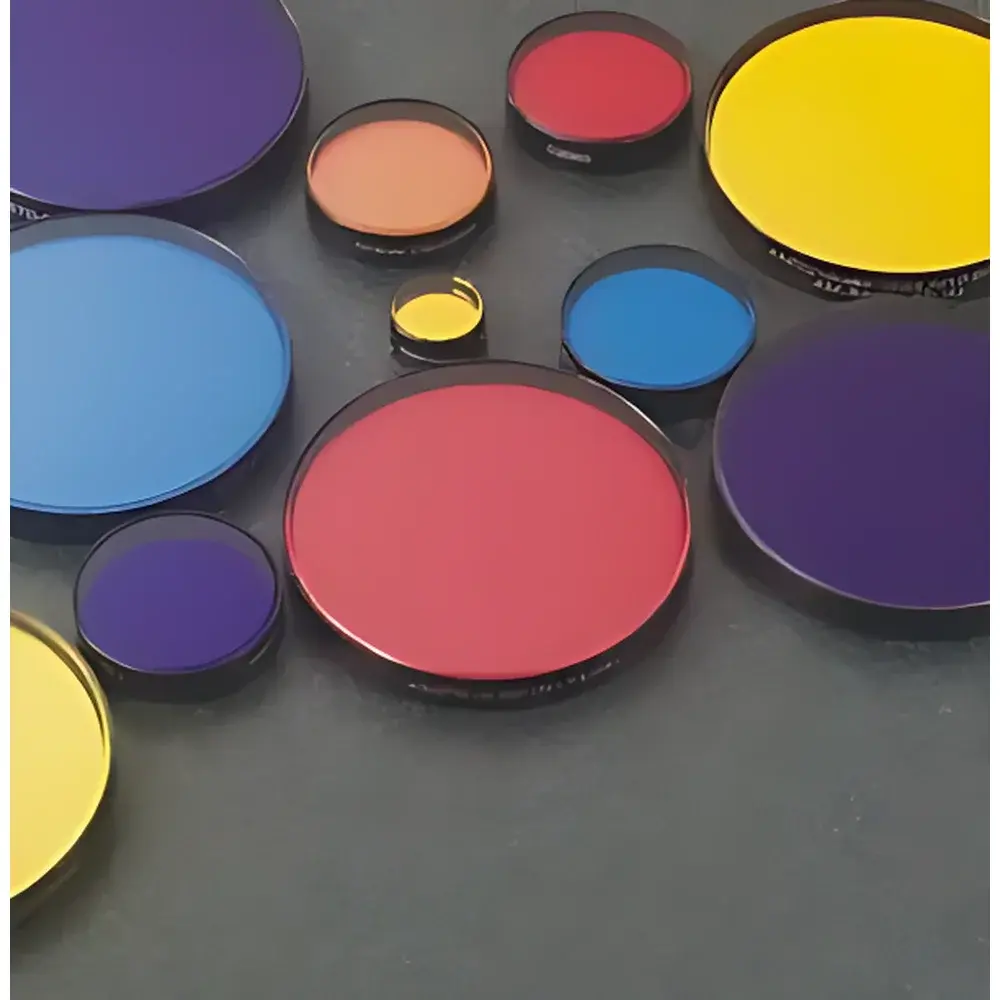
ZOLIX JSL Series Narrow Bandpass Interference Filters
| Brand | ZOLIX |
|---|---|
| Origin | Beijing, China |
| Manufacturer Type | OEM/ODM Manufacturer |
| Regional Classification | Domestic (China) |
| Model Range | JSL394-25 to JSL750-25, JSL589-50, JSL620-50, JSL670-50, JSL680-25, etc. |
| Optical Coating | Hard Dielectric Multilayer Interference Stack |
| Substrate Material | UV-Fused Silica or BK7 (application-dependent) |
| Diameter Options | 12.5 mm, 25 mm, 50 mm (standard) |
| Center Wavelength Range | 193 nm – 1550 nm |
| FWHM Tolerance | ±2–5 nm (depending on specification) |
| Peak Transmission | ≥30% (typical), up to ≥90% for high-efficiency variants |
| Blocking OD | ≥6 (200–1200 nm, typical), extended blocking available |
| Surface Quality | 40–20 scratch-dig |
| Parallelism | <3 arcsec |
| Wavefront Distortion | λ/4 @ 633 nm |
Overview
ZOLIX JSL Series Narrow Bandpass Interference Filters are precision optical components engineered for spectral isolation in demanding laboratory and industrial applications. Based on multilayer dielectric thin-film interference principles, these filters selectively transmit a narrow band of wavelengths—defined by center wavelength (CWL) and full width at half maximum (FWHM)—while rejecting adjacent spectral regions with high optical density (OD ≥6). The JSL series leverages robust hard-coated architectures deposited via ion-assisted electron-beam evaporation, ensuring environmental stability, low angle sensitivity, and long-term spectral fidelity. Designed for integration into spectroscopic systems, fluorescence microscopy, laser line cleanup, Raman excitation/detection, and atomic emission analysis, each filter meets stringent requirements for repeatability, thermal stability, and mechanical durability under controlled optical alignment conditions.
Key Features
- Precision Spectral Control: CWL tolerance of ±1.5–3.5 nm and FWHM control within ±2 nm (e.g., JSL400-25: 400 nm ±2 nm, FWHM = 15 ±2 nm), enabling accurate spectral channel definition across UV-VIS-NIR bands.
- High Optical Density Blocking: Broadband rejection from 200 nm to 1200 nm (OD ≥6), with optional extended blocking up to 1550 nm for NIR-sensitive configurations.
- Low Polarization Sensitivity: Optimized layer design minimizes shift in CWL and FWHM with incident angle variation (ΔCWL < 0.1 nm/degree up to 10° AOI), critical for collimated beam applications.
- Environmental Robustness: Hard dielectric coatings withstand humidity (IEC 60068-2-78), temperature cycling (−40 °C to +85 °C), and abrasion resistance per MIL-C-48497A specifications.
- Substrate Flexibility: Available on UV-fused silica (for deep-UV transmission down to 193 nm) or BK7 glass (cost-optimized VIS performance), both polished to λ/4 surface flatness and 40–20 scratch-dig quality.
- Standardized Mounting Compatibility: Supplied unmounted or pre-mounted in black anodized aluminum rings (Φ12.5 mm, Φ25 mm, Φ50 mm) with ±0.25 mm diameter tolerance and anti-reflective (AR) coated rear surfaces upon request.
Sample Compatibility & Compliance
The JSL series is compatible with standard optomechanical components including lens tubes, filter wheels, cage systems (e.g., Thorlabs CAGE, Newport Kinematic Mounts), and OEM optical engines. All filters comply with ISO 10110-7 (surface imperfections), ISO 9211-4 (optical coating requirements), and RoHS 2015/863/EU directives. For regulated environments—including clinical diagnostics, pharmaceutical QC, and environmental monitoring—the filters support traceable calibration documentation and can be supplied with individual spectral transmission reports (measured on calibrated PerkinElmer Lambda 1050+ or Shimadzu UV-3600i spectrophotometers). While not inherently FDA 21 CFR Part 11 compliant (as passive optical components), they are routinely integrated into Class I and IIa medical devices certified under ISO 13485 and IEC 62304.
Software & Data Management
ZOLIX provides comprehensive spectral data packages for all JSL models, including measured transmission curves (0.5 nm resolution, 190–1100 nm range), CWL drift vs. temperature profiles (−20 °C to +60 °C), and angular tuning maps (0°–15° incidence). These datasets are delivered in ASCII (.txt) and CSV formats, fully compatible with MATLAB, Python (NumPy/Pandas), LabVIEW, and commercial optical design software (Zemax OpticStudio, CODE V). Optional spectral certification includes NIST-traceable reference measurements and uncertainty budgets aligned with GUM (JCGM 100:2018). No proprietary software is required—filters operate as standalone passive elements with no firmware, drivers, or connectivity dependencies.
Applications
- Laser-Based Instrumentation: Line isolation for He-Cd (325 nm), Ar⁺ (488/514 nm), Nd:YAG (532/1064 nm), and diode lasers (405/450/635/785 nm).
- Fluorescence Microscopy: Excitation/emission filtering in widefield, confocal, and TIRF systems—compatible with common fluorophores (DAPI, FITC, TRITC, Cy5) and multiplexed assays.
- Spectroscopic Analysis: Wavelength selection in UV-Vis absorption, atomic absorption spectroscopy (AAS), and LIBS detection channels.
- Environmental Monitoring: Mercury vapor line detection (253.7 nm), NO₂ sensing (400–450 nm), and CH₄/CO₂ gas analysis (1650–1700 nm, via extended NIR variants).
- Astronomical Instrumentation: Narrowband imaging (Hα, OIII, SII) in adaptive optics-coupled telescopes and space-qualified payloads (qualification testing available).
FAQ
What is the typical damage threshold for JSL filters under continuous-wave laser illumination?
For uncoated fused silica substrates and standard hard dielectric coatings, the LIDT is ≥5 J/cm² at 1064 nm, 10 ns pulse width, 20 Hz repetition rate (ISO 21254-1). CW thresholds exceed 1 kW/cm² at 532 nm with proper heat sinking.
Can ZOLIX provide custom center wavelengths or non-standard FWHM values?
Yes—custom designs are supported for CWL from 193 nm to 1550 nm and FWHM from 0.5 nm to 40 nm, subject to minimum order quantities (MOQ = 10 pcs per specification) and lead time extension (8–12 weeks).
Do JSL filters exhibit wavelength shift when mounted in kinematic mounts?
Mount-induced stress birefringence is minimized through precision-ground edge geometry and compliant ring mounting. Measured CWL shift remains <0.3 nm under standard torque (0.25 N·m) for Φ25 mm filters.
Is spectral certification included with every shipment?
Standard orders include batch-level spectral verification. Individual unit certification (with serial-numbered test report) is available as an optional add-on, aligned with ISO/IEC 17025-accredited measurement practices.
Are there options for anti-reflection coating on the substrate back surface?
Yes—single-layer MgF₂ or broadband AR (BBAR) coatings (R < 0.5% over 400–700 nm) can be applied to reduce ghost reflections and improve system throughput; specify during quoting.





