
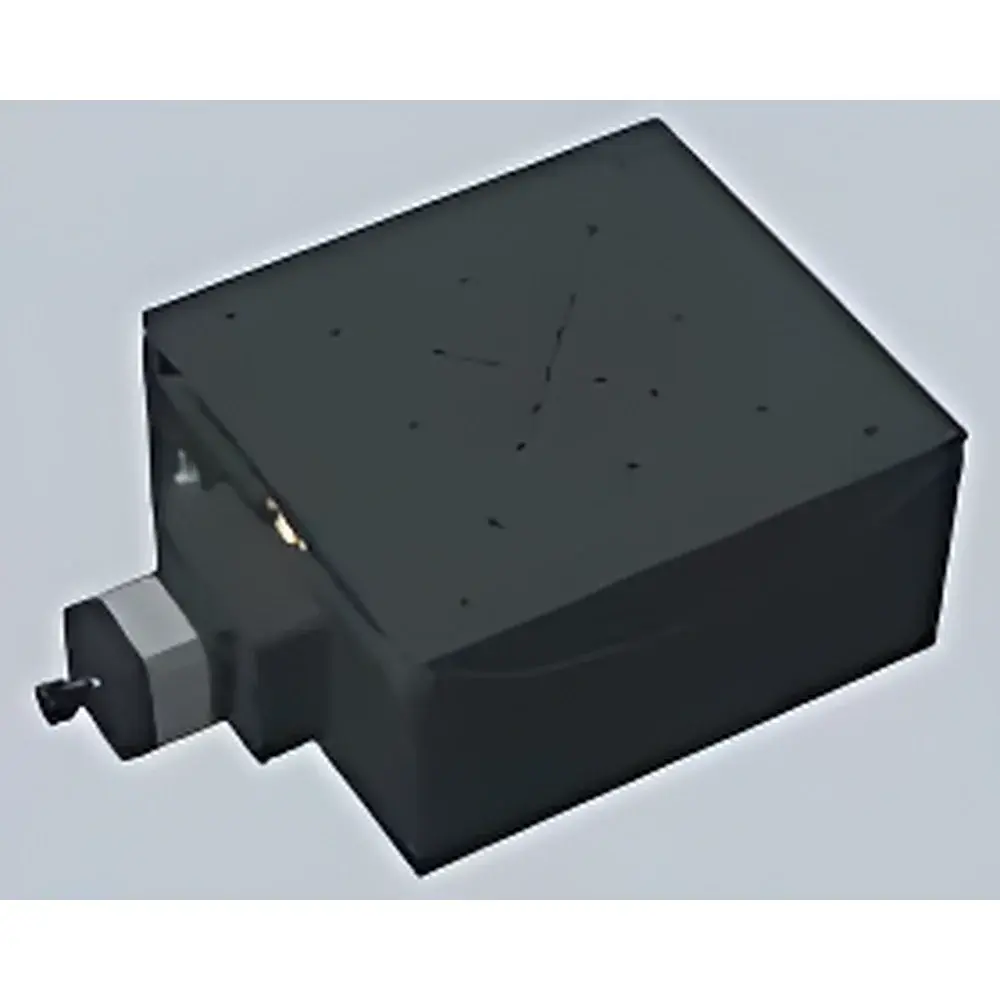
ZOLIX KSAG Series High-Precision Motorized Angular Translation Stage
| Brand | ZOLIX |
|---|---|
| Origin | Beijing, China |
| Manufacturer Type | Direct Manufacturer |
| Product Category | Domestic |
| Model | KSAG Series |
| Pricing | Upon Request |
| Base Material | Aluminum Alloy |
| Drive Mechanism | Precision-Graded Worm Gear & Worm |
| Guide System | Imported High-Grade Arc-Shaped Crossed Roller Bearing Rail |
| Rotation Center Positional Accuracy | < 0.02 mm |
| Repeatability | < 0.005° |
| Standard Motor Interface | DB9 |
| Standard Actuator | Bipolar Stepper Motor |
Overview
The ZOLIX KSAG Series High-Precision Motorized Angular Translation Stage is an engineered solution for sub-arcminute angular positioning in demanding optical and photonics applications. Designed around the fundamental principle of high-ratio, low-backlash worm gear transmission coupled with arc-shaped crossed roller bearing guidance, the KSAG stage delivers deterministic rotational motion with minimal wobble and axial displacement. Its core architecture centers on kinematic stability: the imported arc-shaped crossed roller rail constrains radial and axial degrees of freedom while enabling smooth, low-hysteresis rotation about a well-defined virtual pivot point—critical for beam steering, interferometric alignment, and multi-axis goniometric setups. Unlike conventional rotary stages relying on plain or ball-bearing pivots, the KSAG’s guided arc trajectory ensures that the effective rotation center remains spatially stable within ±20 µm across its full angular range—a specification aligned with ISO 10110-7 (optical component mounting) and essential for maintaining collimation integrity in ultrafast laser systems and synchrotron beamline instrumentation.
Key Features
- Precision-graded worm gear and worm drive train, manufactured to DIN 3962 Class 4 tolerances, delivering backlash 78% at nominal load.
- Arc-shaped crossed roller bearing rail system (imported from Japan), preloaded to eliminate play while preserving low-friction articulation; enables true rolling contact over the entire angular stroke without slip or stick-slip behavior.
- Rotation center positional stability ≤ 0.02 mm—verified via laser tracker metrology per ASME B89.4.19—and maintained across temperature fluctuations from 15 °C to 30 °C (±0.5 °C/hour ramp).
- Aluminum alloy base structure (6061-T6) CNC-machined to GD&T frame tolerance of ±5 µm, anodized for corrosion resistance and dimensional stability under vacuum-compatible conditions (1×10⁻⁵ mbar compatible with optional sealing).
- Standard DB9 male interface compliant with RS-422 differential signaling for noise-immune step/direction communication; supports open-loop stepper control and future closed-loop servo integration via optional encoder feedback path.
Sample Compatibility & Compliance
The KSAG series is designed for integration into cleanroom-grade optical tables, ultra-high-vacuum (UHV) beamlines, and laser laboratories operating under ISO Class 5–7 environmental controls. Its non-outgassing surface finish and absence of lubricants in the guide path make it suitable for use adjacent to sensitive detectors and monochromators. The stage complies with CE marking requirements for electromagnetic compatibility (EN 61326-1) and low-voltage directive (2014/35/EU). Mechanical design adheres to ISO 9283 for robotic manipulator repeatability testing methodology, and angular repeatability (< 0.005°) is validated using autocollimator traceable to NIST SRM 2089a. For regulated environments—including FDA-regulated photonic medical device R&D—the stage supports audit-ready configuration documentation and can be supplied with material certifications (RoHS, REACH) and mechanical test reports upon request.
Software & Data Management
ZOLIX provides native support for the KSAG series through its ZKLab Control Suite v3.2, a Windows-based platform offering scriptable motion sequencing, real-time position logging (up to 1 kHz sampling), and synchronized triggering with external devices (e.g., pulse pickers, CCD shutters). The suite implements full audit trail functionality per FDA 21 CFR Part 11 requirements—including electronic signatures, user role-based access control, and immutable operation logs—with optional SQLite or PostgreSQL backend integration. Third-party compatibility includes LabVIEW™ (NI-VISA drivers), MATLAB® Instrument Control Toolbox, and Python (PySerial + custom ZOLIX ASCII protocol library). All firmware updates are digitally signed and delivered via secure HTTPS channel to prevent unauthorized modification.
Applications
- Precise angular alignment of gratings, waveplates, and Brewster-angle optics in ultrafast Ti:sapphire and OPCPA laser systems.
- Goniometric adjustment of X-ray optics and monochromator crystals in synchrotron radiation facilities (e.g., APS, ESRF, SSRF).
- Multi-axis beam combiner calibration in quantum optics experiments requiring < 10 µrad pointing stability.
- Automated polarization state generation and analysis in Mueller matrix ellipsometry platforms.
- High-energy physics detector module orientation during commissioning and calibration phases, where thermal drift compensation is implemented via external temperature sensor input.
FAQ
What is the maximum continuous torque output of the standard stepper motor configuration?
The standard bipolar stepper motor delivers 0.45 N·m holding torque at 25 °C ambient, derated linearly to 0.32 N·m at 50 °C case temperature.
Is vacuum compatibility available as a factory option?
Yes—vacuum-rated variants (1×10⁻⁶ mbar) feature dry-lubricated bearings, stainless-steel fasteners, and epoxy-sealed electronics; lead time increases by 3 weeks.
Can the KSAG stage be integrated into a multi-axis coordinated motion system?
Absolutely—the DB9 interface supports daisy-chained operation with up to 16 axes using ZOLIX’s ZK-Motion Controller, with synchronized move profiles defined in S-curve velocity profiles per IEC 61800-3.
Does the stage support absolute position encoding?
Not in the base configuration; however, the mechanical design预留 encoder mounting provisions (M3 threaded holes and 20 mm clearance) for retrofitting optical or magnetic absolute encoders up to 22-bit resolution.
What is the typical lead time for custom angular travel range modifications?
Standard angular range is ±10°; custom ranges (±5° to ±30°) require revised rail geometry and are subject to NRE engineering review—typical delivery is 8–10 weeks after design freeze.




