
ZOLIX Laser-Induced Fluorescence Spectroscopy System
| Brand | ZOLIX |
|---|---|
| Origin | Beijing, China |
| Manufacturer Type | Original Equipment Manufacturer (OEM) |
| Country of Origin | China |
| Model | LIF-Spectroscopy System |
| Pricing | Upon Request |
Overview
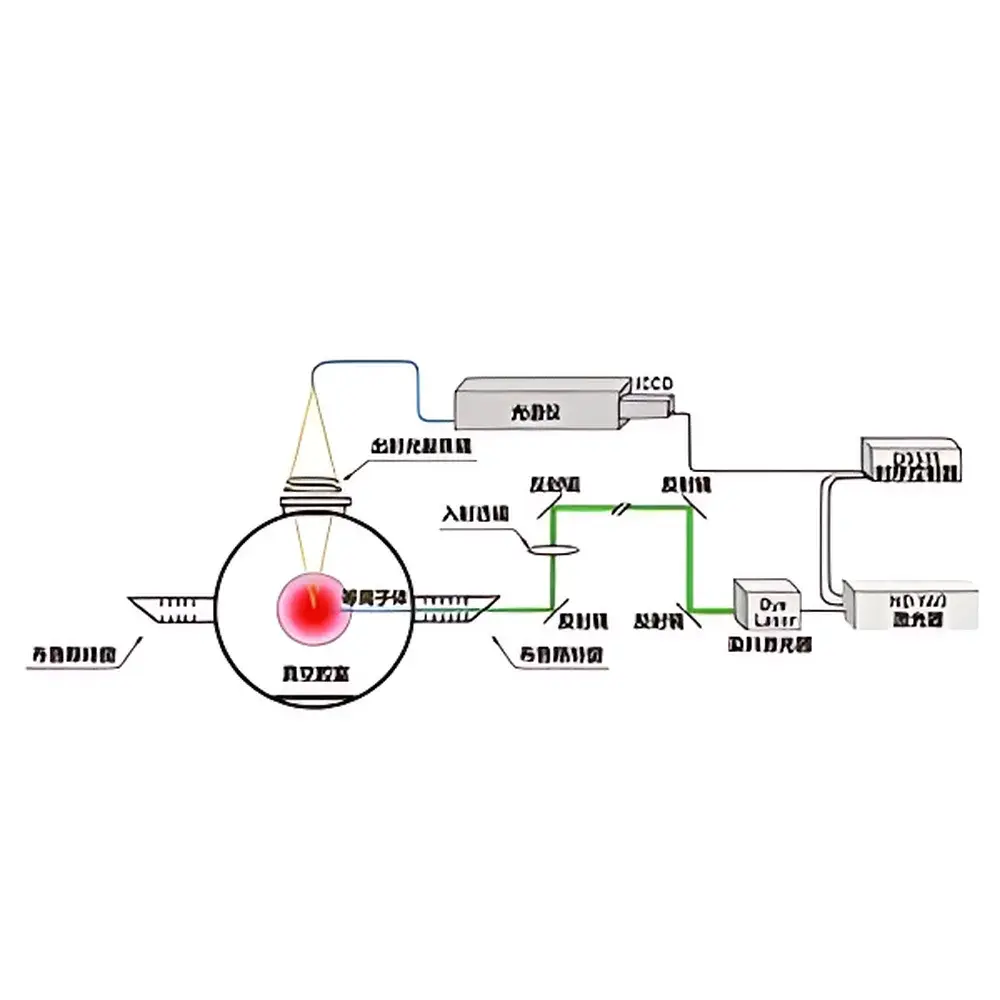
Laser-Induced Fluorescence (LIF) spectroscopy is a highly selective, non-intrusive optical diagnostic technique widely employed in low-temperature plasma physics, combustion science, and reactive flow chemistry. It operates on the principle of resonant excitation: a narrowband pulsed laser—typically with nanosecond pulse duration and tunable wavelength—is tuned to match a specific electronic-vibrational-rotational transition of a target neutral or ionic species in its ground or metastable state. Upon absorption, the species is promoted to an excited electronic state; subsequent spontaneous radiative decay emits fluorescence photons at longer wavelengths. The intensity of this fluorescence is directly proportional to the local number density of the probed species, enabling quantitative, spatially resolved measurements of absolute concentration, velocity distribution (via Doppler-shifted excitation), and internal energy state populations (e.g., rotational, vibrational, and electronic temperatures).
Key Features
- Engineered for high spectral selectivity and signal-to-noise ratio in complex plasma environments, minimizing interference from broadband emission and scattered laser light.
- Compatible with tunable nanosecond dye lasers covering 200–4500 nm, enabling resonance excitation of key species including H (205 nm), CF (261 nm), Ar (611 nm), He, O, N, OH, and NO.
- Optimized for time-resolved detection: synchronized operation with ICCD cameras (13 × 13 mm active area, 18 mm image intensifier) allows gated acquisition down to sub-nanosecond temporal resolution.
- Modular architecture supports integration with standard timing controllers (e.g., Stanford Research DG645/DG535) for precise laser–detector–plasma source synchronization.
- Designed for vacuum-compatible and atmospheric-pressure plasma diagnostics, with flexible optical path configuration for line-of-sight, planar, or tomographic LIF implementations.
Sample Compatibility & Compliance
The system is validated for quantitative diagnostics of atomic and molecular neutrals (e.g., H, O, N, OH, CH, CN), metastable atoms (e.g., Arm, Hem), and selected ions in non-equilibrium plasmas—including ECR, ICP, helicon, microwave CVD, and dielectric barrier discharges. It complies with standard laboratory safety protocols for Class IV laser operation (IEC 60825-1) and supports traceable calibration procedures aligned with ISO/IEC 17025 requirements for analytical instrumentation. While not inherently GLP/GMP-certified, the architecture supports audit-ready data acquisition workflows when paired with timestamped, metadata-embedded ICCD frames and calibrated spectral references (e.g., Hg/Ne lamps).
Software & Data Management
Data acquisition and processing are performed using vendor-supplied control software compatible with Windows-based platforms, supporting real-time laser wavelength scanning, ICCD gate delay/width adjustment, and multi-frame averaging. Raw spectral datasets are exported in HDF5 or ASCII formats, preserving full metadata (laser energy, grating position, detector gain, timing parameters). Post-processing workflows integrate with MATLAB, Python (NumPy/SciPy), or Igor Pro for spectral deconvolution, Boltzmann plot analysis, Doppler profile fitting, and Abel inversion (for axisymmetric plasmas). The system does not include FDA 21 CFR Part 11-compliant electronic signature or audit trail functionality by default; such capabilities require third-party validated software layers deployed per site-specific regulatory requirements.
Applications
- Quantitative mapping of ground-state and metastable atom densities (e.g., Arm, Hem) in magnetized and unmagnetized plasmas.
- Measurement of translational velocity distributions via Doppler-shifted LIF scans—enabling derivation of ion-neutral relative drift velocities and kinetic temperature.
- Determination of rotational and vibrational temperatures in molecular plasmas (e.g., N2, CO, OH) through spectral line intensity ratios and band contour analysis.
- Time-resolved tracking of radical production and loss kinetics during pulsed plasma operation (e.g., OH in afterglow chemistry).
- Cross-validation of Langmuir probe and optical emission spectroscopy (OES) results in multi-diagnostic plasma characterization campaigns.
FAQ
What species can be measured using this LIF system?
The system is capable of detecting any atom, molecule, or ion whose electronic transitions fall within the tunable laser range (200–4500 nm) and which exhibits measurable fluorescence quantum yield—common targets include H, O, N, OH, CH, CN, Ar, He, and CF radicals.
Is vacuum compatibility included in the standard configuration?
Yes—the optical interface is designed for UHV-compatible flange mounting (CF or KF standards); beam delivery optics and collection lenses may require optional vacuum-rated housings depending on chamber geometry.
Can the system perform two-dimensional planar LIF (PLIF)?
Yes—when coupled with a laser sheet generator and appropriate imaging spectrometer or intensified camera, the platform supports PLIF for spatially resolved species mapping; optical layout customization is available upon request.
What spectral resolution can be achieved with the recommended ZOLIX Omni-500i/750i spectrometers?
Using 1200 l/mm or 1800 l/mm holographic gratings, the system achieves resolving powers (λ/Δλ) of ~10,000–25,000 across the UV–VIS range, sufficient for resolving rotational structure in diatomic spectra under typical plasma conditions.
Does the system support absolute density calibration?
Absolute calibration requires separate reference measurements (e.g., Rayleigh scattering for electron density, calibrated lamp sources for detector response); the hardware provides all necessary interfaces and stability for such procedures, though calibration kits are sold separately.






