
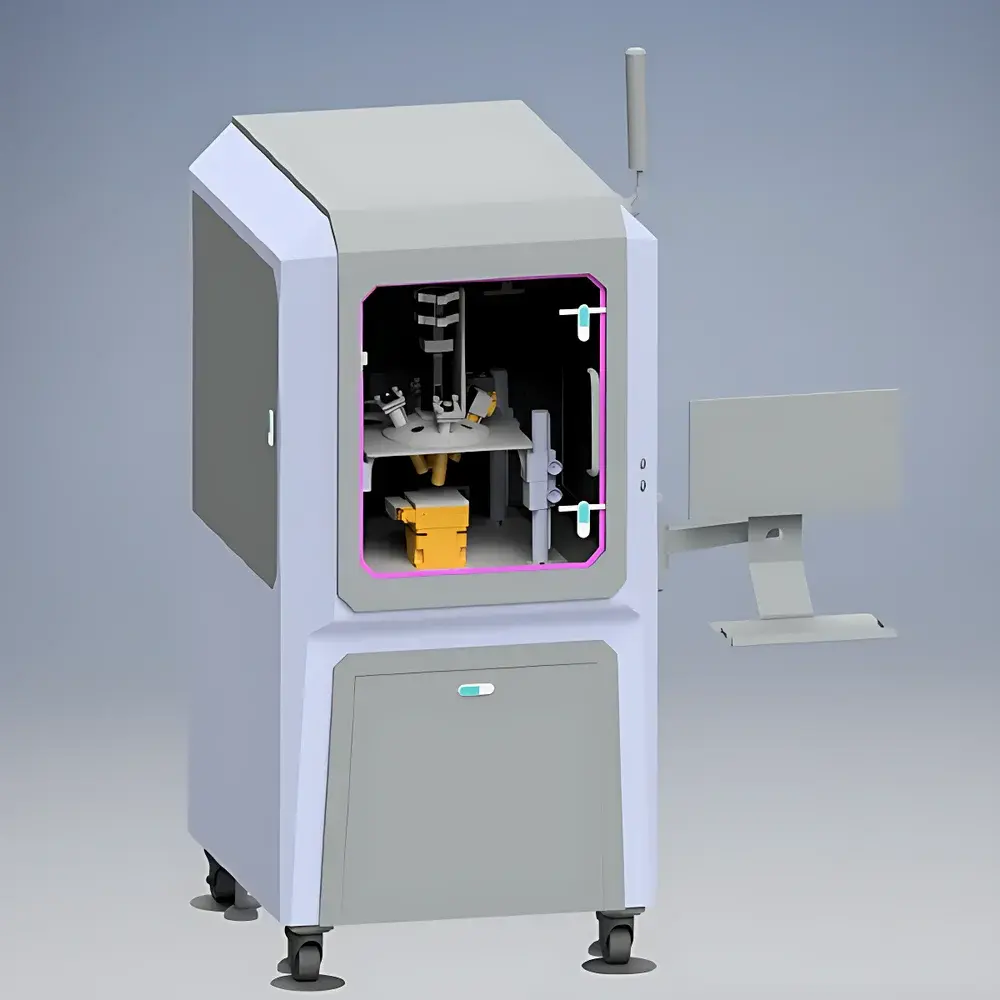
ZOLIX LIBS-E900 Benchtop Laser-Induced Breakdown Spectroscopy System
| Brand | ZOLIX |
|---|---|
| Origin | Beijing, China |
| Manufacturer Type | Direct Manufacturer |
| Regional Classification | Domestic (China) |
| Model | LIBS-E900 |
| Instrument Form Factor | Benchtop |
| Detection Wavelength Range | 200–900 nm (customizable) |
| Optical Resolution | <0.1 nm (higher resolution optional) |
| Minimum Gating Width | 3 ns |
| Detector | Domestic iCMOS Camera |
| Timing Precision (Delay & Gate) | 10 ps |
| Laser Pulse Energy Options | 50, 100, 200, 400 mJ |
| Wavelength Repeatability | ±0.01 nm |
| XYZ Translation Stage | Customizable Travel Range |
| Sample Environment Control | Gas Purge Capability |
| Real-Time Autofocus | Laser + Vision Algorithm Based |
| Software Features | Peak Identification, FWHM Calculation, Auto-Save, Elemental Mapping, Pseudocolor Distribution Rendering, Database Integration Interface |
Overview
The ZOLIX LIBS-E900 Benchtop Laser-Induced Breakdown Spectroscopy System is an engineered platform for elemental analysis based on laser-induced plasma emission spectroscopy. It operates by focusing high-peak-power nanosecond or sub-nanosecond laser pulses onto a sample surface—solid, liquid, or gas—to generate transient microplasma (>10,000 K). This plasma emits element-specific atomic and ionic spectral lines across the UV-VIS-NIR range. The emitted light is collected via optimized fiber-coupled or free-space optics and dispersed by a high-resolution Czerny–Turner spectrometer equipped with a domestically developed iCMOS detector. With full spectral coverage from 200 to 900 nm and optical resolution better than 0.1 nm, the system enables detection of most elements in the periodic table—including light elements (Li, Be, B, C, N, O, F) that are challenging for XRF or SEM-EDS—without requiring matrix-matched standards in semi-quantitative mode.
Key Features
- Benchtop architecture with integrated safety enclosure compliant with Class 1 laser safety standards (IEC 60825-1), enabling immediate deployment in standard laboratory environments without structural modification.
- Dual optical path configuration: coaxial and off-axis collection geometries support flexibility in experimental design—e.g., reflective vs. transmissive sample mounting, standoff analysis, or coupling with auxiliary modules (microscopy, Raman, fluorescence).
- Real-time autofocus subsystem combining structured-light projection and vision-based surface topography tracking, ensuring consistent ablation crater depth and plasma reproducibility across uneven or curved samples.
- Programmable XYZ translation stage with micrometer-level repeatability, supporting automated raster scanning for spatially resolved elemental mapping (LIBS imaging) at user-defined step sizes down to 1 µm.
- Modular vacuum chamber option (≤10⁻³ mbar base pressure) for controlled ambient conditions—critical for enhancing signal-to-background ratio of low-Z elements and suppressing atmospheric nitrogen/oxygen spectral interference.
- Gas purge interface (N₂, Ar, He) compatible with inert or reactive atmospheres to stabilize plasma lifetime and improve spectral line intensity and stability.
Sample Compatibility & Compliance
The LIBS-E900 accommodates heterogeneous sample types without destructive pre-treatment: conductive and non-conductive solids (metals, ceramics, polymers, geological specimens), slurries, liquids (via droplet or thin-film deposition), and gases (using flow-through cells). Its open-path design permits direct analysis of irregular, large-format, or temperature-sensitive specimens. All hardware and firmware comply with CE electromagnetic compatibility (EMC) directives and meet RoHS material restrictions. Software supports audit trail logging and user-access control per GLP/GMP-aligned workflows; optional 21 CFR Part 11 compliance package available upon request for regulated QC/QA laboratories.
Software & Data Management
The proprietary ZOLIX LIBS Studio software provides a unified interface for instrument control, spectral acquisition, real-time visualization, and quantitative post-processing. Core functions include automatic peak identification against NIST Atomic Spectra Database (ASD) v2023, background subtraction using iterative polynomial fitting, intensity normalization to internal reference lines (e.g., Fe I 371.99 nm), and multivariate calibration (PLS, PCA) for matrix-effect correction. Mapping data are rendered as interactive pseudocolor heatmaps overlaid on live CCD camera images. Raw spectra and metadata (laser energy, gate delay, stage coordinates) are saved in HDF5 format for long-term archival and third-party interoperability (e.g., Python/SciPy, MATLAB, OriginLab). API access enables integration with LIMS and enterprise databases via ODBC or RESTful endpoints.
Applications
- Metallurgy & Mining: Rapid grade verification of ores, slags, and alloys; inclusion analysis in steel production; coal ash composition profiling per ASTM D3176 and ISO 1171.
- Environmental Monitoring: In-situ detection of Pb, Cd, As, Cr, Hg in soil digests, airborne particulates, and aqueous suspensions—aligned with EPA Method 6010D and ISO 17294-2.
- Geosciences & Archaeometry: Provenance studies of ceramics and obsidian; stratigraphic layering analysis; dating support through trace-element ratio correlation (e.g., Sr/Ca, Ba/Sr).
- Life Sciences: Label-free elemental mapping of biological tissues (e.g., Ca/P distribution in bone sections, Zn accumulation in tumor margins); single-cell metalloproteomics screening.
- Materials Science: Depth profiling of thin-film coatings (TiN, DLC), dopant homogeneity assessment in semiconductors, and additive manufacturing powder characterization.
FAQ
What laser wavelengths are supported by the LIBS-E900?
The system is configured for fundamental Nd:YAG output at 1064 nm but accepts harmonic modules (532 nm, 355 nm, 266 nm) via OEM-integrated beam delivery paths.
Can the LIBS-E900 perform quantitative analysis without certified reference materials?
Yes—semi-quantitative results are achievable using internal standardization or calibration-free LIBS (CF-LIBS) algorithms embedded in the software; however, trace-level accuracy (<5% RSD) requires matrix-matched standards per ISO 14801.
Is vacuum operation required for nitrogen or oxygen detection?
Not mandatory, but strongly recommended: atmospheric O₂ and N₂ bands dominate the 700–850 nm region; vacuum or argon purging significantly improves detection limits for these elements by two orders of magnitude.
How is spectral calibration maintained over time?
Wavelength calibration is performed automatically before each measurement sequence using a built-in Hg–Ne–Ar hollow cathode lamp; drift compensation uses real-time centroid tracking of reference lines with ±0.01 nm repeatability.
What third-party databases can be interfaced for spectral matching?
Native support includes NIST ASD and Kaye & Laby tables; custom database ingestion (e.g., commercial mineral libraries, nuclear fuel databases) is enabled via CSV/XML schema import and spectral fingerprint indexing.






