
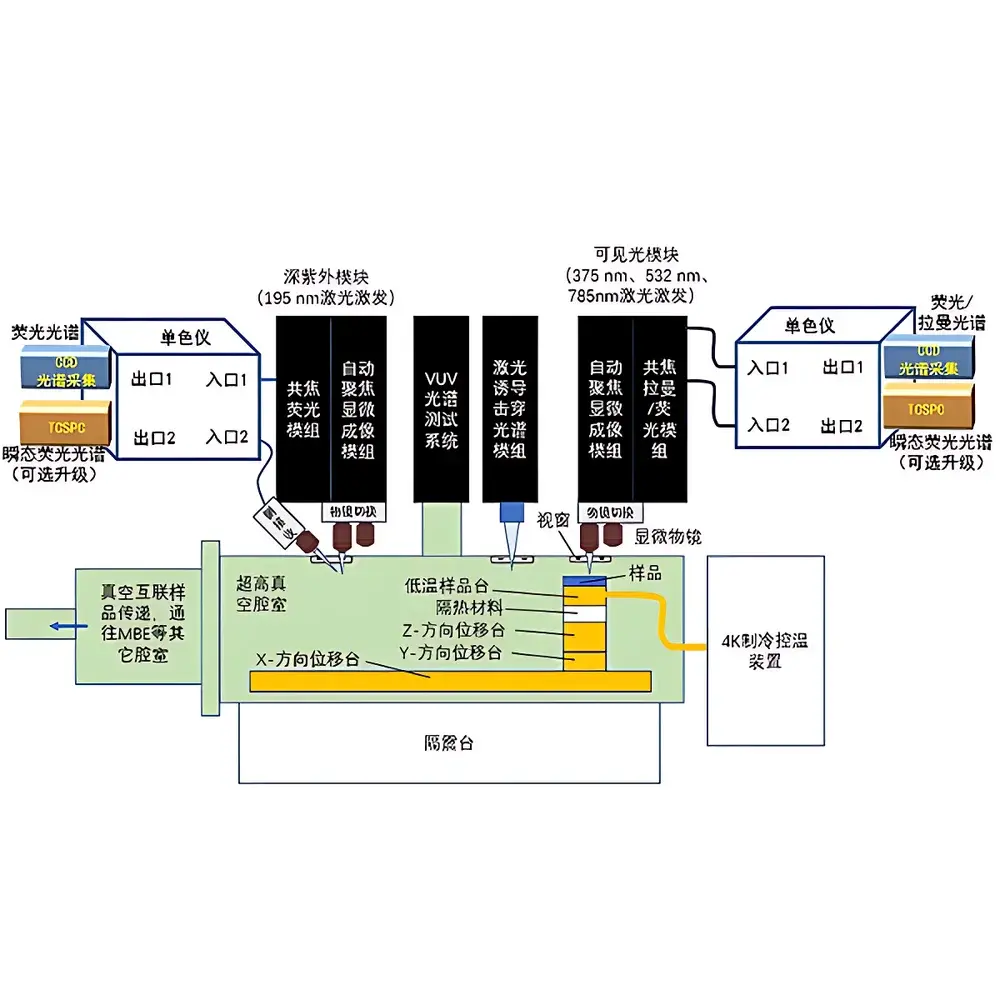
ZOLIX LIBS-Multi900 Modular Integrated LIBS-Raman Spectroscopy System
| Brand | ZOLIX |
|---|---|
| Origin | Beijing, China |
| Manufacturer Type | Direct Manufacturer |
| Instrument Type | Benchtop |
| Model | LIBS-Multi900 |
| Key Spectral Ranges | 195–1000 nm (combined LIBS + Raman) |
| LIBS Detection Range | 200–900 nm |
| Raman Shift Range | 80–4000 cm⁻¹ |
| Optical Resolution (LIBS) | <0.1 nm (configurable) |
| Time-Gated Detection | Minimum 3 ns, Timing Precision ±10 ps |
| Laser Energy Options | 50 / 100 / 200 / 400 mJ |
| Excitation Wavelength (Raman) | 532 nm |
| Raman Spectral Resolution | 2 cm⁻¹ |
| Vacuum Compatibility | Ultra-High Vacuum (UHV), down to 10⁻⁸ Pa |
| Sample Temperature Range | 4 K to RT |
| XYZ Motorized Stage | Fully Customizable Travel |
| In-Situ Imaging | Long-Working-Distance Microscope with Real-Time Visual Feedback |
| Automated Focus Tracking | Laser- and Vision-Based Surface Topography Compensation |
| Mapping Capability | Co-registered LIBS/Raman point-by-point scanning |
| Software Control | Unified GUI for hardware orchestration, spectral acquisition, peak identification, data export, and database integration |
Overview
The ZOLIX LIBS-Multi900 Modular Integrated LIBS-Raman Spectroscopy System is a high-precision, vacuum-compatible benchtop platform engineered for concurrent elemental and molecular characterization under controlled environmental conditions. It integrates two complementary optical spectroscopic techniques—Laser-Induced Breakdown Spectroscopy (LIBS) and confocal Raman spectroscopy—within a single, modular UHV architecture. LIBS operates on the principle of pulsed-laser ablation: a high-energy nanosecond or femtosecond laser pulse is focused onto a sample surface, generating a transient microplasma; the emitted atomic/ionic line spectra are dispersed and resolved to quantify elemental composition across the periodic table. Raman spectroscopy, in contrast, relies on inelastic scattering of monochromatic excitation light (532 nm), yielding vibrational fingerprints that report on chemical bonding, crystallinity, phase identity, and molecular conformation. The system’s dual-modal design enables correlative analysis—e.g., mapping elemental distribution (via LIBS) alongside local molecular structure (via Raman)—on the same spatial coordinate set, eliminating registration error and enhancing analytical confidence.
Key Features
- Modular UHV-Compatible Architecture: All optical paths—including spectrometers, detectors, and beam delivery optics—are external to the vacuum chamber; only the objective lens and sample stage reside inside, enabling rapid maintenance and thermal bake-out without disassembly.
- Co-Focused Dual-Modal Scanning: A motorized XYZ stage and long-working-distance microscope support synchronized, co-registered point-by-point mapping for both LIBS and Raman modalities, with sub-micron positional reproducibility.
- Real-Time Surface Tracking: An integrated vision-guided autofocus system dynamically compensates for sample topography during raster scanning, maintaining optimal focus and plasma generation efficiency across non-planar surfaces.
- Wide Spectral Coverage: Combined detection from 195 nm (deep UV) to 1000 nm (NIR) supports broad elemental coverage (LIBS) and full fingerprint-region Raman shifts (80–4000 cm⁻¹).
- Precision Timing Control: LIBS detection employs ultrafast gating (minimum 3 ns width) with ±10 ps delay resolution, enabling time-resolved plasma evolution studies and background suppression.
- Unified Software Platform: A single GUI controls laser triggering, spectrometer acquisition, stage motion, autofocus routines, spectral processing (peak fitting, FWHM calculation, baseline correction), and automated file logging compliant with FAIR data principles.
Sample Compatibility & Compliance
The LIBS-Multi900 accommodates solid, liquid, and gaseous samples within its configurable vacuum chamber (6-inch flange standard). For solids, it supports conductive and insulating materials—including metals, ceramics, semiconductors, geological specimens, and cultural heritage artifacts—without requiring conductive coating. Liquid analysis is enabled via sealed capillary cells or gas-purged sample holders; gas-phase measurements utilize flow-through cells compatible with inert or reactive atmospheres. The system meets mechanical and electrical safety requirements per IEC 61010-1 and CE marking directives. Its software architecture supports audit trails, user access levels, and electronic signatures aligned with GLP and FDA 21 CFR Part 11 readiness. Vacuum performance (≤10⁻⁸ Pa) and cryogenic operation (4 K–RT) comply with ISO 27893 for ultra-high-vacuum instrumentation qualification.
Software & Data Management
Acquisition and analysis are managed through ZOLIX SpectraControl™ v4.x—a Qt-based application supporting cross-platform deployment (Windows/Linux). Core functions include real-time spectral preview, automatic peak identification against NIST Atomic Spectra Database (ASD) and RRUFF reference libraries, quantitative calibration using certified standards (e.g., NIST SRMs), and multi-dimensional data export (CSV, HDF5, JCAMP-DX). The software features an open API (Python/C++ bindings) for integration with LIMS, ELN, or custom ML pipelines. Spectral metadata—laser energy, gate delay, grating position, stage coordinates, vacuum pressure, and temperature—is embedded in every saved file. Optional database modules enable direct query against commercial elemental and molecular spectral repositories (e.g., SDBS, ICDD PDF-4+), facilitating automated compound identification and classification.
Applications
- Materials Science: Correlative analysis of alloy segregation (LIBS) and precipitate phase identity (Raman) in Ni-based superalloys; quantification of dopant distribution and lattice strain in 2D transition metal dichalcogenides.
- Environmental Monitoring: Simultaneous detection of heavy metals (Pb, Cd, As via LIBS) and organic pollutants (PAHs, PCBs via Raman) in soil extracts and airborne particulates collected on filters.
- Cultural Heritage: Non-invasive stratigraphic analysis of pigment layers in Renaissance frescoes—LIBS identifies inorganic chromophores (e.g., vermilion HgS), while Raman distinguishes binding media (egg tempera vs. linseed oil) and degradation products (e.g., lead soaps).
- Geoscience: In-situ mineral identification on drill core fragments: LIBS provides bulk stoichiometry (e.g., Mg/Fe ratio in olivine), Raman confirms polymorph (forsterite vs. fayalite) and hydration state.
- Biomedical Research: Spatially resolved mapping of Ca/P distribution (LIBS) and collagen cross-linking signatures (Raman amide I/III ratios) in osteoarthritic cartilage sections.
FAQ
Is the system compatible with existing UHV infrastructure?
Yes—the LIBS-Multi900 is designed with CF-150 and KF-40 flange options and includes differential pumping interfaces to integrate seamlessly into pre-existing UHV systems.
Can Raman and LIBS data be acquired simultaneously?
No—due to fundamental incompatibility between high-power ablation pulses and low-noise Raman signal collection, acquisition is sequential but fully co-registered via shared stage control and coordinate referencing.
What vacuum-compatible detector options are available for LIBS?
Standard configuration uses a back-illuminated iCMOS sensor; optional upgrades include gated ICCD or MCP-PMT detectors for enhanced UV sensitivity and sub-nanosecond temporal resolution.
Does the system support quantitative analysis out-of-the-box?
Yes—calibration workflows include internal standardization (e.g., matrix-normalized intensity ratios) and external calibration curves using certified reference materials; uncertainty estimation follows ISO/IEC 17025 guidelines.
Is remote operation supported?
All hardware modules expose TCP/IP and RS-232 interfaces; secure remote access is enabled via VNC or dedicated client-server mode with TLS encryption and role-based authentication.
Related Products



