
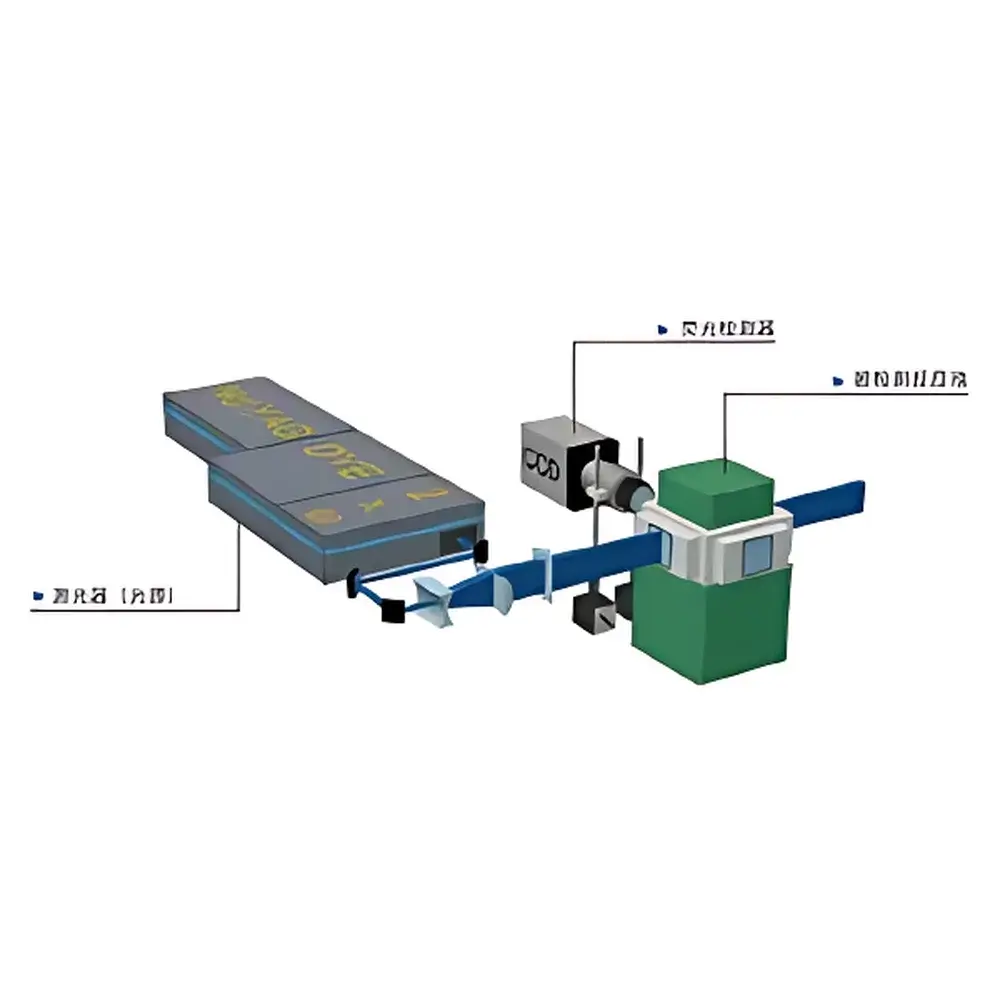
ZOLIX LIF/PLIF Combustion Diagnostics System
| Brand | ZOLIX |
|---|---|
| Origin | Beijing, China |
| Manufacturer Type | Original Equipment Manufacturer (OEM) |
| Product Category | Domestic |
| Model | LIF/PLIF Combustion Diagnostics System |
| Pricing | Available Upon Request |
| Tunable Dye Laser Wavelength Range | 220–780 nm (extendable to 200–4500 nm) |
| Spectral Linewidth | 0.06 cm⁻¹ |
| Pulse Energy | 110 mJ @ 560 nm |
| Laser Repetition Rate | 10 Hz |
| Laser Sheet Thickness | 0.1–0.3 mm |
| Temporal Delay Range | 0–2000 s |
| Timing Resolution | 5 ps |
| Synchronization Channels | 4 (expandable to 8) |
| ICCD Optical Gate Width | <2 ns |
| ICCD Delay Resolution | 10 ps |
| ICCD Insertion Delay | ≥19 ns |
| ICCD Photocathode Repetition Rate | up to 500 kHz |
| ICCD Cooling | −40 °C (TE-cooled) |
| iStar sCMOS Resolution | 2560 × 2160 pixels |
| iStar sCMOS Full-Frame Rate | 50 fps |
| ROI Frame Rate (512×512) | 203 fps |
| USB Interface | USB 2.0 (iStar ICCD) / USB 3.0 (iStar sCMOS) |
| PIV Mode Minimum Inter-Frame Interval | 200 ns |
| Intelligate™ UV/VUV Gating Extinction Ratio | ≥10⁸:1 |
Overview
The ZOLIX LIF/PLIF Combustion Diagnostics System is a modular, turnkey platform engineered for quantitative, two-dimensional, time-resolved optical diagnostics in reactive flows. It implements Planar Laser-Induced Fluorescence (PLIF), a non-intrusive laser-based imaging technique grounded in quantum mechanical resonance absorption and spontaneous emission. By tuning a narrow-linewidth pulsed dye laser to match the electronic transition wavelength of target species—such as OH, CH, CO, NO, or fuel tracers—the system selectively excites molecules within a thin laser sheet (0.1–0.3 mm thickness). The resulting planar fluorescence emission is captured with nanosecond-gated, time-synchronized intensified cameras (ICCD or iStar sCMOS), enabling spatially resolved measurement of species concentration, mixture fraction, temperature, and reaction rate fields in turbulent flames, ignition events, and spray combustion.
Key Features
- Integrated tunable dye laser source with continuous wavelength coverage from 220–780 nm (extendable to 200–4500 nm), spectral linewidth ≤0.06 cm⁻¹, and pulse energy up to 110 mJ at 560 nm
- Laser sheet generation optics including cylindrical and spherical focusing lenses (f = 50 mm and 500 mm, respectively) for precise beam shaping and uniform illumination across the measurement plane
- Nanosecond-precision timing control system with 5 ps resolution, 4 configurable delay channels (expandable to 8), and sub-20 ns total insertion delay for synchronization with high-speed lasers and detectors
- High-sensitivity detection options: iStar ICCD (2 ns optical gate width, −40 °C TE cooling, P43/P46 phosphor options) or iStar sCMOS (5.5 Mpix, USB 3.0 interface, 50 fps full-frame, 203 fps at 512×512 ROI)
- Dedicated software suite supporting real-time acquisition, multi-parameter calibration (e.g., OH PLIF thermometry, CO quenching correction), quantitative image processing, and volumetric reconstruction via tomographic post-processing
- Modular architecture compliant with ISO/IEC 17025 laboratory infrastructure standards; supports integration with Particle Image Velocimetry (PIV), Rayleigh scattering, and Raman spectroscopy subsystems
- Configurable optical layout accommodating standard C- and F-mount interfaces, water-cooling provisions, dry-gas purging ports for low-EBI operation, and vibration-isolated optical breadboard mounting
Sample Compatibility & Compliance
The system is validated for use with gaseous and liquid-fueled combustion environments—including premixed, non-premixed, and partially premixed flames—as well as plasma-assisted ignition and scramjet-relevant high-speed reacting flows. It enables quantitative mapping of key intermediates (OH, CH, HCO), pollutants (NO, soot precursors), and scalar fields (mixture fraction, temperature) under conditions compliant with ASTM E1317 (laser diagnostic validation), ISO 14644-1 (cleanroom-compatible optical alignment), and USP (optical measurement system qualification). All timing electronics and data acquisition modules meet IEC 61000-4 electromagnetic compatibility requirements. Software features audit-trail logging, user-access controls, and export formats compatible with GLP/GMP-regulated reporting (CSV, HDF5, TIFF with embedded metadata).
Software & Data Management
ZOLIX PLIF Control Suite is a native Windows application built on Qt and Python-based scientific libraries (NumPy, SciPy, OpenCV, h5py). It provides synchronized hardware control of laser pulsing, ICCD/sCMOS gating, delay generator sequencing, and optional PIV triggering. Calibration workflows include spectral registration, pixel-to-physical-unit mapping, background subtraction, shot-to-shot normalization, and Abel inversion for axisymmetric flame analysis. Temperature derivation follows established OH-PLIF two-line thermometry protocols (e.g., Q₁(1)/Q₁(2) ratio method), while mixture fraction quantification employs dual-tracer or single-tracer ratiometric approaches per Sandia Flame D/E conventions. Data export supports FAIR principles: machine-readable metadata (JSON-LD), version-controlled processing scripts, and interoperability with MATLAB, Python, and commercial CFD post-processors (ANSYS CFD-Post, Tecplot).
Applications
- Aerospace propulsion research: supersonic combustion, flame stabilization in scramjets, injector spray-flame interaction
- Advanced energy systems: oxy-fuel combustion, hydrogen-blend flame dynamics, catalytic surface reactions
- Automotive R&D: direct-injection gasoline and diesel engine combustion, low-temperature oxidation pathways
- Fundamental combustion science: turbulent flame front structure, extinction limits, autoignition chemistry
- Plasma-assisted combustion: nanosecond-pulsed discharge coupling with OH/CH PLIF
- Fire safety engineering: flame spread in confined geometries, soot formation kinetics
FAQ
What species can be measured using this PLIF system?
The system supports quantitative imaging of OH, CH, CO, NO, CN, HCO, and common fuel tracers (e.g., acetone, toluene, diethyl ether) via appropriate laser wavelength selection and spectral filtering. Multi-species simultaneous detection is achievable using multi-wavelength laser pumping and spectral separation.
Is the system compatible with existing PIV setups?
Yes. The integrated digital delay generator provides four (expandable to eight) independent TTL/CMOS outputs with programmable jitter <10 ps, enabling precise synchronization between PLIF excitation and PIV double-pulse illumination. Optional beam-splitting and dichroic filter modules facilitate co-aligned dual-modality imaging.
How is temperature quantified in OH-PLIF measurements?
Temperature is derived from the intensity ratio of two rotational lines within the A²Σ⁺–X²Π (0,0) band of OH (e.g., Q₁(1) and Q₁(2)), calibrated against NIST spectral databases and corrected for collisional quenching using pressure- and composition-dependent models.
Does the software support automated batch processing of large PLIF datasets?
Yes. The suite includes a CLI-mode script engine and Python API for pipeline automation—including dark/bias correction, flat-field normalization, chemiluminescence subtraction, and statistical ensemble averaging across hundreds of flame cycles.
What level of technical support and documentation is provided?
ZOLIX delivers comprehensive installation qualification (IQ), operational qualification (OQ), and performance qualification (PQ) documentation aligned with ISO/IEC 17025. On-site commissioning, application-specific training, and remote troubleshooting are included with extended service contracts.
Related Products




