
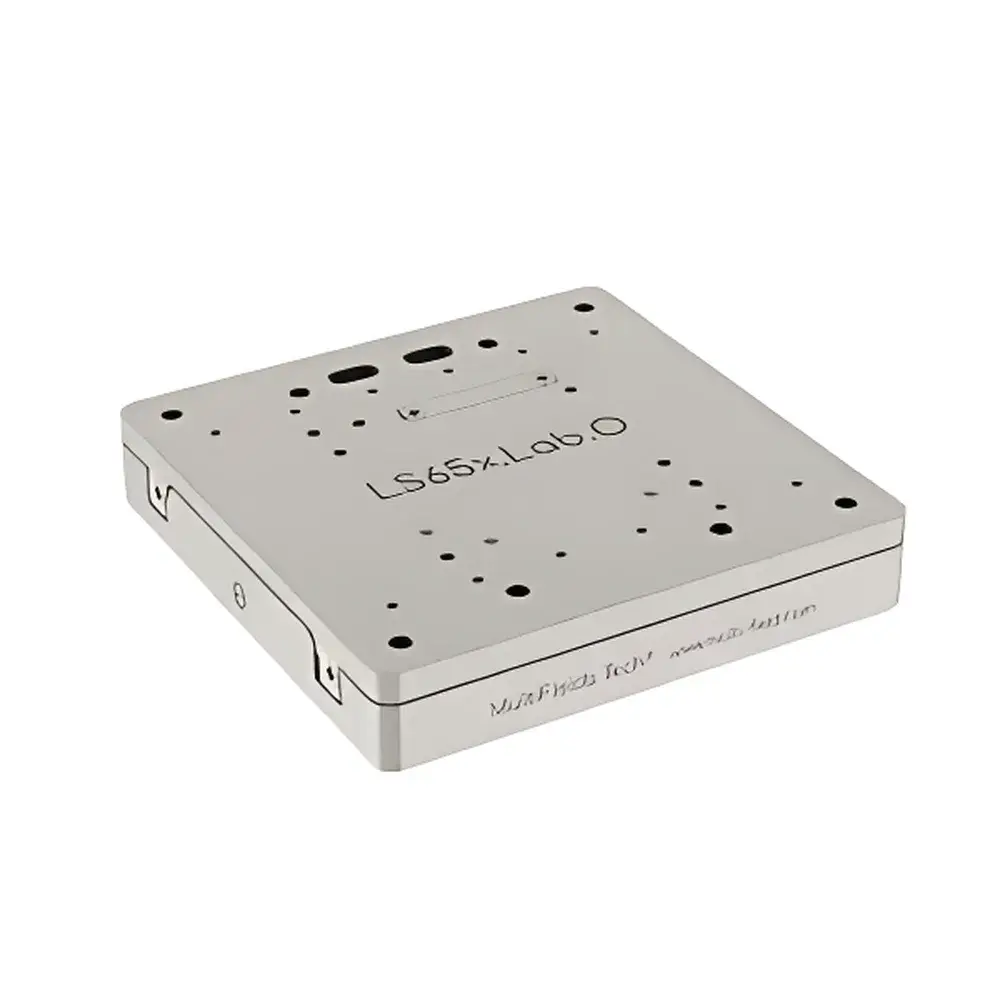
ZOLIX LS65x.Lab.O / LS65x.Lab.R Closed-Loop Piezoelectric Linear Translation Stage
| Brand | ZOLIX |
|---|---|
| Origin | Beijing, China |
| Manufacturer | ZOLIX (OEM/ODM Capable) |
| Product Type | Motorized Linear Translation Stage |
| Model | LS65x.Lab.O / LS65x.Lab.R |
| Control Loop | Closed-Loop |
| Actuation Principle | Piezoelectric Inertial Drive (Stick-Slip) |
| Travel Range | 30 mm |
| Max. Speed | ~20 mm/s |
| Min. Step Size | <10 nm |
| Max. Horizontal Push Force | 2 N |
| Holding Force | 5 N |
| Pitch/Yaw Deviation (Full Travel) | 0.3 mrad / 0.2 mrad |
| Max. Vertical Load Capacity | 2 N |
| Sensor Type | Optical Encoder (.O) or Resistive Potentiometer (.R) |
| Position Sensing Range | 30 mm |
| Resolution (.O) | 1 nm (optional), 10 nm (standard) |
| Resolution (.R) | 100–200 nm |
| Drive Frequency | Up to 20 kHz |
| Dimensions (L×W×H) | 65 mm × 65 mm × 12 mm |
| Body Material | Stainless Steel (Standard), Titanium (Optional for .NM), Vacuum-Compatible Stainless Steel (.HV/.UHV) |
| Environmental Options | Non-Magnetic (.NM), High Vacuum (.HV), Ultra-High Vacuum (.UHV) |
| Cable Interface | Shielded Cable with D-Sub 9-pin Connector (Standard), Kapton-insulated PEEK-pin Option for UHV |
Overview
The ZOLIX LS65x.Lab.O and LS65x.Lab.R are compact, high-stiffness, closed-loop piezoelectric linear translation stages engineered for precision optical alignment, interferometry, nanoscale sample positioning, and vacuum-compatible instrumentation. Based on a stick-slip inertial drive mechanism, these stages deliver sub-nanometer resolution motion without electromagnetic interference or mechanical backlash—making them ideal for applications where electromagnetic compatibility (EMC), thermal stability, and positional repeatability are critical. Unlike stepper- or servo-driven stages, the LS65x.Lab series operates silently at drive frequencies up to 20 kHz, eliminating audible noise and vibration coupling into sensitive optical paths. The stage’s monolithic stainless steel (or titanium, per .NM variant) construction ensures long-term dimensional stability and resistance to creep under load, while its ultra-low profile (12 mm height) enables integration into multi-axis stacks and space-constrained optical breadboards.
Key Features
- Ultra-compact footprint: 65 mm × 65 mm × 12 mm—optimized for modular optical system integration.
- Closed-loop feedback architecture supporting two sensor configurations: optical encoder (.O) with 10 nm standard resolution (1 nm optional) or resistive potentiometric sensor (.R) with 100–200 nm resolution—enabling cost-performance optimization per application requirement.
- Sub-10 nm minimum step size and <0.3 mrad pitch/yaw deviation over full 30 mm travel—ensuring high-fidelity trajectory fidelity in scanning and alignment tasks.
- 2 N maximum horizontal push force and 5 N static holding force—capable of driving small optics mounts, fiber couplers, or microfluidic cartridges without external bracing.
- Vacuum-ready variants available: non-magnetic (.NM), high-vacuum (.HV), and ultra-high-vacuum (.UHV) versions feature compatible materials (e.g., titanium body, Kapton-insulated PEEK-pin cabling), zero-outgassing adhesives, and bakeable construction per ISO 10100 and ASTM E595 standards.
- Fully compatible with ZOLIX’s multi-axis control ecosystem—including rotation stages, tip-tilt platforms, and XYθ controllers—enabling synchronized motion profiles via TTL-triggered or analog voltage interfaces.
Sample Compatibility & Compliance
The LS65x.Lab stage is designed for direct mounting of optical components (e.g., mirrors, lenses, fiber collimators), MEMS devices, and miniature sensors onto its top plate using M3 or #4-40 tapped holes. Its low mass (1.2 kHz) minimize dynamic coupling during rapid positioning sequences. All standard variants comply with RoHS 2011/65/EU and CE marking requirements for laboratory equipment. Vacuum-rated models meet ISO 27498 (vacuum cleanliness), ISO 10100 (vacuum material compatibility), and NASA-SSP 30236 (outgassing specifications). For regulated environments (e.g., GLP/GMP labs), traceable calibration certificates (per ISO/IEC 17025) and audit-ready controller firmware logs (supporting 21 CFR Part 11 electronic signature compliance when paired with ZOLIX CNTL-PRO software) are available upon request.
Software & Data Management
Stage operation is managed via ZOLIX’s CNTL-PRO software suite (Windows/Linux), offering real-time position monitoring, waveform-based motion scripting (sine, sawtooth, custom LUT), and automated hysteresis compensation. Data export supports CSV, HDF5, and MATLAB-compatible MAT formats. Controller firmware implements non-volatile memory for user-defined zero points, velocity profiles, and sensor calibration offsets. For OEM integration, ASCII-based serial protocol (RS-232/USB-CDC) and EtherCAT interface options are supported—enabling seamless incorporation into LabVIEW, Python (PyVISA), or MATLAB instrument control frameworks. All position data includes timestamping at ≥1 kHz sampling rate, with built-in error logging for motion timeout, overcurrent, or sensor saturation events.
Applications
- Nanoscale optical path length adjustment in Michelson and Mach-Zehnder interferometers.
- Precision alignment of single-mode fiber arrays in photonic integrated circuit (PIC) testing.
- Automated focus scanning in confocal and super-resolution microscopy systems.
- Beam steering and cavity length tuning in tunable laser cavities and external-cavity diode lasers (ECDLs).
- Positioning of cryogenic samples in dilution refrigerator-mounted optical experiments (with .NM and .UHV variants).
- Multi-axis nanopositioning for atomic force microscope (AFM) scanner calibration and probe approach routines.
FAQ
What is the difference between the .O and .R sensor variants?
The .O version uses a compact optical grating encoder with 10 nm standard resolution (1 nm optional), delivering higher linearity and lower hysteresis. The .R version employs a precision resistive potentiometer with 100–200 nm resolution—suitable for cost-sensitive applications where absolute accuracy is secondary to repeatable relative motion.
Can multiple LS65x.Lab stages be synchronized?
Yes—via ZOLIX’s master-slave daisy-chain mode using TTL synchronization pulses or shared analog reference voltage, enabling coordinated motion across X-Y-Z or X-θ configurations with sub-millisecond timing jitter.
Is thermal drift compensated in closed-loop operation?
While the piezoelectric actuator itself exhibits minimal thermal expansion, the optical encoder (.O) provides real-time position feedback independent of temperature-induced mechanical drift; no active thermal compensation is required for ambient lab conditions (15–30 °C).
What controller is required for closed-loop operation?
The ZOLIX CNTL-200 series controller (firmware v3.2+) is mandatory for closed-loop mode, providing PID tuning, sensor bias correction, and dynamic response optimization per load condition.
Are custom cable lengths or connector types available?
Yes—custom-length shielded cables with SMA, LEMO, or vacuum feedthrough connectors are available under OEM agreement, including Kapton-insulated PEEK-pin assemblies rated for 10⁻¹⁰ mbar UHV environments.





