
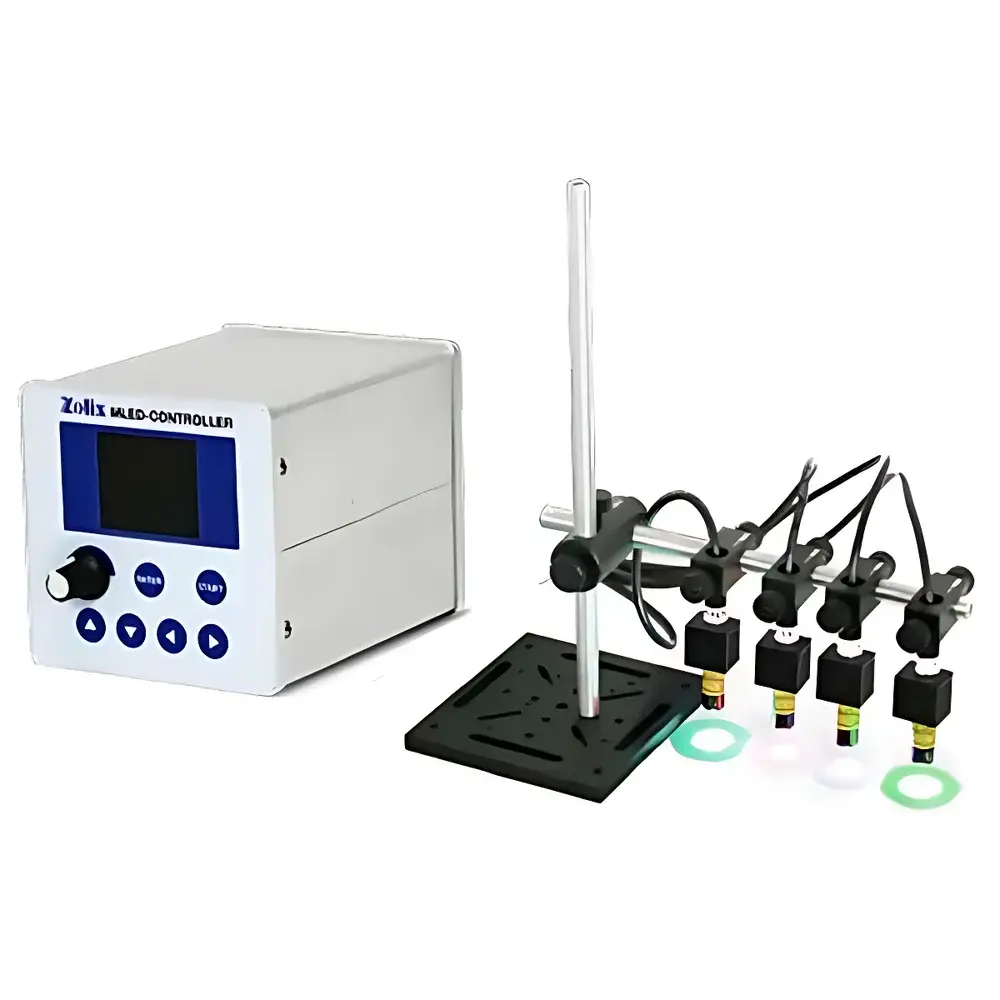
ZOLIX LSDS-30 Multi-Channel LED Light Source
| Brand | ZOLIX |
|---|---|
| Model | LSDS-30 |
| Origin | Beijing, China |
| Manufacturer Type | Original Equipment Manufacturer (OEM) |
| Light Source Type | High-Power Tunable LED Array |
| Control Interface | RS232, Digital TTL, Manual Knob |
| Output Regulation | 0–100% PWM (120 Hz), Adjustable Exposure Time up to 9999.9 s |
| Cooling Method | Forced Air |
| Input Power | AC 110–220 V, DC 12 V / 4 A |
| Operating Temperature | +5 to +35 °C |
| Storage Temperature | −10 to +55 °C (non-condensing) |
| Humidity Range | 20–80% RH (non-condensing) |
| Weight | ~3.5 kg (packaged), ~1.5 kg (controller only) |
| Compliance | CE-marked for laboratory use |
Overview
The ZOLIX LSDS-30 Multi-Channel LED Light Source is a modular, digitally controllable illumination platform engineered for precision optical experimentation and industrial process integration. Unlike broadband arc lamps or filtered halogen sources, the LSDS-30 leverages discrete high-radiance LED emitters—each selected for spectral purity, thermal stability, and calibrated radiant flux—to deliver stable, narrowband irradiance across ultraviolet (290–405 nm), visible (425–690 nm), and near-infrared (735–1030 nm) ranges. Its core architecture implements a constant-current driver topology with real-time thermal feedback, ensuring ±1% output stability (±2% at 290 nm) over extended operation. The system operates on a fundamental principle of electroluminescent excitation in semiconductor junctions, enabling rapid on/off switching (<1 µs rise time), absence of ozone generation, and zero warm-up delay—critical for time-resolved photochemical assays and synchronized optical triggering.
Key Features
- Four independent, isolated output channels (MLED4-1 to MLED4-5 variants), each supporting programmable current drive up to 700 mA for UV/VIS LEDs or 350 mA for NIR emitters
- Modular illumination head compatibility: Over 25 standardized LED heads (e.g., M365L @ 365 nm, M530L @ 530 nm, M850L @ 850 nm), all with 10 mm nominal beam diameter and ±10 nm wavelength tolerance
- Digital intensity control via 0–100% pulse-width modulation (120 Hz fixed frequency), eliminating analog drift and enabling precise dose delivery (J/cm²)
- Flexible exposure scheduling: User-defined irradiation sequences with duration resolution of 0.1 s and maximum runtime of 9999.9 s per step
- Multi-mode operation: Local manual control (rotary encoder + status LED), TTL-level digital triggering (active-high), and bidirectional RS232 serial communication (ASCII command set compliant with SCPI subsets)
- Integrated forced-air cooling with thermally monitored heatsink design, maintaining junction temperature below 65 °C under continuous full-load operation
Sample Compatibility & Compliance
The LSDS-30 accommodates diverse sample geometries through its interchangeable LED mounting system (MLED-POST1 to MLED-POST4), supporting single- to quad-head configurations with adjustable height (200 mm range) and angular orientation (±30° tilt). Each LED head delivers collimated output optimized for uniform irradiance over planar surfaces—suitable for cuvette-based photoreactors, Petri dish illumination, fiber-coupled spectroscopy, and microscope epi-illumination. The system complies with IEC 61000-6-3 (radiated/conducted emissions) and IEC 61000-6-2 (electrostatic discharge and RF immunity), meeting essential electromagnetic compatibility requirements for shared laboratory environments. While not certified for clinical diagnostics or GMP manufacturing, its deterministic output behavior and audit-ready parameter logging support GLP-aligned experimental documentation.
Software & Data Management
The LSDS-30 controller stores up to 10 user-defined irradiation protocols internally, including channel enable/disable states, current setpoints, exposure durations, and inter-step delays. RS232 communication enables integration into LabVIEW, Python (pySerial), or MATLAB automation frameworks via ASCII commands (e.g., “CH1:CURR 500” sets Channel 1 current to 500 mA; “EXPO:START” initiates sequence). All operational parameters—including real-time current draw, controller temperature, and cumulative operating hours—are accessible via query commands. No proprietary software is required; raw data export (CSV-compatible) is achievable through terminal emulation or custom scripts. Audit trails are maintained via timestamped command logs, satisfying basic traceability needs for method validation under ISO/IEC 17025 Clause 7.7.
Applications
- Photocatalysis research: Quantitative evaluation of TiO₂, g-C₃N₄, or MOF-mediated degradation kinetics under monochromatic UV/VIS excitation
- Molecular biology: Blue-light-inducible gene expression (e.g., CRY2/CIB1 systems), optogenetic stimulation of neuronal cultures, and UV crosslinking for CLIP-seq
- Pharmaceutical stability testing: ICH Q1B-compliant photostability assessment using controlled 320–400 nm irradiance
- Materials science: Accelerated aging of polymers, OLED emissive layer characterization, and quantum dot photoluminescence quantum yield measurement
- Forensic analysis: Alternate light source (ALS) examination of latent fingerprints, bodily fluids, and counterfeit document features
- Archaeometric imaging: Multispectral reflectance mapping of pigments and binding media using sequential narrowband excitation
FAQ
What is the spectral bandwidth (FWHM) of the standard LED heads?
Standard ZOLIX LED heads exhibit FWHM values ranging from 12 nm (UV diodes, e.g., M290L) to 25 nm (NIR diodes, e.g., M940L), as verified by factory spectral radiometric calibration.
Can the LSDS-30 drive non-ZOLIX LED modules?
Only when matched to the controller’s voltage compliance (≤12 V forward) and current limits (≤700 mA per channel); ZOLIX does not guarantee performance or thermal safety with third-party emitters.
Is analog dimming supported?
No—the system uses digital PWM exclusively to preserve LED spectral fidelity and avoid low-frequency flicker artifacts in high-speed imaging applications.
How is beam uniformity characterized?
Each 10 mm output head is measured with a calibrated CCD-based irradiance profiler; flat-top profiles with ≤15% center-to-edge variation are specified at 50 mm working distance.
Does the controller support external trigger synchronization?
Yes—TTL input accepts rising-edge triggers to initiate or halt exposure sequences, enabling hardware-level coordination with cameras, shutters, or lock-in amplifiers.




