
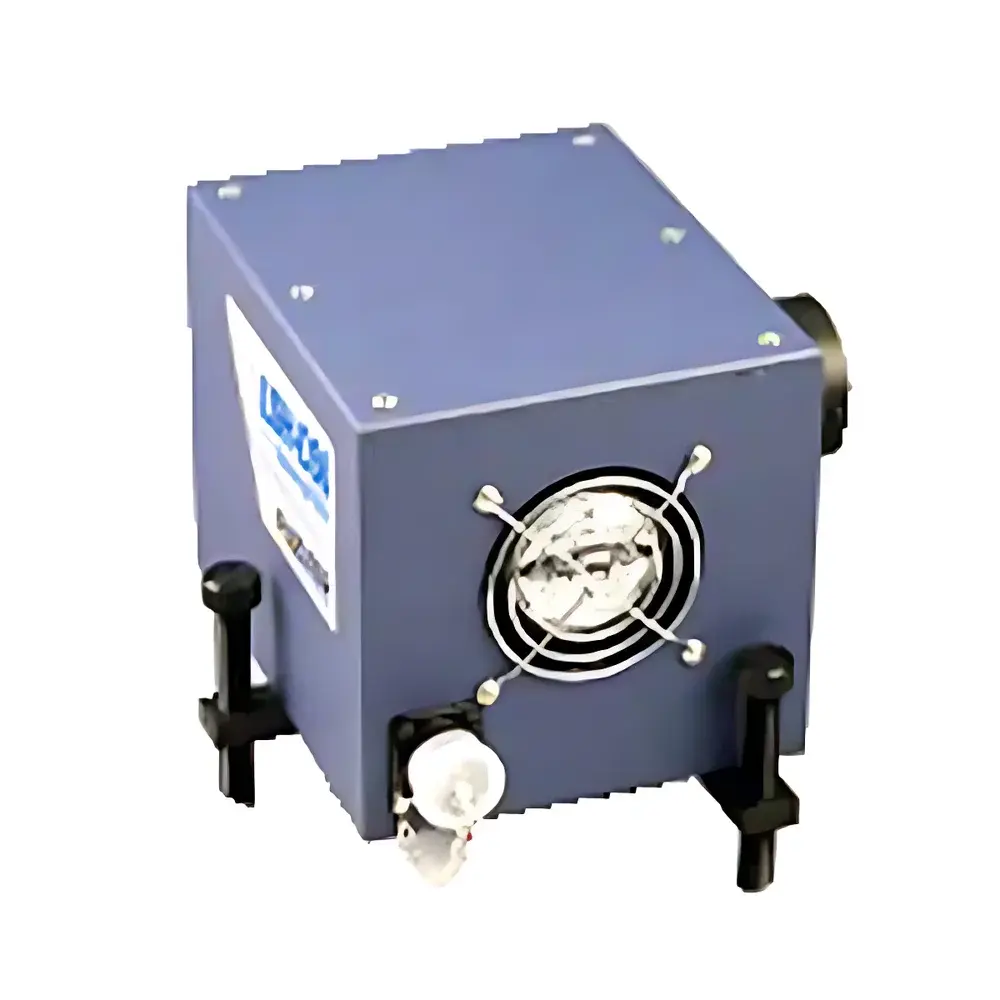
ZOLIX LSH-D30 Deuterium Lamp Light Source with LSP-D30 Constant-Current Power Supply
| Brand | ZOLIX |
|---|---|
| Origin | Beijing, China |
| Manufacturer Type | OEM Manufacturer |
| Region of Origin | Domestic (China) |
| Model | LSH-D30 |
| Price | Upon Request |
| Lamp Power | 30 W |
| Lamp Current | 300 mA |
| Lamp Voltage | 70–90 V |
| Ignition Voltage | >350 V DC |
| Emission Region Diameter | Ø1 mm |
| Average Lamp Lifetime | 2000 h |
| Light Output Stability (Irradiance Fluctuation) | ≤0.5% RMS |
| Current Stability (LSP-D30) | ≤0.05% per hour |
| Input Voltage (LSP-D30) | 24 V DC |
| Optical Axis Height Adjustment Range | 115–154 mm |
| Spectral Output Range | 200–400 nm |
Overview
The ZOLIX LSH-D30 deuterium lamp light source—paired with the dedicated LSP-D30 constant-current power supply—is a precision-engineered ultraviolet (UV) continuum radiation source designed for integration into UV-Vis spectrophotometers, HPLC-UV detectors, and other spectroscopic systems requiring stable, broadband UV emission. Based on the principle of molecular deuterium discharge in a low-pressure quartz envelope, the LSH-D30 generates intense, smooth spectral irradiance across the 200–400 nm range, with peak intensity near 220 nm and minimal structure compared to tungsten-halogen or LED-based alternatives. Its optimized optical design ensures collimated output with high spatial coherence and minimal divergence, enabling efficient coupling into monochromators, fiber-optic interfaces, or sample compartments. The system is engineered for long-term operational reliability in analytical laboratories where reproducible baseline stability and minimal photometric drift are prerequisites for quantitative absorbance, kinetic, or calibration measurements.
Key Features
- Stable UV continuum output from 200 nm to 400 nm, compliant with ISO 6507-1 spectral irradiance reference requirements for UV photometric validation
- Optical axis height continuously adjustable between 115 mm and 154 mm to accommodate diverse optical path geometries in benchtop and OEM instrumentation
- Integrated thermal management and quartz envelope geometry minimize thermal lensing and spectral shift over extended operation
- LSP-D30 power supply delivers precise 300 mA constant current with ≤0.05% per hour stability—critical for minimizing signal drift during multi-hour kinetics or sequence-based assays
- Ignition circuit provides reliable cold-start capability at >350 V DC, ensuring consistent lamp strike without external trigger modules
- 2000-hour rated average lifetime under recommended operating conditions (defined per IEC 62471 photobiological safety guidelines for UV lamps)
Sample Compatibility & Compliance
The LSH-D30/LSP-D30 system is compatible with standard 1-inch (25.4 mm) optical mounts and accepts Ø1 mm diameter deuterium lamp bulbs (model LSB-D30), facilitating straightforward replacement and alignment. It meets mechanical and electrical interface conventions used in major UV-Vis spectrometer platforms—including Shimadzu, Agilent, and PerkinElmer OEM designs—when integrated via custom adapter plates. From a regulatory standpoint, the lamp assembly complies with RoHS Directive 2011/65/EU for hazardous substance restrictions, and its spectral output is traceable to NIST-traceable UV radiometric standards when calibrated using a certified spectroradiometer. For GLP/GMP environments, the LSP-D30 supports optional analog monitoring outputs (0–5 V) for real-time current logging and audit trail generation in validated systems.
Software & Data Management
While the LSH-D30/LSP-D30 operates as a hardware-level illumination module, it is fully compatible with third-party instrument control software frameworks including LabVIEW™, Python-based PyVISA drivers, and MATLAB Instrument Control Toolbox. When interfaced via optional analog voltage monitoring or digital TTL status lines (available upon request), lamp current and ignition state can be logged synchronously with spectral acquisition in compliance with FDA 21 CFR Part 11 requirements for electronic records and signatures. No proprietary firmware or closed-loop control algorithms are embedded—ensuring full transparency, deterministic behavior, and compatibility with legacy and modern DAQ architectures alike.
Applications
- Primary UV source in double-beam and array-based UV-Vis spectrophotometers for routine quantification of nucleic acids, proteins, and small molecules
- Reference emitter in wavelength accuracy verification protocols per ASTM E275 and USP
- Stimulus source in photochemical reaction monitoring setups requiring defined UV flux density
- Calibration standard for UV-sensitive CCD and CMOS detectors in imaging spectroscopy applications
- OEM integration into portable or field-deployable analyzers where compact size, low heat dissipation, and DC-only input are essential
FAQ
What is the typical warm-up time required to achieve spectral stability?
The LSH-D30 reaches photometric equilibrium within 15–20 minutes after ignition; full spectral stability (±0.2% irradiance variation across 220–300 nm) is achieved after 30 minutes of continuous operation.
Can the LSH-D30 be operated in pulsed mode?
No—the LSP-D30 is a dedicated constant-current DC driver; pulsed operation is not supported and may reduce lamp lifetime or cause arc instability.
Is the lamp socket compatible with non-ZOLIX deuterium bulbs?
Mechanical fit is specific to the LSB-D30 form factor; substitution with non-OEM bulbs voids lifetime guarantees and may compromise thermal and electrical performance.
Does the system include a shutter or intensity modulation capability?
No—intensity control is achieved externally via neutral density filters or aperture adjustment; no built-in mechanical or electronic shutter is provided.
What maintenance is recommended to sustain optimal output stability?
Annual cleaning of the exit window with spectroscopic-grade methanol and inspection of electrode alignment are recommended; avoid touching the quartz envelope with bare hands to prevent contamination-induced hot spots.




