
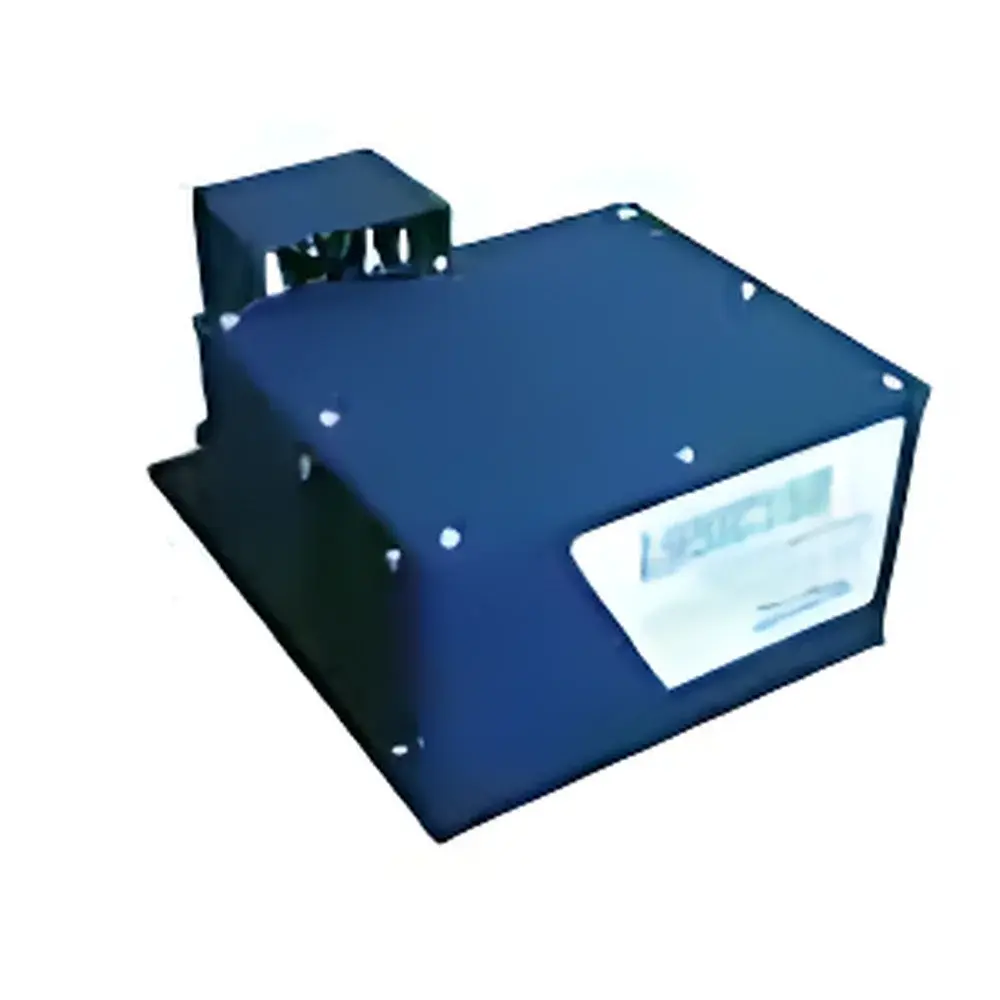
ZOLIX LSH-SiC200 Silicon Carbide Infrared Source
| Brand | ZOLIX |
|---|---|
| Model | LSH-SiC200 |
| Power | >200 W |
| Spectral Range | 1–16 µm |
| f-number | f/4 |
| Emissive Area | 5 × 14 mm |
| Rated Current | 18 A |
| Lifetime | >400 h |
| Optical Center Height | 128–168 mm (adjustable) |
| Operating Temperature | 900–1200 K |
| Mirror Reflectivity | >98% (Au-coated) |
| Cooling | Recirculating Water |
| Compliance | Designed for ISO/IEC 17025-compliant optical labs |
| Sample Interface | Compatible with FTIR, dispersive IR spectrometers, and radiometric calibration setups |
Overview
The ZOLIX LSH-SiC200 Silicon Carbide Infrared Source is a high-stability, broadband thermal emitter engineered for demanding mid- to far-infrared spectroscopic applications. It operates on the principle of incandescent blackbody-like radiation from a resistively heated silicon carbide (SiC) rod, optimized for spectral continuity and thermal stability across 1–16 µm. Unlike halogen or Nernst glower sources, SiC offers superior emissivity uniformity (>0.92 across the band), minimal spectral structure, and enhanced mechanical robustness under thermal cycling. The source integrates a gold-coated elliptical reflector assembly with f/4 output geometry—specifically aligned to maximize étendue matching with commercial Fourier-transform infrared (FTIR) spectrometers and monochromator-based systems such as the ZOLIX “Spectrum King” series. Its thermally isolated chamber design minimizes convective drift, while the water-cooled housing maintains stable junction temperature at the SiC rod base—critical for long-term radiometric reproducibility in quantitative IR measurements.
Key Features
- High-power thermal emission: >200 W electrical input supporting stable radiant exitance up to 12 W·sr⁻¹·cm⁻² in the 2–12 µm range.
- Broadband spectral coverage: Continuous emission from 1 µm (near-IR edge) to 16 µm (far-IR cutoff), enabling calibration and characterization across multiple IR sub-bands.
- Gold-coated reflective optics: Elliptical mirror with >98% average reflectance from 0.8 µm to 20 µm; surface roughness <5 nm RMS ensures diffraction-limited beam quality.
- Precision mechanical adjustability: Optical center height continuously adjustable between 128 mm and 168 mm to accommodate varied instrument mounting interfaces and alignment requirements.
- Integrated recirculating cooling system: Includes stainless-steel reservoir, submersible pump, flow sensor, and over-temperature cut-off—designed to maintain SiC rod base temperature within ±2 K during continuous operation.
- Low air disturbance architecture: Eliminates fan-induced turbulence common in air-cooled IR sources, preserving interferometric stability in FTIR environments.
Sample Compatibility & Compliance
The LSH-SiC200 is compatible with standard 25.4 mm (1″) or 38.1 mm (1.5″) optical mounts and interfaces directly with ZOLIX FTIR platforms, Bruker VERTEX series, Thermo Nicolet iS50, and PerkinElmer Frontier systems via optional collimating adapters. Its spectral radiance profile conforms to ASTM E1980 (Standard Practice for Calibration of Blackbody Sources) and supports traceable radiometric calibration per ISO/IEC 17025 requirements when used with NIST-traceable reference detectors. The unit meets CE electromagnetic compatibility directives (2014/30/EU) and RoHS 2011/65/EU material restrictions. No hazardous substances are employed in SiC rod fabrication or gold deposition processes.
Software & Data Management
While the LSH-SiC200 operates as a standalone analog source, its DC power supply includes analog voltage control (0–10 V) and RS-232 interface for integration into automated lab environments. When paired with ZOLIX SpectraMaster software or third-party DAQ platforms (e.g., LabVIEW, MATLAB Data Acquisition Toolbox), users can log current, coolant flow rate, and external thermocouple readings synchronized with spectral acquisition. Audit trails for power-on duration, thermal soak cycles, and operational history are retained in non-volatile memory—supporting GLP-compliant recordkeeping and FDA 21 CFR Part 11–aligned electronic signatures when deployed in regulated QC/QA workflows.
Applications
- Radiometric calibration of FTIR spectrometers, especially for atmospheric transmission modeling and gas-phase absorption studies (e.g., CO₂, CH₄, NH₃).
- Reference source for emissivity measurement of industrial coatings and aerospace materials in vacuum chambers.
- Benchmark emitter for validating MCT and DTGS detector linearity in the 3–12 µm region.
- Source for reflection-absorption IR spectroscopy (RAIRS) on catalytic surfaces under controlled thermal environments.
- Calibration anchor in multi-spectral imaging systems requiring stable, spatially uniform IR illumination between 2–14 µm.
FAQ
What is the recommended operating current for optimal lifetime and spectral stability?
The SiC rod is rated for 18 A DC; however, sustained operation at 16–17 A yields optimal balance between radiant output and >400 h service life. Exceeding 18 A accelerates grain boundary diffusion and reduces emissivity homogeneity.
Can the LSH-SiC200 be used in vacuum or inert-gas purge environments?
Yes—the source chamber features sealed feedthroughs for electrical and coolant lines; optional vacuum-compatible flanges (CF-35 or KF-40) are available upon request.
Is the gold-coated reflector susceptible to sulfur or chloride contamination in industrial lab settings?
Gold exhibits excellent chemical inertness; however, prolonged exposure to H₂S or Cl₂ atmospheres above 60 °C may induce surface tarnish. Routine cleaning with anhydrous ethanol and nitrogen blow-off is sufficient for maintenance.
Does the system support remote power ramping for thermal gradient experiments?
Yes—via RS-232 command set (e.g., “SETCURR 15.5”) or analog voltage sweep, enabling programmable heating profiles for time-resolved emissivity studies.
How often should the coolant fluid be replaced in closed-loop operation?
Deionized water with 10% glycol antifreeze should be refreshed every 6 months or after 1000 operational hours—whichever occurs first—to prevent biofilm formation and copper corrosion in the pump head.




