
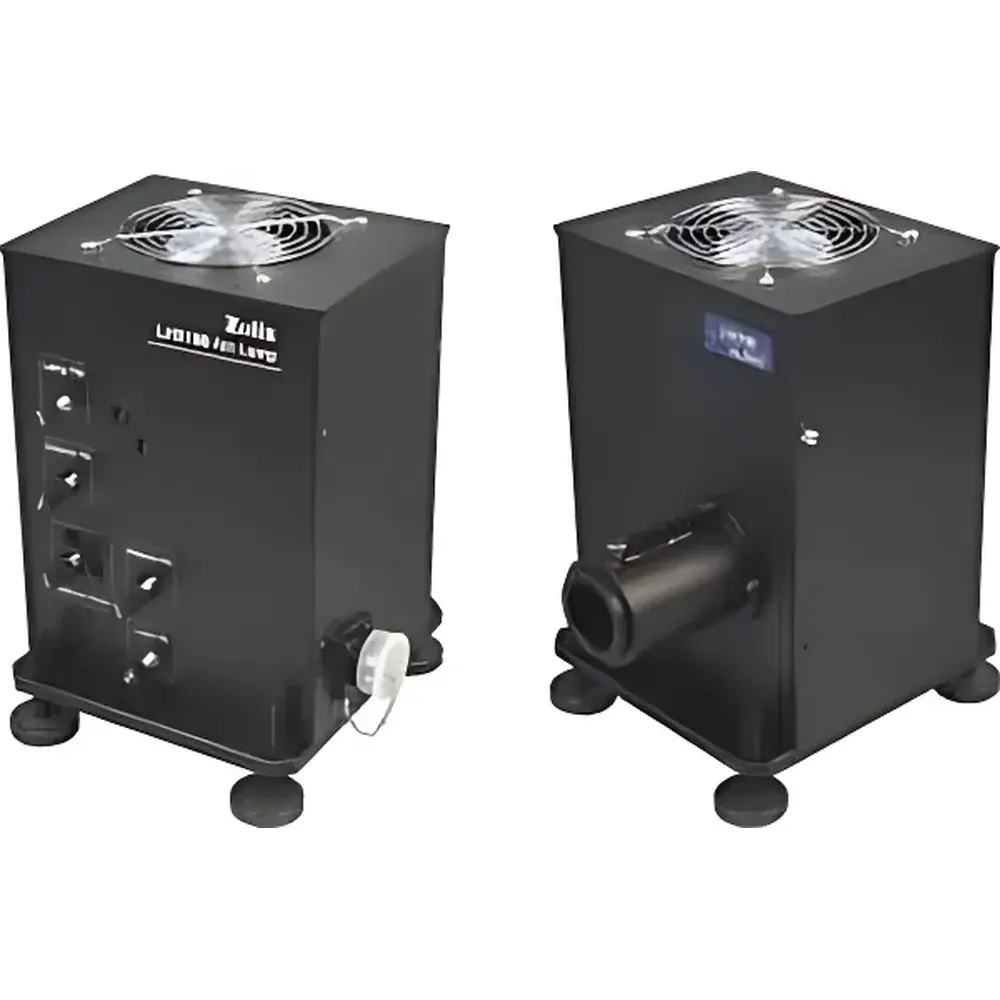
ZOLIX LSH-X150 Xenon Light Source with LSP-X150 Constant-Current Power Supply
| Brand | ZOLIX |
|---|---|
| Origin | Beijing, China |
| Manufacturer Type | Original Equipment Manufacturer (OEM) |
| Product Category | Domestic |
| Model | LSH-X150 |
| Light Source Type | Short-Arc Xenon Lamp |
| Illumination Configuration | Internal Illumination |
| Optical Output Stability | ±0.5% (with LSP-X150 power supply) |
| Current Regulation Range | 7–9.5 A |
| Current Stability | ±0.05% (@ 8.5 A) |
| Input Voltage | 110/220 V AC ±10% |
| Spectral Range | 200–2500 nm (peak output 250–1800 nm) |
| Color Temperature | ~6000 K |
| Collimated Beam Diameter | 38 mm |
| Adjustable Optical Axis Height | 134–154 mm |
| Cooling Method | Forced-air convection |
| Lamp Life | ≥2000 h |
| Lamp Dimensions | Ø20 mm × length |
| Arc Size | 0.5 × 1.6 mm |
Overview
The ZOLIX LSH-X150 Xenon Light Source is a high-intensity, short-arc xenon lamp system engineered for precision optical applications requiring broadband spectral continuity, high radiance, and exceptional temporal stability. Operating on the principle of high-pressure gas discharge in a sealed quartz envelope, the LSH-X150 generates a near-daylight spectrum (CCT ≈ 6000 K) with strong emission from the deep ultraviolet (200 nm) through the near-infrared (2500 nm), making it ideal for spectroscopic calibration, solar simulation, photochemical reaction studies, and optical component testing. Unlike continuous-wave halogen or LED sources, the xenon arc offers superior spatial coherence and spectral uniformity across its compact plasma region (0.5 × 1.6 mm), enabling efficient coupling into monochromators, spectrometers, and fiber-optic interfaces. The system comprises two integrated subsystems: the LSH-X150 lamp housing—featuring a rear-mounted elliptical reflector and dual-focus UV-grade fused silica lens—and the LSP-X150 constant-current power supply, which delivers tightly regulated DC current to maintain arc position stability and minimize intensity drift.
Key Features
- UV-optimized optical train: Dual-focus fused silica lens assembly maximizes photon collection efficiency (>85% transmission from 250–1800 nm) while minimizing chromatic aberration and thermal lensing.
- Rear-mounted reflective mirror architecture: Increases effective radiant flux by >50% compared to front-reflector configurations, reducing stray light and improving beam collimation.
- Adjustable optical axis height (134–154 mm): Ensures mechanical compatibility with standard optical tables, spectrometer entrance slits, and custom optical benches.
- Integrated high-voltage igniter: Eliminates external trigger cables and associated EMI risks; enables safe, repeatable lamp ignition without manual HV handling.
- Forced-air cooling system: Maintains stable thermal equilibrium during extended operation (up to 8 h continuous duty), preventing quartz envelope devitrification and arc wander.
- Modular mechanical interface: Standardized flange dimensions (Ø36 mm for LSH-X150) support rapid integration with ZOLIX LHL series coupling lenses, LHF filter holders, LHI variable apertures, and LHC fiber couplers.
Sample Compatibility & Compliance
The LSH-X150 is compatible with a broad range of optical and photonic instrumentation, including but not limited to: Czerny-Turner and imaging spectrometers (e.g., ZOLIX “SpectraMaster” and “Imaging SpectraMaster” platforms), monochromators with f/4–f/10 input optics, integrating spheres (30–150 mm diameter), quantum yield measurement systems, and photocatalytic reactors. Its spectral output conforms to ISO 9001-certified manufacturing processes and meets key requirements for laboratory-grade light sources under ASTM E927-21 (Standard Specification for Solar Simulation for Photovoltaic Testing) when paired with AM1.5G filters. While not inherently compliant with IEC 62471 (Photobiological Safety), the system includes interlocked shutter options and UV-blocking enclosure kits for Class 3R laser safety alignment per ANSI Z136.1. All electrical components comply with CE marking directives (EMC Directive 2014/30/EU and Low Voltage Directive 2014/35/EU).
Software & Data Management
The LSP-X150 power supply supports analog 0–5 V and 0–10 V external control inputs for remote intensity modulation, enabling synchronization with data acquisition systems (e.g., NI DAQ, Thorlabs Kinesis). Optional RS-232 or USB-to-serial adapters allow ASCII command-based control (e.g., “CURR 8.5”, “ON”, “OFF”) for integration into LabVIEW, Python (PySerial), or MATLAB automation scripts. Audit-trail-capable logging is achievable via third-party SCADA platforms; however, the unit does not natively implement FDA 21 CFR Part 11 electronic signature or GLP/GMP audit trail functionality. For regulated environments, users are advised to deploy external timestamped data loggers recording voltage, current, and runtime metrics.
Applications
- Solar simulator subsystems: With AM1.5G filter (LHF50 + certified filter), the LSH-X500 variant meets Class AAA spectral match criteria per IEC 60904-9 for PV cell IV characterization.
- UV-Vis-NIR spectrophotometer calibration: Serves as a NIST-traceable broadband reference source for wavelength and photometric accuracy verification.
- Photochemical kinetics: Enables time-resolved irradiation experiments in heterogeneous catalysis (e.g., TiO₂ degradation studies) under controlled photon flux (measurable via calibrated silicon or thermopile sensors).
- Fiber-optic sensor excitation: Coupled via LHC36-1 SMA905 adapter, it provides stable broadband launch into multimode fibers (core Ø400–1000 µm) for absorption or fluorescence sensing.
- Optical thin-film metrology: Delivers uniform illumination for ellipsometry and reflectometry setups requiring high signal-to-noise ratio across 250–1800 nm.
FAQ
What is the recommended lamp replacement interval?
Lamp lifetime is rated at ≥2000 hours under nominal current (8.5 A) and proper thermal management. Degradation manifests as increased operating voltage (>20 V), reduced UV output (<10% at 254 nm after 1500 h), or visible electrode erosion. We recommend scheduled replacement at 1800 h for critical metrology applications.
Can the LSH-X150 be operated in pulsed mode?
No—the LSP-X150 is a DC constant-current supply optimized for continuous arc stability. Pulsed operation requires specialized high-frequency ballasts and is not supported.
Is the spectral output NIST-traceably calibrated?
Factory calibration certificates include relative spectral irradiance (250–1800 nm) measured against a NIST-traceable deuterium-halogen reference lamp. Absolute irradiance calibration requires user-performed radiometric validation using a calibrated spectroradiometer.
What safety interlocks are built into the system?
The lamp housing features a mechanical safety switch that disables high-voltage ignition when the access door is open. Optional external interlock ports (3.5 mm jack) support integration with lab-wide emergency stop circuits.
How does the rear-mirror design improve optical throughput compared to front-mirror systems?
By positioning the reflector behind the lamp envelope, the rear-mirror configuration captures backward-emitted photons (≈40% of total radiance) and redirects them forward through the primary lens—increasing usable flux without introducing additional optical surfaces or alignment sensitivity.




