
ZOLIX LSXS-500 Photocatalysis-Optimized Xenon Arc Light Source
| Brand | ZOLIX |
|---|---|
| Origin | Beijing, China |
| Manufacturer Type | OEM Manufacturer |
| Country of Origin | China |
| Model | LSXS-500 |
| Light Source Type | Xenon Arc Lamp |
| Illumination Mode | Internal Irradiation Configuration |
| Spectral Range | 250–2500 nm |
| Adjustable Light Source Height | 157–193 mm |
| Output Beam Diameter (Collimated) | 46 mm |
| Optical Collection Efficiency Gain | >60% (vs. standard parabolic reflector) |
| Radiant Instability | ≤1% (with high-stability constant-current power supply) |
| Max. Envelope Temperature (Quartz Envelope) | <500 °C at 600 W equivalent load |
| Anode Temperature | <180 °C |
| Safety Features | Interlocked lid cutoff, thermal shutdown (>safe threshold), ignition failure lockout (after 10 s no-arc) |
| Lamp Compatibility | 350–500 W xenon, mercury-xenon, and mercury short-arc lamps |
| Lamp Life | Up to 2000 h (LSB-X500AOF150) |
| Lamp Dimensions (L × Ø) | 190 × 35 mm |
| UV Hazard Class | IEC 62471 Risk Group 3 (High UV Hazard) |
Overview
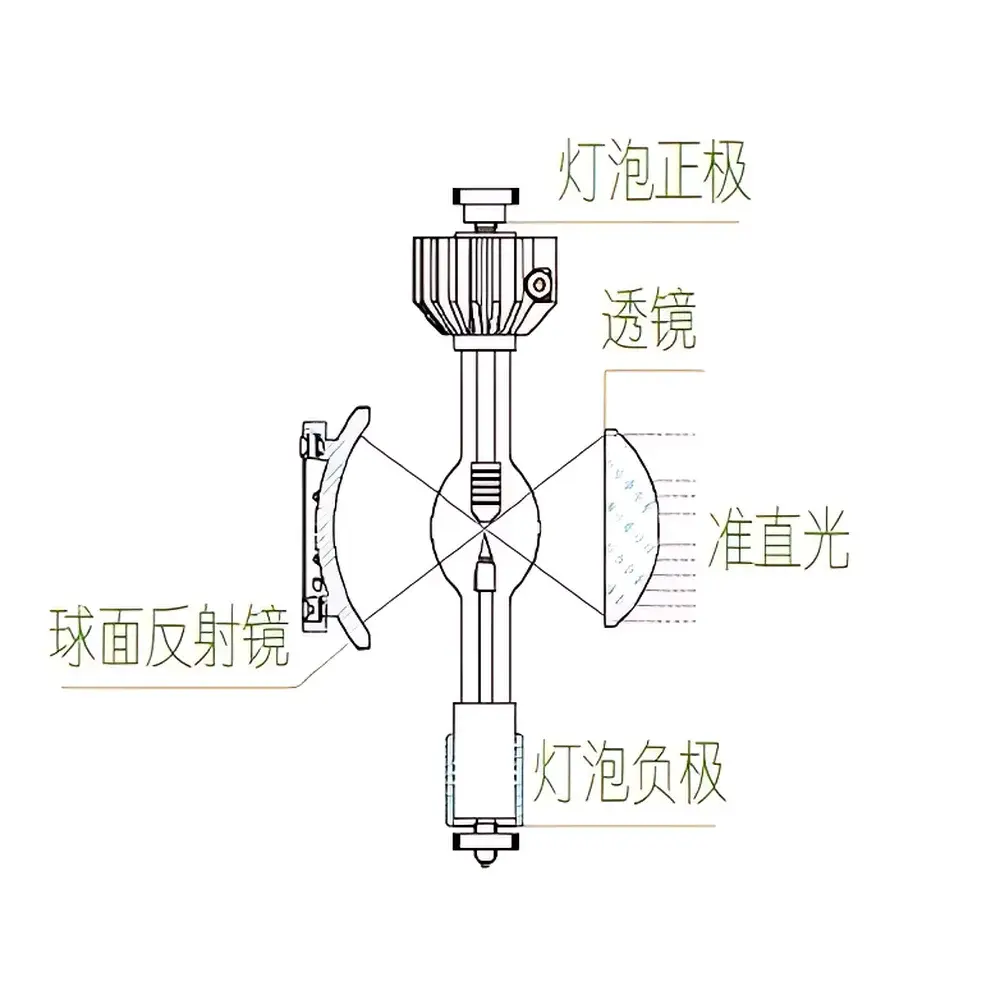
The ZOLIX LSXS-500 is a purpose-engineered xenon arc light source designed specifically for photocatalytic reaction systems, quantum yield measurements, and accelerated photostability testing in research and industrial laboratories. It operates on the principle of high-pressure DC-excited arc discharge within a fused silica envelope, generating a broadband continuum spanning 250–2500 nm—covering deep UV (UVC), near-UV (UVA), visible, and short-wave near-infrared (NIR) spectral regions. With a correlated color temperature of ~5800 K, its spectral irradiance closely approximates natural solar irradiance under AM1.5G conditions—making it suitable for solar-simulated photocatalysis, dye-sensitized solar cell (DSSC) characterization, and photochemical kinetics studies. The system integrates a precision-machined spherical reflector cavity that enhances optical collection efficiency by over 60% compared to conventional ellipsoidal or parabolic designs, enabling higher photon flux delivery to reactors or monochromators without increasing electrical input.
Key Features
- Spherical reflector architecture with micrometer-precision external adjustment knobs for real-time alignment of filament image and reflected beam—achieving optimal overlap and maximum radiant throughput.
- Modular lamp chamber design supporting rapid interchange of 350 W, 500 W xenon, mercury-xenon, and mercury short-arc lamps; lamp swaps require no recalibration or optical re-alignment.
- Thermally optimized forced-air cooling system maintaining quartz envelope temperature below 500 °C and anode temperature under 180 °C—even during sustained 20% overload operation—thereby extending lamp service life and ensuring stable radiometric output.
- Integrated safety interlocks: automatic power cutoff upon chamber or power supply enclosure opening; thermal shutdown triggered when internal cavity temperature exceeds preset limits; and ignition lockout after ten seconds of failed arc initiation to prevent electrode erosion and trigger coil fatigue.
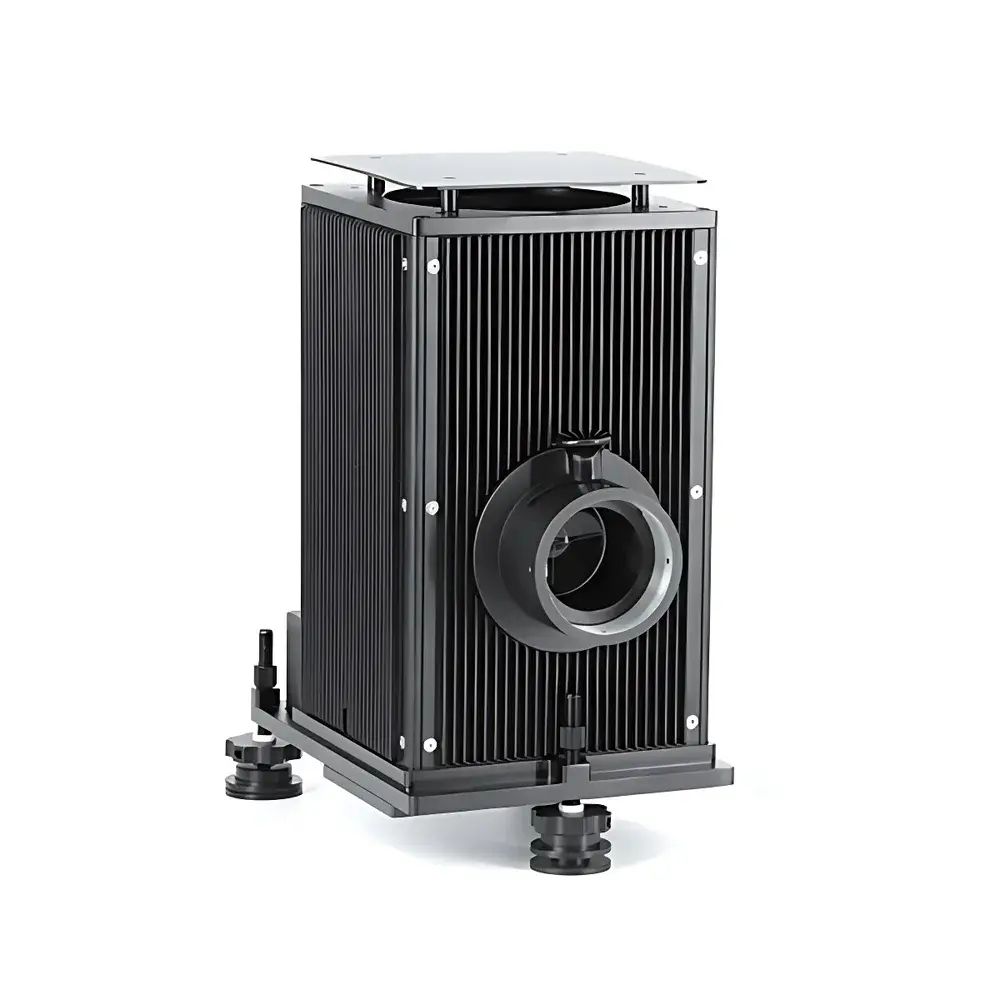
- Collimated output beam with 46 mm diameter and adjustable optical axis height (157–193 mm), facilitating seamless integration with commercial photoreactors, fiber-coupled spectrometers, and custom optical benches.
Sample Compatibility & Compliance
The LSXS-500 is compatible with standard cylindrical and flat-bottom quartz photoreactors (e.g., 10–100 mL volume), immersion well-type reactors, and flow-through photocatalytic cells. Its UV-rich spectrum enables direct excitation of TiO₂, g-C₃N₄, MOFs, and other wide-bandgap semiconductors without supplemental filtering. The system conforms to IEC 62471:2006 (Photobiological Safety of Lamps and Lamp Systems) as Risk Group 3 for UV hazard—mandating use of ANSI Z87.1+ UV-blocking safety goggles and opaque shielding during operation. All electrical components comply with IEC 61010-1:2010 for laboratory equipment safety. While not certified for GMP manufacturing environments, its design supports GLP-compliant documentation workflows—including audit-trail-capable power logging via optional RS-485 interface—and aligns with ASTM E2078-21 (Standard Practice for Solar Simulation for Photocatalytic Activity Testing) for spectral match and irradiance uniformity requirements.
Software & Data Management
The LSXS-500 operates as a standalone hardware platform but interfaces seamlessly with third-party control systems via analog voltage (0–5 V) intensity modulation input and digital TTL-triggered ignition. Optional ZOLIX LSP-X500A power supply units include USB/RS-485 ports for remote monitoring of lamp voltage, current, operating hours, and thermal sensor readings. Data can be logged into CSV-compatible formats using ZOLIX’s free LabControl Suite (v3.2+), which supports time-stamped irradiance stability tracking, scheduled on/off cycling, and event-based alerts (e.g., overtemperature, ignition failure). No proprietary cloud services or mandatory firmware updates are required—ensuring full data sovereignty and long-term reproducibility in regulated academic or contract research settings.
Applications
- Quantitative photocatalytic degradation assays (e.g., methylene blue, phenol, rhodamine B) under simulated solar irradiation.
- Photoelectrochemical cell (PEC) performance evaluation including incident photon-to-current efficiency (IPCE) mapping.
- Accelerated UV aging tests per ISO 4892-2 (Plastics—Methods of exposure to laboratory light sources) and ASTM G154 (Standard Practice for Operating Fluorescent Ultraviolet (UV) Lamp Apparatus).
- In situ DRIFTS and Raman spectroscopy of surface adsorbates during illumination.
- Calibration of broadband radiometers and spectroradiometers traceable to NIST SRM standards.
FAQ
What lamp types are supported beyond 500 W xenon?
The LSXS-500 chamber accommodates 350 W and 500 W xenon lamps (e.g., LSB-X500AOF150), as well as mercury-xenon (e.g., LSB-GX500) and pure mercury short-arc lamps—provided matching constant-current power supplies and appropriate lamp holders are used.
Is the output beam truly collimated?
The system delivers a quasi-collimated beam with divergence <±1.5° over the central 46 mm diameter, verified by beam profiler measurements at 1 m working distance. For applications requiring diffraction-limited collimation, users should integrate an external achromatic collimator lens pair.
Can this source be integrated into an automated reaction station?
Yes—via TTL triggering for ignition control and 0–5 V analog input for continuous intensity modulation. Full integration schematics and communication protocols are provided in the ZOLIX Hardware Integration Manual (Rev. D, 2023).
Does the system meet FDA 21 CFR Part 11 requirements?
While the base unit does not include electronic signature or audit trail functionality, the optional LSP-X500A power supply with RS-485 + LabControl Suite supports configurable user access levels, timestamped operational logs, and exportable raw data files—enabling compliance-ready validation when deployed within a validated laboratory information management system (LIMS).
What maintenance intervals are recommended?
Inspect quartz window cleanliness and reflector alignment every 200 operating hours; replace air filters quarterly under continuous operation; perform full thermal calibration annually using supplied reference thermocouples and NIST-traceable IR thermometer.



