
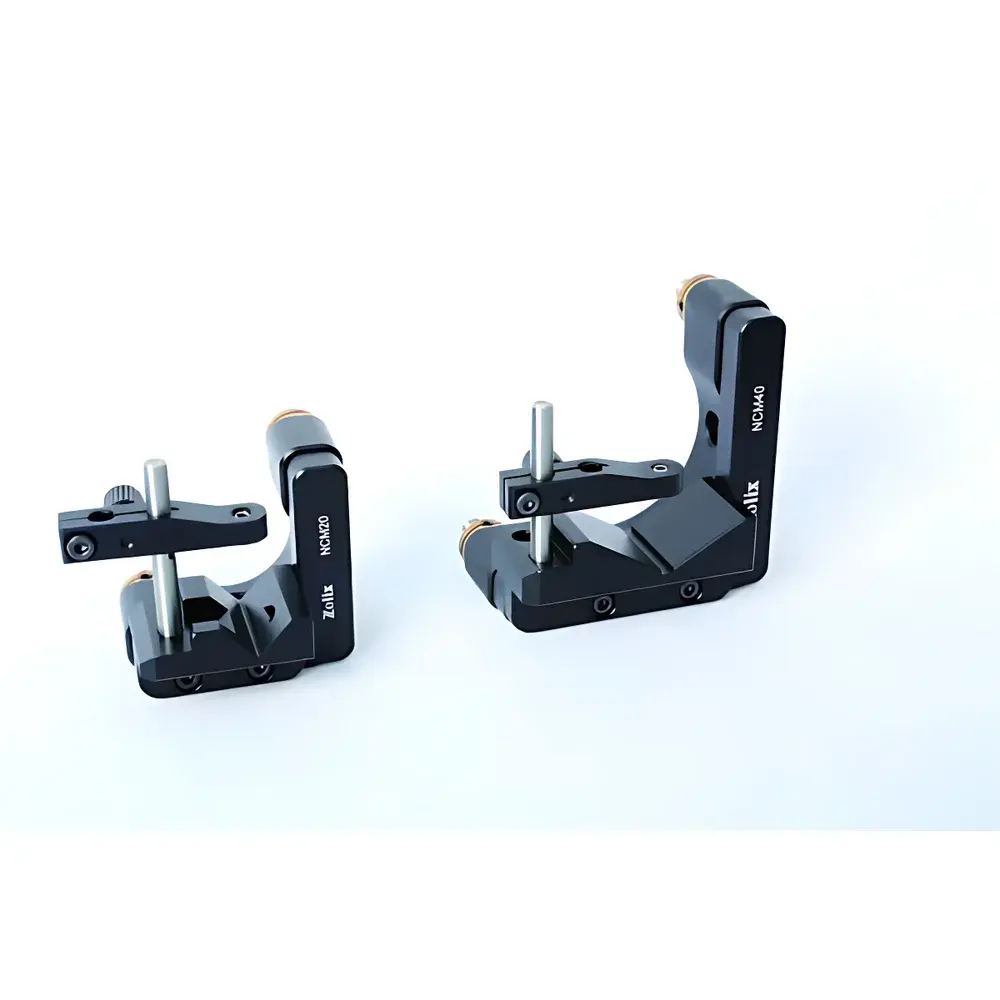
ZOLIX NCM Series 3-Axis Adjustable V-Mount
| Brand | ZOLIX |
|---|---|
| Origin | Beijing, China |
| Manufacturer Type | Direct Manufacturer |
| Product Category | Domestic |
| Model | NCM Series |
| Price Range | USD 700 – 1,400 (FOB) |
| Adjustment Range | ±3° |
| Max Clamping Diameter | 20 mm (NCM20), 40 mm (NCM40) |
| Min Clamping Diameter | 6 mm (NCM20), 10 mm (NCM40) |
| V-Groove Width | 15 mm (NCM20), 38 mm (NCM40) |
| Overall Height | 57.5 mm (NCM20), 79 mm (NCM40) |
| Overall Width | 61.5 mm (NCM20), 71.5 mm (NCM40) |
| Mounting Holes | M6 counterbored φ8 (bottom), M4 (top) |
Overview
The ZOLIX NCM Series 3-Axis Adjustable V-Mount is an engineered optical mounting solution designed for precise angular alignment and stable mechanical retention of cylindrical optical components in laboratory and industrial optical systems. Based on the Couette-type kinematic principle—where three orthogonal micrometer-driven adjustments enable independent control over pitch, yaw, and vertical translation—the NCM mount provides deterministic, repeatable positioning without inducing parasitic motion or stress-induced birefringence in sensitive elements. Its core function is to secure laser diodes, fiber collimators, cylindrical lenses, and other rotationally symmetric optics while maintaining sub-arcminute angular stability under thermal cycling and mechanical vibration. The mount’s structural topology eliminates flexure-based drift by distributing clamping forces uniformly across four preloaded tension springs, making it suitable for applications requiring long-term alignment integrity in interferometric setups, free-space coupling systems, and OEM laser packaging lines.
Key Features
- High-resolution angular adjustment: Dual-axis tilt (pitch/yaw) and vertical lift controlled via three independently actuated 0.2 mm pitch precision screws—enabling <15 arcsecond incremental resolution per full turn.
- Uniform force distribution architecture: Four symmetrically arranged stainless steel tension springs ensure balanced preload across the V-groove interface, minimizing localized deformation and improving repeatability after repeated clamping cycles.
- Dual-mounting flexibility: Standardized M6 counterbored holes (φ8) on the base plate allow rigid integration onto optical tables or breadboards; optional M4 threaded holes on the top surface support stacking or auxiliary bracket attachment.
- Optimized V-groove geometry: Precision-machined grooves with 90° included angle and hardened tool-steel contact surfaces provide consistent centering for cylindrical diameters ranging from 6–40 mm, accommodating both standard SM1-threaded collimators and custom-diameter laser housings.
- Tool-agnostic adjustability: Each axis features a rear-mounted hex socket (2 mm) compatible with either the included ergonomic knurled handwheel or standard 2 mm Allen wrenches—enabling fine-tuning even in space-constrained optical enclosures.
Sample Compatibility & Compliance
The NCM series accommodates a broad range of cylindrical optomechanical components, including but not limited to TO-can laser diodes (5.6 mm, 9 mm packages), FC/PC and SMA fiber collimators (Ø12.7 mm, Ø25.4 mm), plano-convex cylindrical lenses (f = 25–200 mm), and vacuum-compatible laser modules with outer diameters between 6 mm and 40 mm. All aluminum alloy bodies undergo black anodization (Type II, ASTM B580) for enhanced corrosion resistance and reduced stray light reflection. Surface finish meets ISO 10110-7 specifications for optical mounting hardware. No RoHS exemptions apply; lead-free solder and halogen-free plastics are used throughout. Compliant with CE marking requirements for mechanical equipment (2006/42/EC) and conforms to ISO 9001:2015 manufacturing controls.
Software & Data Management
As a purely mechanical adjustment platform, the NCM series does not incorporate embedded electronics or digital interfaces. However, its dimensional repeatability (< ±5 µrad angular deviation over 1000 adjustment cycles) enables seamless integration into automated alignment workflows when paired with external position-sensing systems such as quadrant photodiodes, beam profilers, or vision-based metrology tools. Alignment logs—including screw position counts, torque values (recommended max: 0.3 N·m), and environmental conditions—can be recorded manually or imported into LabVIEW, Python (via PyVISA), or MATLAB environments using third-party motorized actuator adapters (e.g., Thorlabs K10CR1 + NCM adapter plate). Full traceability is supported for GLP/GMP-aligned labs through standardized calibration templates aligned with ISO/IEC 17025 documentation practices.
Applications
- Free-space fiber-to-laser coupling optimization in quantum optics testbeds
- Active alignment of VCSEL arrays during wafer-level packaging
- Stabilized mounting of cylindrical waveplates in polarization control assemblies
- Thermal drift compensation in high-power DPSS laser cavities
- Alignment fixture for ISO 11146-compliant beam propagation analysis (M² measurement)
- OEM integration into compact spectrometer and OCT probe designs
FAQ
What materials are used in the V-groove contact surfaces?
The V-groove inserts are fabricated from hardened 440C stainless steel (HRC 58–60) with a ground surface finish ≤0.2 µm Ra, ensuring minimal galling during repeated clamping.
Is the NCM mount compatible with vacuum environments?
Yes—standard aluminum alloy construction (6061-T6) and absence of adhesives or elastomers permit operation at pressures down to 1×10⁻⁵ Torr; optional vacuum-compatible lubricants available upon request.
Can I replace the spring set for higher clamping force?
No—spring constants are calibrated per model to maintain optimal force balance; unauthorized replacement voids mechanical warranty and risks groove misalignment.
Do you provide mounting templates or CAD models?
Yes—STEP and IGES files for all NCM variants, along with DIN 476-compliant mounting hole layout diagrams, are available for download from the ZOLIX Technical Resource Portal.
What is the maximum recommended torque for adjustment screws?
0.3 N·m maximum—exceeding this threshold may deform the brass nut insert and degrade angular resolution.




