
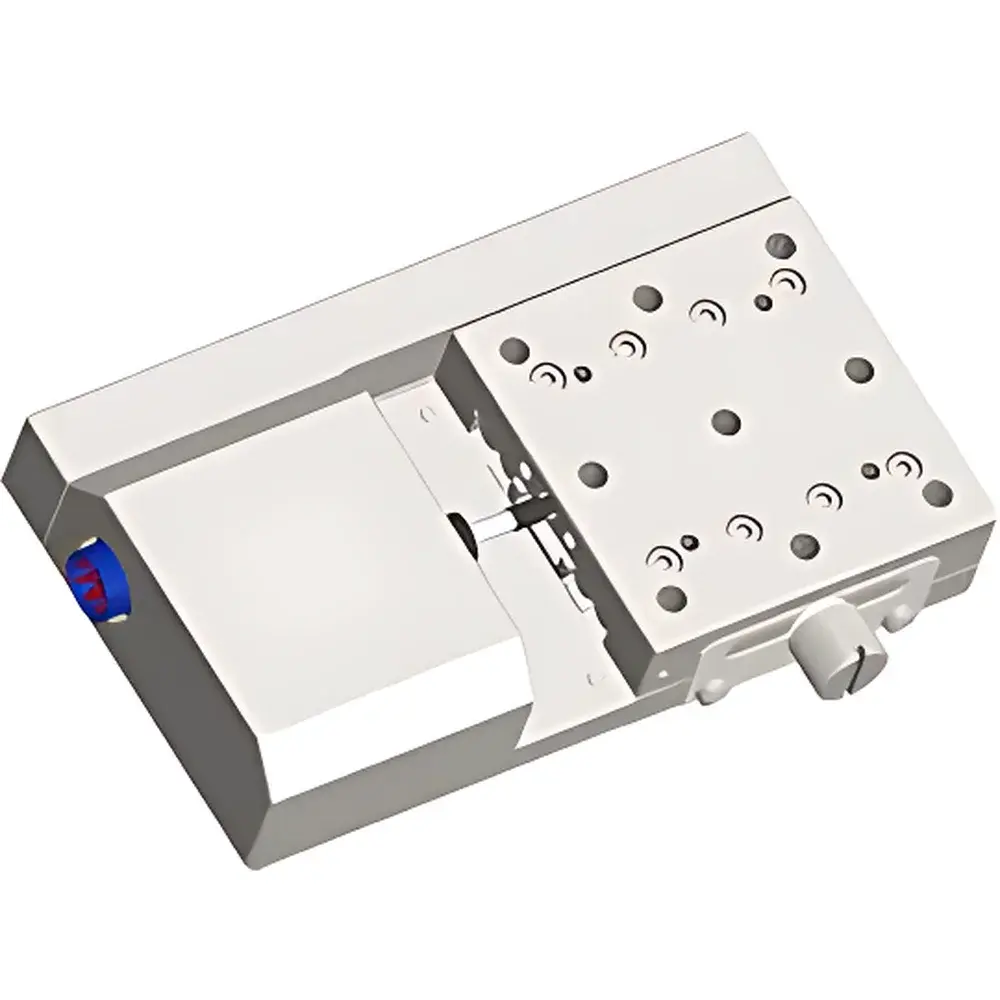
ZOLIX NFPA-x461/x462 Series Ultra-High-Precision Motorized Translation Stages
| Brand | ZOLIX |
|---|---|
| Origin | Beijing, China |
| Manufacturer Type | OEM Manufacturer |
| Product Origin | Domestic (China) |
| Model | NFPA-x461/x462 Series |
| Pricing | Upon Request |
| Actuation | Linear Stepper Motor (Lead-Screw Type) |
| Theoretical Resolution | 0.01 µm (32x Microstepping) |
| Verified Resolution | < 0.1 µm (Laser Interferometer Calibration) |
| Travel Range | 10 mm or 25 mm |
| Stage Surface Dimensions | 40×40 mm or 65×65 mm |
| Guideway | Imported Ultra-Precision Crossed-Roller Bearings |
| Straightness | < 3 µm |
| Load Capacity | Up to 7 kg (Horizontal), 2.5 kg (Vertical) |
| Limit Switches | Dual Photoelectric Endstops (Front & Rear) |
| Mounting Configurations | Horizontal (–C), Vertical (–CZ), Dual-Axis (–CC), Tri-Axis (–CCZ) |
Overview
The ZOLIX NFPA-x461/x462 Series Ultra-High-Precision Motorized Translation Stages are engineered for demanding optical alignment, interferometry, nanophotonics, and quantum optics applications where sub-micron positional repeatability and minimal Abbe error are critical. Built upon the proven mechanical foundation of the manual NFP-x461/x462 ultra-precision stages, the NFPA series replaces traditional micrometer drives with custom-integrated linear stepper actuators—specifically lead-screw-based DC stepper motors—enabling deterministic, closed-loop-capable open-loop motion control. Unlike generic motorized stages relying on rotary motor + timing belt or ball screw transmission, this architecture eliminates backlash and reduces hysteresis by directly coupling rotational-to-linear conversion within the actuator body. The result is a stage platform optimized for high-resolution incremental positioning (theoretically 0.01 µm at 32-step microstepping), with verified performance of < 0.1 µm minimum resolvable displacement under ISO 230-2 compliant laser interferometric validation. All models feature imported ultra-precision crossed-roller bearings delivering straightness better than ±3 µm over full travel—critical for maintaining collimation in multi-axis beam steering systems.
Key Features
- Ultra-low-error motion platform derived from ZOLIX’s NFP manual stage lineage—retaining precision ground surfaces, kinematic mounting interfaces, and thermal stability design.
- Integrated linear stepper actuator (lead-screw type) enabling direct-drive linear motion without gear reduction or belt compliance—ensuring high positional fidelity and low settling time.
- Dual photoelectric endstops (front and rear) provide hardware-level travel limit protection, essential for safeguarding sensitive optical components during automated sequencing.
- Modular configuration options: single-axis (–C horizontal / –CZ vertical), dual-axis (–CC), and tri-axis (–CCZ) assemblies—each preserving individual axis orthogonality and load-bearing integrity.
- Two standard travel variants: 10 mm (NFPA-x461) and 25 mm (NFPA-x462), both supporting identical resolution and straightness specifications.
- Stage top plates available in two sizes: 40×40 mm (x461 series) and 65×65 mm (x462 series), featuring standardized M4 and M6 tapped holes for universal optical component mounting.
- Central drive architecture minimizes moment arm effects; vertical configurations (–CZ) utilize counterbalanced shaft alignment to maintain rated load capacity under gravity loading.
Sample Compatibility & Compliance
The NFPA series is designed for integration into cleanroom-compatible optical tables, vacuum-compatible enclosures (with optional non-outgassing lubricants), and ISO Class 5+ laboratory environments. While not inherently rated for UHV, all structural components—including base plates, bearing housings, and motor casings—are machined from stress-relieved 6061-T6 aluminum alloy and anodized to MIL-A-8625 Type II specifications. The crossed-roller guideways are sourced from Tier-1 Japanese manufacturers meeting JIS B 1546 precision grade standards. All electrical interfaces comply with IEC 61000-6-3 (EMI emission) and IEC 61000-6-2 (immunity) requirements. For regulated environments, the stages support traceable calibration documentation per ISO/IEC 17025 when paired with external interferometric verification equipment. No proprietary firmware or embedded OS is present—ensuring compatibility with third-party motion controllers adhering to RS-485, USB CDC, or step/direction TTL protocols.
Software & Data Management
ZOLIX provides native ASCII command protocol documentation (ASCII-based SCPI-like syntax) for seamless integration with LabVIEW, MATLAB, Python (via PySerial), and EPICS-based control systems. No vendor-locked GUI is required; users retain full control over trajectory planning, acceleration profiling, and homing routines. Each stage supports non-volatile memory storage of user-defined zero-offset positions and soft-limit boundaries. While the motor driver operates in open-loop mode by default, the stage’s mechanical design enables straightforward retrofitted integration with external position feedback (e.g., capacitive sensors or encoder strips) for closed-loop operation—fully compatible with common motion controller architectures including Galil, Aerotech, and Newport ESP302. Audit trails, parameter versioning, and configuration export/import are managed externally via host software—aligning with GLP/GMP-aligned lab informatics workflows requiring 21 CFR Part 11-compliant electronic records.
Applications
- Precision alignment of fiber optic couplers, photonic integrated circuits (PICs), and free-space-to-fiber interfaces.
- Sub-pixel scanning in confocal microscopy, structured illumination, and optical coherence tomography (OCT) reference arms.
- Active stabilization platforms for cavity ring-down spectroscopy (CRDS) and Pound–Drever–Hall (PDH) laser locking loops.
- Multi-axis nanopositioning in atomic force microscopy (AFM) sample scanners and near-field scanning optical microscopy (NSOM).
- Automated filter wheel and grating turret positioning in Raman and fluorescence spectrometers requiring repeatable angular indexing.
- Beam steering and wavefront correction in adaptive optics testbeds using segmented mirror mounts or liquid crystal spatial light modulators (SLMs).
FAQ
What is the difference between theoretical and verified resolution? Why is 0.1 µm cited instead of 0.01 µm?
Theoretical resolution assumes ideal microstepping and zero mechanical compliance. Verified resolution reflects real-world performance measured via calibrated laser interferometry per ISO 230-2 Annex B—accounting for thermal drift, bearing preload variation, and encoder quantization noise.
Can these stages operate in vacuum or inert gas environments?
Standard units are rated for ambient air use. Vacuum-compatible versions are available with dry-film lubricants, stainless steel fasteners, and outgassing-tested adhesives—contact engineering support for custom qualification to ASTM E595 specifications.
Do the –CZ (vertical) models require active braking or holding torque during power-off?
No. Mechanical self-locking is inherent to the lead-screw pitch geometry; static load retention meets ISO 10100 requirements without auxiliary brakes. Dynamic load limits apply only during motion.
Is encoder feedback integrated, or must it be added externally?
No built-in encoder. The design prioritizes mechanical simplicity and thermal stability. High-accuracy closed-loop operation requires external position sensing—fully supported via standard analog/digital interface headers.
How does the NFPA series compare to piezoelectric or voice-coil alternatives?
Piezo stages offer higher bandwidth but limited stroke (< 100 µm) and hysteresis-dependent accuracy. Voice-coil stages lack intrinsic holding force. The NFPA series delivers deterministic 10–25 mm travel with metrology-grade linearity—complementing rather than replacing short-stroke technologies.





