
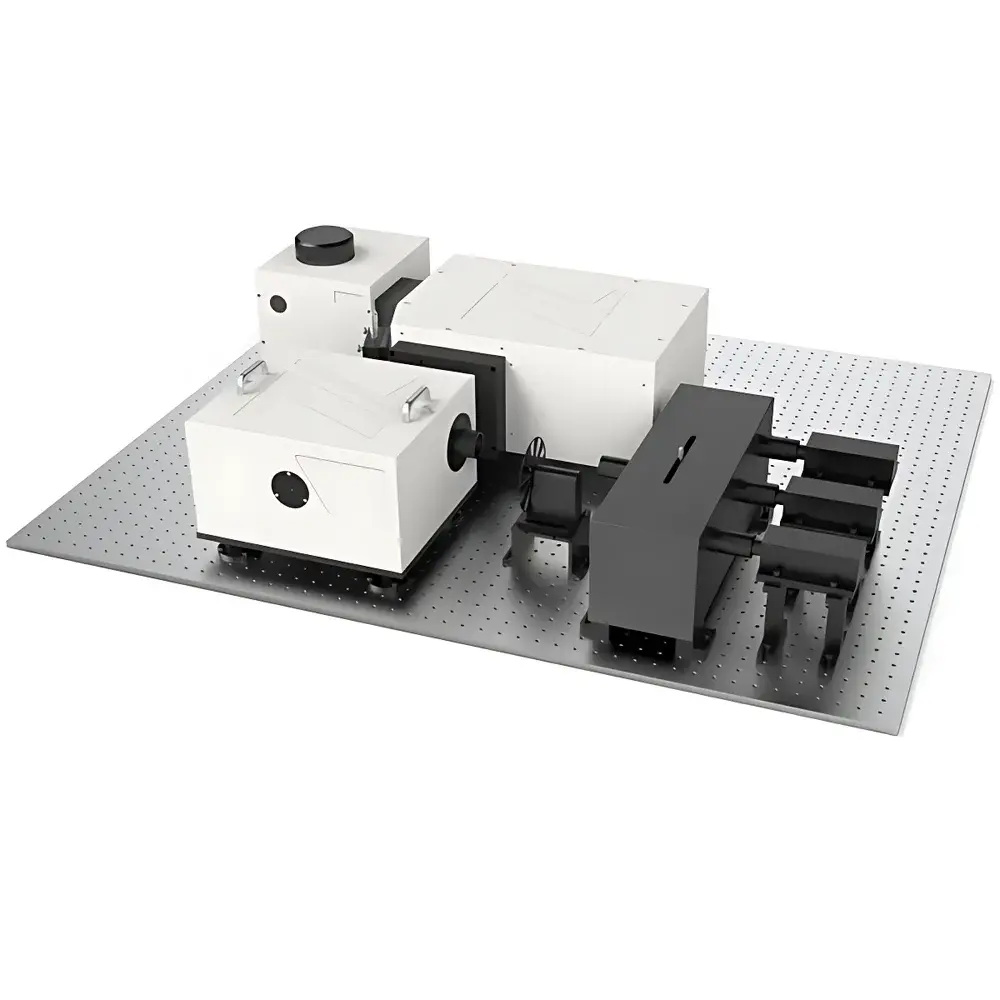
ZOLIX NIR-MIR Fluorescence Spectroscopy System
| Brand | ZOLIX |
|---|---|
| Origin | Beijing, China |
| Manufacturer Type | Direct Manufacturer |
| Instrument Type | Steady-State & Time-Resolved Fluorescence Spectrometer |
| Excitation Sources | 808 nm, 980 nm, 1064 nm, 1550 nm, 1940 nm CW lasers |
| Detection Range | 1–5.5 μm (InSb), 2–12 μm (MCT), 800–2600 nm (TE-InGaAs), 300–1700 nm (LN-PMT) |
| Spectral Resolution | ≤0.1 nm (with 320 mm Czerny-Turner monochromator & 68 mm × 68 mm gratings) |
| Fluorescence Lifetime Range | μs to seconds (with TCSPC or oscilloscope synchronization) |
| Optical Platform | Damped vibration-isolation table (1800 × 1200 × 800 mm) |
Overview
The ZOLIX NIR-MIR Fluorescence Spectroscopy System is a high-sensitivity, dual-mode optical characterization platform engineered for quantitative steady-state and time-resolved fluorescence measurements across the near-infrared (NIR) to mid-infrared (MIR) spectral region — spanning 700 nm to 8 µm. Unlike conventional visible or UV-Vis fluorimeters, this system addresses the unique challenges of low-photon-energy emission in the NIR-MIR regime, where thermal noise, detector dark current, and atmospheric absorption (e.g., H₂O, CO₂ bands) significantly impact signal fidelity. It employs a modular architecture integrating quantum-limited detection (liquid-nitrogen-cooled InSb and MCT detectors), high-throughput Czerny-Turner spectrography (f = 320 mm, stray light < 1×10⁻⁵), and synchronized excitation sources — enabling rigorous photophysical analysis of rare-earth-doped glasses, chalcogenide crystals, quantum dots, and transition-metal-activated phosphors. The system adheres to fundamental principles of molecular luminescence: excitation-induced electronic transitions followed by radiative relaxation, with spectral position, bandwidth, quantum yield, and lifetime directly correlating to local crystal field symmetry, phonon coupling, and non-radiative decay pathways.
Key Features
- Multi-source excitation flexibility: Integrated 808 nm, 980 nm, and 1064 nm CW diode lasers; optional OPO (210–3450 nm, 20 Hz, ≤6 ns pulse width, mJ-level energy); ns-pulsed solid-state lasers at 2940 nm and 532 nm.
- Dual-mode detection architecture: Configurable photon-counting PMTs (300–1700 nm, LN-cooled), TE-cooled InGaAs arrays (800–2600 nm), and cryogenic InSb (1–5.5 µm) or MCT (2–12 µm) detectors — each with calibrated responsivity, active cooling, and low-noise preamplification.
- Optimized optical path: Gold-coated reflective sample chamber with dual laser absorption traps, high-pass filter slots, and standardized holders for liquid, powder, and thin-film specimens.
- Precision temporal resolution: Time-Correlated Single Photon Counting (TCSPC) module (100 Mcps count rate, 16–1024 ps binning resolution, 65,535 channels); compatible with external oscilloscopes (500 MHz bandwidth, 2.5 GSa/s sampling) for µs–s scale decay kinetics.
- Modular grating spectrograph: Three interchangeable 68 mm × 68 mm ruled gratings mounted on motorized turret; Czerny-Turner design ensures high throughput and minimal aberration across extended IR ranges.
- Full-system synchronization: Programmable timing controller (6-channel, 100 ns–1 s delay range, 1 µs resolution) coordinates laser pulses, chopper modulation (20–3 kHz), detector gating, and data acquisition.
Sample Compatibility & Compliance
The system accommodates diverse solid-state and condensed-phase samples relevant to advanced photonics R&D: fluoride and chalcogenide glasses (e.g., Er³⁺:ZBLAN, Ho³⁺:Ge-Ga-S-CsI), laser ceramics (YAG, YLF), sulfide quantum dots (PbS), and Bi-doped crystalline hosts (Bi:CsI). Its optical design minimizes background contributions from ambient thermal radiation and stray excitation light — critical for measuring weak MIR emissions such as the 2.7 µm (⁴I₁₁/₂ → ⁴I₁₃/₂) transition in Er³⁺ systems or the 2.8–3.0 µm band in Ho³⁺-doped materials. All hardware and software modules comply with ISO/IEC 17025 traceability requirements for calibration of spectral response and radiometric sensitivity. Data acquisition protocols support GLP-compliant audit trails, including timestamped metadata for excitation wavelength, detector bias, integration time, and environmental temperature — essential for regulatory submissions under FDA 21 CFR Part 11 when used in pharmaceutical or biomedical material qualification.
Software & Data Management
Omni-Win control software provides unified operation for both steady-state and transient modes via Windows-based GUI. Steady-state functions include excitation scan, emission scan, synchronous scan (Δλ = constant), and 3D contour mapping. Transient capabilities encompass kinetic decay profiling, lifetime mapping across spectral windows, and time-resolved emission spectra (TRES) reconstruction. Raw data are stored in HDF5 format with embedded instrument configuration metadata, ensuring long-term reproducibility and interoperability with MATLAB, Python (h5py), and OriginLab. Optional modules enable automated temperature-dependent scans using cryostat or furnace integration, with real-time feedback on sample thermal stability. All software components undergo version-controlled release cycles and support export to ASTM E1421-compliant spectral data exchange formats.
Applications
This system serves core research and development needs in infrared laser material science, including: quantification of 2.7 µm emission efficiency in Er³⁺-doped microcrystalline fluorozirconate glasses for medical and military laser applications; comparative lifetime analysis of Ho³⁺/Yb³⁺ co-doped fluorophosphate glasses targeting 2.85 µm lasing; spectral deconvolution of overlapping NIR-MIR bands in PbS quantum dot ensembles for bioimaging contrast agent optimization; and characterization of broadband supercontinuum generation in As₂S₃ fibers (2–6.5 µm) via calibrated output spectral measurement. Additional use cases span environmental gas sensing (via rovibrational fluorescence of trace species), astronomical detector calibration standards, and quality control of rare-earth-doped gain media in fiber amplifier manufacturing.
FAQ
What spectral range does “NIR-MIR” cover in this system?
The operational fluorescence detection range extends from 700 nm to 8 µm, with standard configurations covering 1–5.5 µm (InSb) and 2–12 µm (MCT); extended coverage requires optional detector swaps.
Can the system measure fluorescence lifetimes below 1 nanosecond?
Yes — with the TCSPC module and sub-ns pulsed excitation (e.g., 532 nm or 2940 nm lasers), lifetime resolution down to 16 ps is achievable.
Is vacuum or purged operation required for MIR measurements?
For measurements above 2.5 µm, N₂ purging of the optical path is recommended to suppress atmospheric H₂O absorption; full vacuum compatibility is available upon request.
How is spectral calibration performed across such a broad range?
Calibration uses NIST-traceable emission lines from Hg-Ne, Ar, and SiC sources, supplemented by internal reference diodes and motorized grating zero-order alignment routines.
Does the system support compliance with pharmaceutical analytical method validation guidelines?
Yes — the software supports IQ/OQ documentation templates, electronic signatures, and audit-trail-enabled data handling aligned with ICH Q2(R2) and USP guidelines.





