
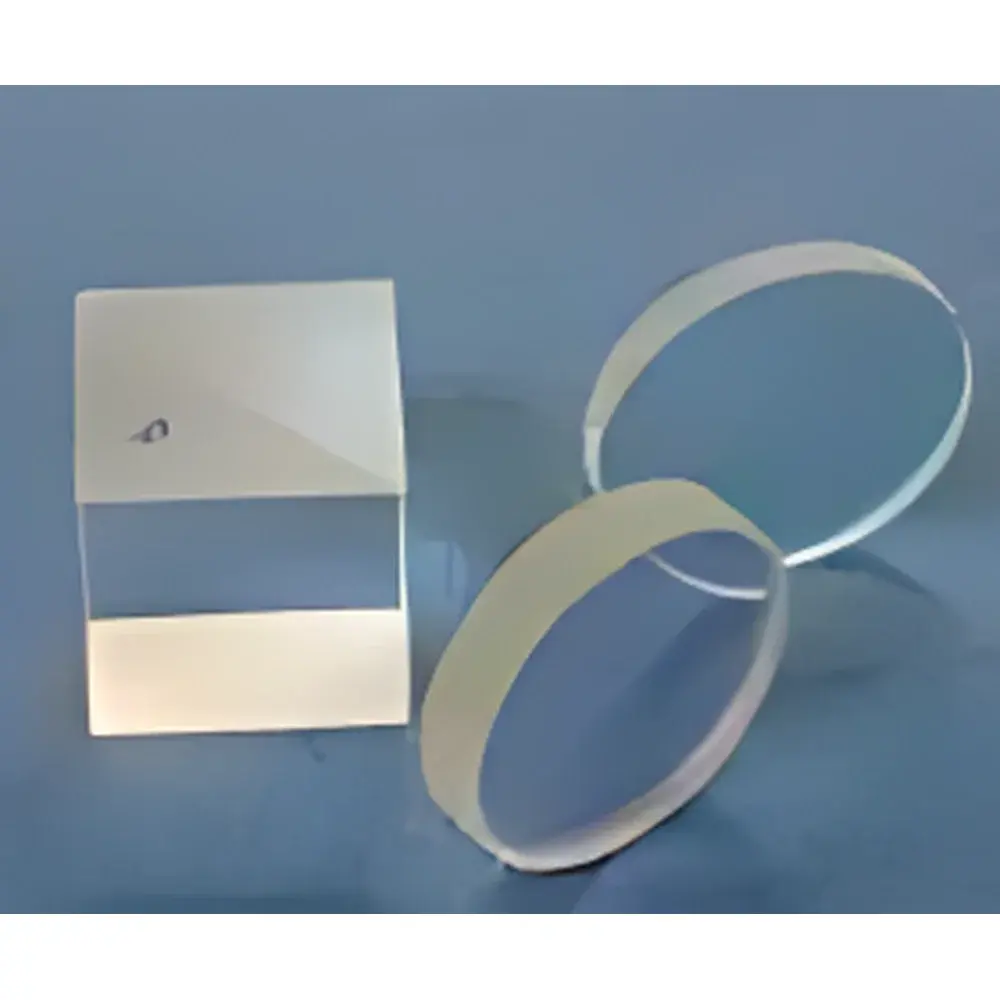
ZOLIX OBPL Series Plate Beamsplitters for Laser Wavelengths
| Brand | ZOLIX |
|---|---|
| Origin | Beijing, China |
| Manufacturer Type | OEM Manufacturer |
| Product Origin | Domestic (China) |
| Model | OBPL Series |
| Pricing | Upon Request |
Overview
ZOLIX OBPL Series Plate Beamsplitters are precision-engineered optical components designed for stable, high-fidelity beam division in laser-based optical systems. These flat, uncoated-substrate-compatible beamsplitters operate on the principle of thin-film interference, utilizing dielectric multilayer coatings optimized for specific laser wavelengths—ranging from 441 nm (blue-violet) to 1064 nm (near-infrared). Unlike pellicle or cube-type alternatives, the plate configuration minimizes wavefront distortion and eliminates cement-induced thermal instability or birefringence, making them ideal for interferometry, cavity dumping, pump-probe setups, and alignment-sensitive applications. Each OBPL unit is fabricated on high-grade fused silica or BK7 substrates with λ/4 surface flatness (per ISO 10110-3), ensuring minimal phase error across the active aperture. The coating architecture is rigorously tested for LIDT (Laser-Induced Damage Threshold) compliance per ISO 21254–1, supporting continuous-wave and pulsed laser operation under controlled environmental conditions.
Key Features
- Wavelength-specific dielectric coatings: Optimized for discrete laser lines including 441 nm, 488 nm, 514 nm, 532 nm, 632.8 nm, and 1064 nm
- Precisely controlled reflectance/transmittance ratios: Standard R/T = 50/50; custom variants available at R = 20–90% in 10% increments
- Substrate options: Fused silica (for UV–NIR broadband stability) or BK7 (cost-optimized NIR performance)
- λ/4 surface flatness (peak-to-valley) over full clear aperture, verified via phase-shifting interferometry
- Anti-reflection (AR) coating applied to the rear surface to suppress ghost reflections and improve contrast ratio
- Edge-blackened or anodized metal mounting frames available upon request for stray-light suppression
- Compliant with RoHS 2011/65/EU and REACH (EC) No. 1907/2006 material declarations
Sample Compatibility & Compliance
The OBPL series supports integration into standard optomechanical platforms—including kinematic mounts, translation stages, and lens tubes—with nominal dimensions of 20 × 4 mm and 25 × 5 mm (rectangular) or Ø25.4 mm (circular). All units are qualified for use in Class 1 and Class 3B laser environments per IEC 60825-1:2014. Coating durability meets MIL-C-48497A specifications for abrasion resistance and humidity cycling (95% RH, 40 °C, 100 h). Substrate material certifications include ASTM F796 for fused silica homogeneity and ISO 10110-2 for refractive index uniformity. For regulated laboratories, traceable calibration reports (including spectral reflectance curves measured on PerkinElmer Lambda 1050+ spectrophotometer) are provided with each batch shipment.
Software & Data Management
While the OBPL beamsplitters themselves are passive optical elements, ZOLIX provides downloadable spectral performance datasets (CSV and SDF format) for integration into optical design software such as Zemax OpticStudio, CODE V, and FRED. Each model’s angular dependence (R/T vs. AOI from 0° to 45°) and polarization sensitivity (s/p splitting ratio deviation < ±1.2% across ±5° incidence variation) are included. Raw measurement logs adhere to ASTM E2915–21 guidelines for spectral data reporting and are archived for ≥10 years to support GLP audit requirements. No embedded firmware or driver software is required—no power supply or communication interface is involved.
Applications
- Laser cavity output coupling and intracavity beam sampling
- Confocal and multiphoton microscopy illumination path splitting
- Optical coherence tomography (OCT) reference arm routing
- Ultrafast laser pulse characterization (e.g., autocorrelator input splitting)
- Quantum optics experiments requiring high extinction ratio and low group delay dispersion
- Industrial laser processing monitoring (e.g., real-time power tap for closed-loop control)
- Educational optics labs demonstrating interference, polarization, and wavelength selectivity principles
FAQ
What is the maximum incident angle tolerance for specified R/T performance?
The nominal R/T values are specified at 45° angle of incidence (AOI) for p-polarized light. Performance remains within ±3% of nominal reflectance up to ±5° AOI deviation under collimated illumination.
Can OBPL beamsplitters be used with femtosecond pulses?
Yes—when specified with fused silica substrates and low-GDD (group delay dispersion) coatings, OBPL units are compatible with sub-100-fs pulses; GDD values are provided upon request per ISO 15368:2021 Annex B.
Is vacuum compatibility available?
Standard OBPL units are bake-out compatible to 80 °C in ≤10⁻⁵ mbar environments. Vacuum-grade variants with low-outgassing adhesives and substrate annealing certification are available under ZOLIX Part Number suffix “-VAC”.
Do you provide spectral reflectance measurement reports?
Yes—each production lot undergoes full-spectrum (200–2000 nm) reflectance verification using NIST-traceable instrumentation; reports include uncertainty budgets per GUM (JCGM 100:2008).
Are custom coating designs supported?
Yes—ZOLIX offers bespoke thin-film design services for non-standard wavelengths, asymmetric R/T ratios (e.g., R=75%/T=25%), or multi-band hybrid stacks; lead time is typically 6–8 weeks from design freeze.




