
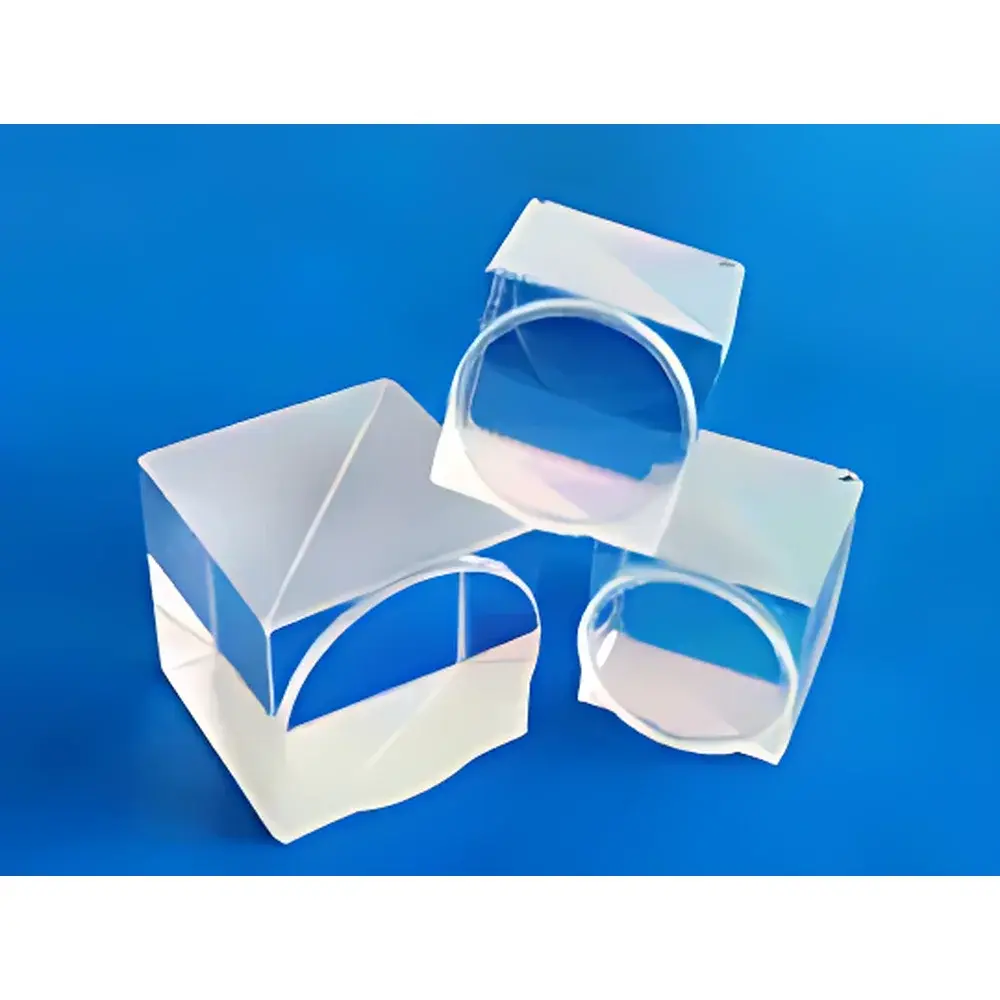
ZOLIX OIS Series Optical Isolator
| Brand | ZOLIX |
|---|---|
| Model | OIS |
| Type | Polarization-Based Faraday-Free Optical Isolator |
| Core Components | Polarizing Beam Splitter Cube + Zero-Order Quarter-Wave Plate (λ/4 @ 632.8 nm) |
| Waveplate Orientation | Fast Axis at 45° to Incident P-Polarization |
| Isolation Ratio | >20 dB |
| Transmission (P-Pol) | >95% |
| Extinction Ratio (S-Pol Leakage) | <1% |
| Reflectivity (S-Pol) | >99% |
| Material Substrates | K9 Glass & Fused Silica |
| Surface Flatness | λ/4 @ 632.8 nm |
| Surface Quality | 60–40 Scratch-Dig |
| Dimensional Tolerance | ±0.2 mm |
| AR Coating | Broadband Antireflection Coating on All Input/Output Faces (R < 0.25% per surface, 400–1100 nm) |
Overview
The ZOLIX OIS Series Optical Isolator is a passive, non-magnetic polarization-based isolator engineered for unidirectional optical transmission in free-space laser systems. Unlike Faraday-effect isolators requiring magnets and magneto-optic crystals, the OIS operates on pure polarization optics—leveraging the reciprocal phase shift behavior of zero-order quarter-wave plates combined with high-extinction polarizing beam splitter (PBS) cubes. When linearly polarized light (P-polarized) enters the device, it passes through the waveplate, converting to right-handed circular polarization. Upon reflection from an external surface (e.g., cavity mirror or fiber facet), the reversed circular polarization becomes left-handed. A second pass through the same waveplate converts it into orthogonally polarized S-light, which is then spatially rejected by the PBS cube. This deterministic polarization rotation pathway ensures robust backward isolation without magnetic field interference—critical for compact, vibration-sensitive, or magnetically constrained environments such as ultrafast amplifier seed paths, diode-pumped solid-state (DPSS) laser cavities, and quantum optics testbeds.
Key Features
- Non-magnetic architecture eliminates magnetic field crosstalk, enabling integration near electron microscopes, atomic clocks, or MRI-compatible optical setups
- Zero-order quartz and K9 glass waveplates minimize thermal birefringence drift and wavelength-dependent retardation error across 400–1100 nm
- PBS cube fabricated from precision-aligned, cemented BK7 substrates with >99.5% extinction ratio (Tp/Ts) at design wavelength
- AR-coated input/output faces reduce Fresnel losses and ghost reflections—coating optimized for low group delay dispersion (GDD < 5 fs²) in ultrafast applications
- Mechanically stable monolithic housing with kinematic mounting interface (M6 tapped holes, ±0.05° angular alignment tolerance)
- No active electronics or power supply required—fully compliant with Class 1 laser safety architecture
Sample Compatibility & Compliance
The OIS series supports collimated free-space beams with diameters up to 8 mm (1/e²), accommodating TEM00 and low-order multimode profiles typical of HeNe, DPSS, and single-emitter diode lasers. It is compatible with standard optomechanical rails (e.g., Thorlabs 30 mm cage system) and vacuum-compatible when ordered with stainless-steel housing variants. All optical surfaces meet ISO 10110-7 scratch-dig specifications (60–40), and surface flatness adheres to ISO 10110-5 (λ/4 @ 632.8 nm). The device satisfies requirements for GLP-compliant optical alignment validation workflows and is routinely deployed in ISO/IEC 17025-accredited metrology labs for laser power stability testing. No RoHS exemptions apply; Pb-free solder and halogen-free epoxies are used in assembly.
Software & Data Management
As a purely passive component, the OIS requires no firmware, drivers, or software integration. However, its performance parameters—including measured isolation ratio, insertion loss, and polarization extinction—are traceably documented in factory calibration reports (NIST-traceable reference standards used). Each unit ships with a unique serial-numbered certificate listing spectral transmittance (400–1100 nm, ±0.5 nm resolution), angular acceptance (±1.2° full width at half maximum), and long-term polarization stability (<0.05° drift over 1,000 hours at 25°C). These datasets are structured in CSV and PDF formats for import into LIMS or LabWare systems supporting ISO/IEC 17025 audit trails.
Applications
- Protection of semiconductor laser diodes from back-reflected light in spectroscopic absorption cells and fiber-coupled sensor heads
- Stabilization of external cavity diode lasers (ECDLs) by suppressing feedback-induced mode hopping
- Isolation between amplifier stages in regenerative Ti:sapphire and Yb-fiber laser systems
- Prevention of parasitic lasing in high-gain Nd:YAG and Nd:YVO4 oscillators
- Optical isolation in interferometric biosensors where magnetic immunity is mandatory near live-cell imaging platforms
- Integration into OEM laser modules requiring CE/UKCA marking under EN 60825-1:2014 for Class 1 enclosure compliance
FAQ
Does the OIS require alignment during installation?
Yes—optimal isolation (>20 dB) requires precise rotational alignment of the incident linear polarization to match the PBS cube’s P-axis. A manual half-wave plate or motorized rotator is recommended for initial setup.
Can the OIS be used with pulsed lasers?
Yes—provided pulse energy density remains below 0.5 J/cm² at 10 ns (10 Hz), and average power does not exceed 5 W to avoid thermal lensing in fused silica elements.
Is there a version optimized for 1550 nm telecom wavelengths?
Standard OIS units operate from 400–1100 nm. Custom variants with MgF₂-coated quartz waveplates and CaF2-based PBS cubes are available for 1200–1650 nm upon request.
What is the maximum beam divergence acceptable for rated isolation performance?
The device maintains >20 dB isolation for input beams with full-angle divergence ≤ 2.5 mrad (FWHM); beyond this, polarization purity degrades due to spatial walk-off in the waveplate.
How is isolation ratio verified during calibration?
Using a stabilized HeNe laser (632.8 nm), a calibrated photodiode, and a high-extinction Glan-Taylor polarizer, backward leakage is measured relative to forward transmission under identical beam geometry and detector linearity conditions.




