
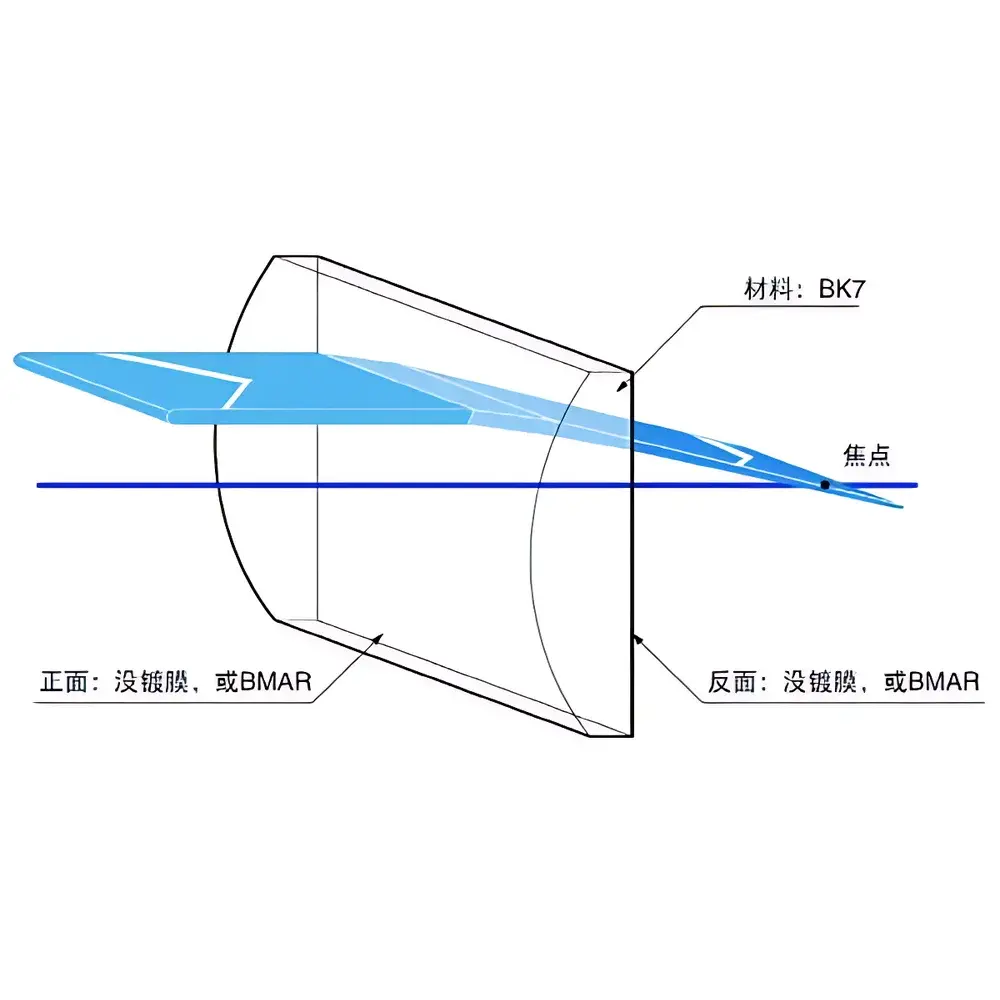
ZOLIX OLBC Series Plano-Convex Cylindrical Lenses
| Brand | ZOLIX |
|---|---|
| Material | K9 Optical Glass |
| Focal Length Tolerance (EFL) | ±2% |
| Dimensional Tolerance | +0.0 / −0.2 mm |
| Coating | Uncoated |
| Product Category | Optical Component |
| Origin | Beijing, China |
| Manufacturer | ZOLIX (OEM/ODM Capable) |
Overview
The ZOLIX OLBC Series Plano-Convex Cylindrical Lenses are precision optical components engineered for controlled one-dimensional focusing and beam shaping in laboratory and industrial optical systems. Based on the fundamental principle of cylindrical refraction—where curvature is applied along a single meridional axis while the orthogonal surface remains planar—these lenses introduce astigmatic focusing: collimated light incident normal to the plano surface converges to a line focus at the specified focal length, rather than a point. This behavior is governed by the lensmaker’s equation adapted for cylindrical geometry and is critical in applications requiring anamorphic beam expansion, laser line generation, optical scanning, and illumination homogenization. Constructed from high-homogeneity K9 borosilicate crown glass (Schott BK7 equivalent), the OLBC series exhibits excellent transmission across the visible spectrum (350–700 nm), low bubble and inclusion content per ISO 10110-3, and consistent thermal and mechanical stability under standard lab conditions. Each lens undergoes dimensional verification and focal length validation via interferometric and autocollimation methods traceable to NIM (National Institute of Metrology, China) standards.
Key Features
- Precision-ground plano-convex cylindrical geometry with axial symmetry along the cylinder axis, enabling deterministic line-focus formation
- K9 optical glass substrate meeting ISO 10110-2 surface quality specifications (scratch-dig ≤ 60-40) and refractive index uniformity Δn ≤ 5 × 10⁻⁶
- Focal length tolerance tightly controlled at ±2% of nominal EFL, verified using calibrated collimators and CCD-based focus position measurement
- Dimensional tolerances held to +0.0 / −0.2 mm on diameter and thickness, ensuring repeatable mounting in kinematic or threaded lens holders
- Uncoated surface finish optimized for minimal residual reflectivity (~4% per surface at 550 nm), suitable for broadband alignment and low-power visible applications
- Available in standardized diameters (e.g., Ø12.7 mm, Ø25.4 mm) and focal lengths ranging from 25 mm to 500 mm, with custom geometries supported under OEM agreement
Sample Compatibility & Compliance
The OLBC series is compatible with standard optomechanical infrastructure including SM-threaded lens mounts (SM1, SM2), cage systems (e.g., Thorlabs 30 mm and 60 mm), and kinematic mirror mounts with adjustable tilt. No adhesives or epoxy bonding is required for secure retention under vibration levels typical of Class 1000 cleanrooms or university teaching labs. All units comply with RoHS Directive 2011/65/EU for hazardous substance restrictions and meet ISO 9012-1:2021 requirements for labeling and packaging of optical components. While not certified to IEC 61000-4 electromagnetic compatibility standards (as passive components), dimensional and material conformity is documented in factory inspection reports available upon request. Traceability to Chinese national metrological standards is maintained for all production batches.
Software & Data Management
As passive optical elements, OLBC lenses do not incorporate embedded electronics, firmware, or digital interfaces. Their performance parameters are fully characterized prior to shipment and delivered in machine-readable format (CSV and PDF) containing measured EFL, surface irregularity (λ/4 @ 633 nm), and centration error (< 3 arcmin). ZOLIX provides optional Zemax OpticStudio-compatible .ZMX files for each standard model, including full surface sag data and bulk dispersion coefficients (Sellmeier coefficients for K9). These files support rigorous system-level modeling of astigmatism, field curvature, and chromatic effects in multi-element assemblies. For GMP or GLP-regulated environments, batch-specific certificates of conformance—including lot number, date of calibration, and operator ID—are issued and archived for ≥10 years.
Applications
- Laser diode collimation and fast-axis correction in fiber coupling setups
- Generation of uniform line illumination for structured light profilometry and machine vision inspection
- Anamorphic beam expansion in ultrafast Ti:sapphire amplifier chains
- Optical pumping configuration in atomic vapor cell experiments (e.g., Rb/D2 line excitation)
- Educational optics kits for demonstrating cylindrical aberration, astigmatism, and Fourier plane analysis
- Custom imaging systems requiring asymmetric magnification, such as slit-scan cameras and spectrograph entrance optics
FAQ
What is the damage threshold for OLBC lenses under continuous-wave laser irradiation?
ZOLIX does not specify a laser-induced damage threshold (LIDT) for uncoated K9 surfaces. For CW operation at 532 nm, conservative use limits are recommended at ≤ 0.5 W/cm² (unfocused, TEM₀₀); users must perform empirical testing under actual beam conditions.
Can these lenses be used in vacuum environments?
Yes—K9 glass exhibits negligible outgassing (per ASTM E595) and is compatible with medium vacuum (10⁻⁴ Pa) without coating degradation or stress birefringence induction.
Is centering error measured and reported for each lens?
Centering error is sampled per ANSI/OPI 1010-2018 at 10% of batch volume; full statistical process control (SPC) charts are available under NDA for qualified customers.
Do you offer anti-reflection coatings for specific wavelengths?
Custom MgF₂ or multilayer V-coatings (e.g., 405 nm, 635 nm, 1064 nm) are available with lead times of 4–6 weeks and minimum order quantities of 10 units.
Are ZOLIX OLBC lenses suitable for UV applications below 350 nm?
No—K9 exhibits increasing absorption below 350 nm; fused silica (SiO₂) alternatives are recommended for deep-UV use.




