
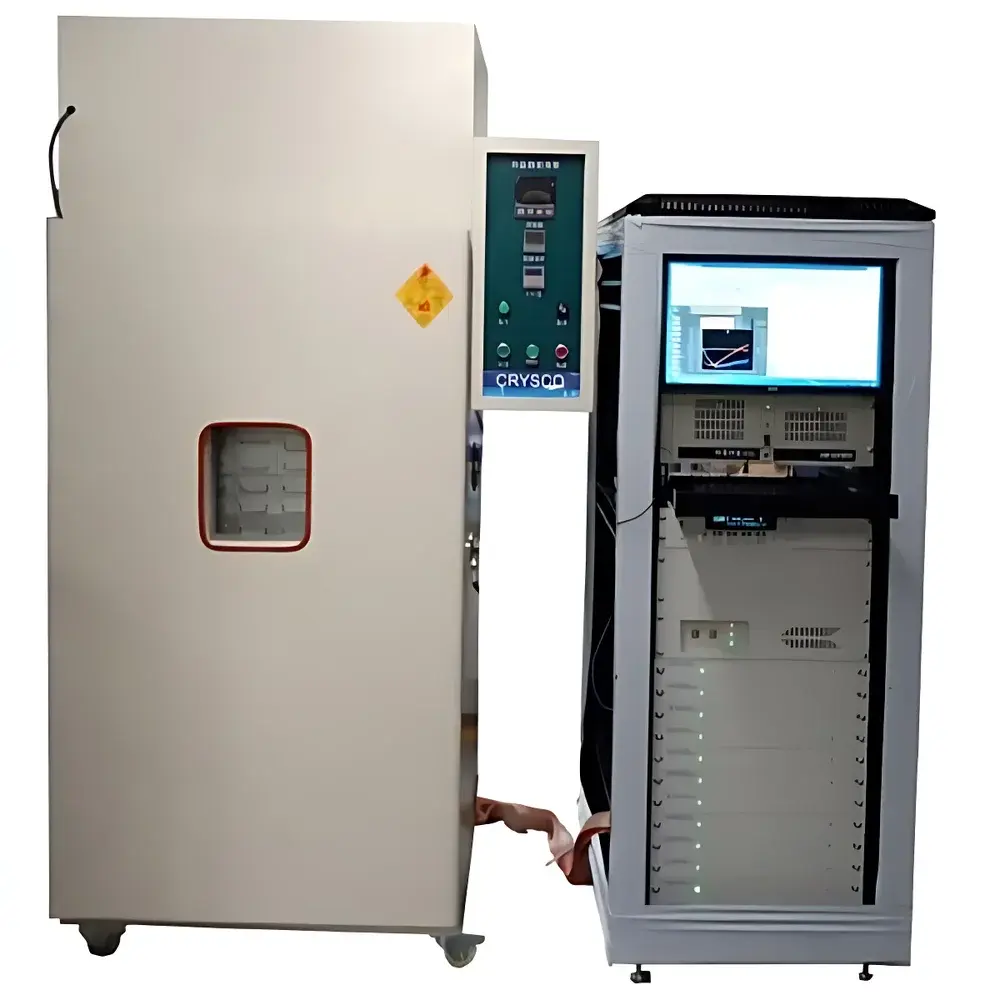
ZOLIX OLED Lifetime Aging Test System
| Brand | ZOLIX |
|---|---|
| Model | Lifetime Aging Test System |
| Type | Integrated Automated OLED Degradation Monitoring Platform |
| Origin | Beijing, China |
| Power Supply | 5 kW / 380 V AC |
| Temperature Range Options | −40 °C to 150 °C, −20 °C to 150 °C, or 0 °C to 150 °C |
| Heating Rate | 2–4 °C/min (nonlinear, no-load) |
| Cooling Rate | 0.7–1.0 °C/min (nonlinear, no-load) |
| Temp. Resolution | ±0.01 °C |
| Humidity Range | 20–98% RH (within 25–85 °C) |
| Humidity Resolution | ±0.1% RH |
| Temp. Uniformity | ±2.0 °C |
| Temp. Stability | ±0.5 °C |
| Humidity Stability | ±2.0% RH |
| Humidity Deviation | ±3% RH (at >75% RH) |
| Channel Configurations | Up to 128 independent current/voltage monitoring channels |
| Control Interface | Touchscreen HMI with programmable temperature/humidity profiles |
| Compliance | Designed for GLP-aligned operational traceability and ASTM D7602-22 (Standard Practice for Accelerated Aging of Organic Light-Emitting Diode Devices) support |
Overview
The ZOLIX OLED Lifetime Aging Test System is a purpose-engineered, fully integrated platform for accelerated degradation testing of organic light-emitting diode (OLED) test structures—including thin-film encapsulated devices, TEGs (test element groups), and JIG-mounted samples—under controlled thermal and hygrothermal stress conditions. The system operates on the fundamental principle of real-time electroluminescent (EL) and electrical parameter tracking: by applying constant-current or constant-voltage bias across multiple device channels while simultaneously recording time-resolved luminance decay (via calibrated silicon photodiodes), voltage drift, and leakage current evolution, it enables quantitative derivation of key lifetime metrics including LT50, LT70, and T90 under defined environmental stressors. Its architecture integrates industrial-grade power supplies, high-stability photodetection circuitry, synchronized data acquisition hardware, and embedded control logic—all coordinated through a ruggedized industrial PC running deterministic real-time software. Unlike generic environmental chambers paired with external measurement tools, this system embeds metrological traceability at the channel level, minimizing signal path variability and enabling statistically robust multi-sample cohort analysis required for R&D validation and reliability qualification.
Key Features
- Modular multi-channel architecture supporting up to 128 independent, galvanically isolated measurement channels—each equipped with precision current sourcing (±0.1% accuracy), voltage sensing (16-bit resolution), and synchronized photometric sampling.
- Integrated environmental chamber with programmable temperature-humidity profiles, featuring dual PID-controlled heating/cooling circuits and humidity generation via steam injection or ultrasonic misting—validated per IEC 60068-3-5 for thermal stability and IEC 60068-2-78 for humidity uniformity.
- Calibrated silicon photodiode detection subsystem with NIST-traceable responsivity characterization (350–1100 nm spectral range), coupled to low-noise transimpedance amplifiers and optical diffusers ensuring Lambertian angular response.
- Real-time data synchronization engine enforcing sub-millisecond timestamp alignment between electrical and photometric datasets across all active channels.
- Rugged industrial PC with SSD storage, extended temperature-rated components (−10 °C to 60 °C operating range), and watchdog-timed firmware recovery to ensure uninterrupted long-duration tests (up to 6,000+ hours).
- Touchscreen HMI interface supporting ISO/IEC 17025-compliant user access levels, audit trail logging, and configurable alarm thresholds for out-of-spec parameter deviation.
Sample Compatibility & Compliance
The system accommodates standard OLED substrate formats (up to 200 × 200 mm), including glass, flexible PI substrates, and encapsulated microcavity devices. It supports both DC and pulsed bias modes, enabling evaluation of burn-in behavior under realistic drive conditions. All hardware and software modules are designed to align with industry-relevant reliability standards: ASTM D7602-22 (accelerated aging methodology for OLEDs), IEC 62717 (LED module lifetime testing principles, adapted for OLED-specific failure modes), and JEDEC JESD22-A110 (highly accelerated temperature-humidity stress testing). Data integrity protocols satisfy FDA 21 CFR Part 11 requirements for electronic records and signatures—including immutable audit trails, user authentication, and electronic signature capture for test initiation and report finalization.
Software & Data Management
The proprietary ZOLIX AgingSuite™ software provides a unified environment for test definition, real-time visualization, automated pass/fail evaluation, and statistical lifetime modeling. It implements Weibull distribution fitting for failure time analysis, Arrhenius-based acceleration factor calculation (Ea extraction), and humidity acceleration modeling using the Peck equation. Raw datasets are stored in HDF5 format with embedded metadata (channel ID, calibration coefficients, environmental setpoints, operator ID, timestamp), ensuring FAIR (Findable, Accessible, Interoperable, Reusable) data principles. Export options include CSV, MATLAB .mat, and PDF reports compliant with ISO/IEC 17025 documentation requirements. Version-controlled software updates are delivered via secure HTTPS with SHA-256 hash verification.
Applications
- Accelerated lifetime qualification of new emitter materials and host-dopant systems under varied T/RH stress combinations.
- Encapsulation barrier performance assessment via humidity-induced dark spot growth kinetics and impedance spectroscopy correlation.
- Process window optimization for vacuum deposition, inkjet printing, and solution processing steps through parametric sensitivity mapping.
- Failure mode analysis (FMA) of cathode delamination, interfacial oxidation, and exciton-polaron quenching mechanisms using synchronized EL spectral shift tracking (when paired with optional fiber-coupled spectrometer add-on).
- Reliability benchmarking against competitive technologies (e.g., QLED, MicroLED) using standardized stress protocols per IDTechEx OLED Reliability Testing Guidelines v3.1.
FAQ
What is the maximum continuous test duration supported by the system?
The system is engineered for unattended operation over durations exceeding 6,000 hours (≈250 days), with redundant power supply monitoring, thermal runaway protection, and automatic log rotation to prevent storage overflow.
Can the system be integrated with third-party spectrometers or external environmental chambers?
Yes—via TTL-triggered synchronization signals and TCP/IP API endpoints. However, full environmental control and photometric calibration traceability are only guaranteed when using the native ZOLIX chamber and detector modules.
Is humidity control available across the entire temperature range?
Humidity conditioning is specified for 25 °C to 85 °C; outside this band, the chamber operates in dry heat or cryo mode without active humidification.
How is calibration maintained during long-term deployment?
Each photodiode channel includes onboard reference LED calibration sources, activated automatically every 24 hours or per user-defined interval, with drift compensation applied in real time to raw luminance values.
Does the software support automated report generation for regulatory submissions?
Yes—templates conform to ICH M4Q(R2) and ISO 10993-17 Annex B requirements, including uncertainty budgeting for lifetime extrapolation and full instrument calibration history embedding.
Related Products




