
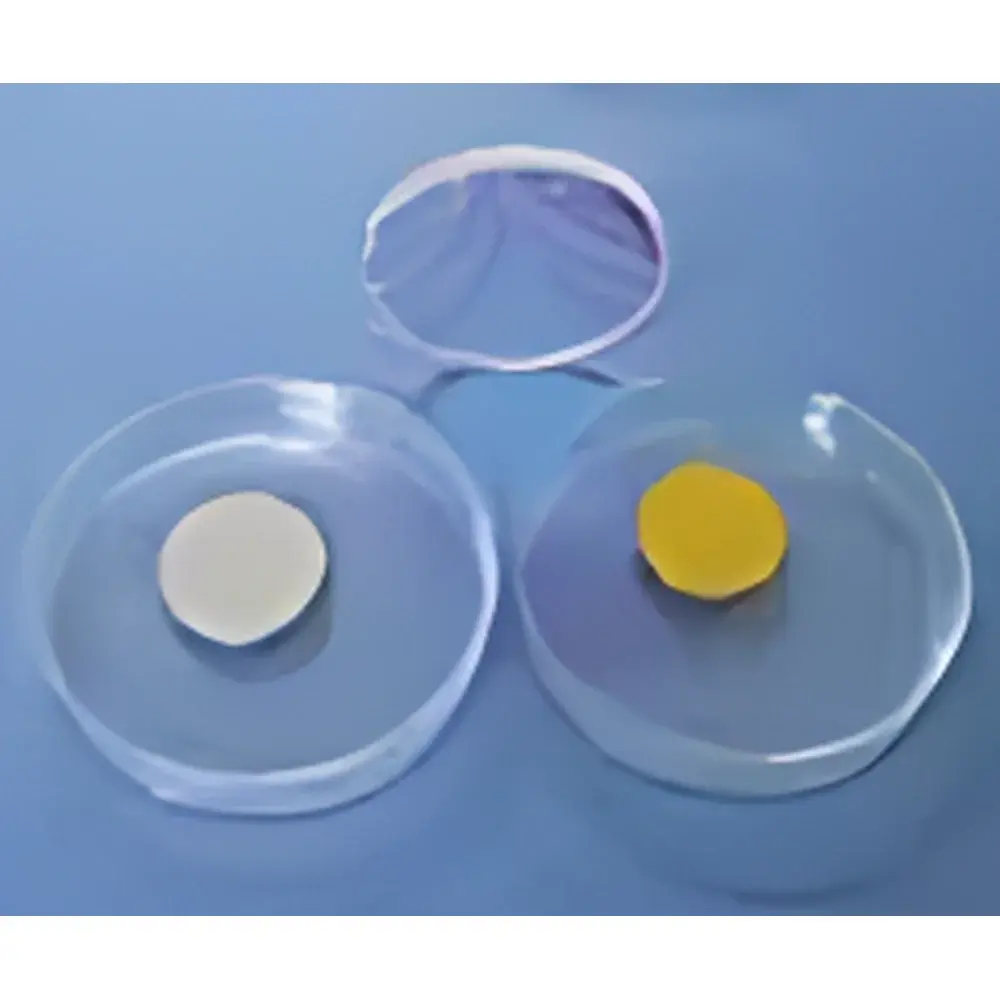
ZOLIX OMAL/OMAg/OMAu Series Metallic Coated Mirror Components
| Brand | ZOLIX |
|---|---|
| Origin | Beijing, China |
| Manufacturer | Yes |
| Type | Domestic Optical Component |
| Coating Options | Aluminum (Al), Protected Aluminum (Al+MgF₂), Enhanced Aluminum (EAV), UV-Enhanced Aluminum (PAUV), Silver (Ag), Protected Silver (PS), Gold (Au), Protected Gold (Au+SiO₂), Rhodium (Rh) |
| Surface Accuracy | λ/4 (standard), λ/10 (high-precision imported variants) |
| Substrate Material | Fused Silica or BK7 (standard), optional CaF₂ or IR-grade substrates |
| Diameter Range | 12.7 mm to 101.6 mm |
| Thickness Range | 4 mm to 12.7 mm |
Overview
The ZOLIX OMAL, OMAg, and OMAu series metallic coated mirror components are precision optical elements engineered for broadband reflectivity, high damage threshold compatibility (within non-laser-class limits), and stable performance across demanding laboratory and industrial optical setups. These mirrors utilize vacuum-deposited metallic thin films—aluminum, silver, or gold—on optically polished substrates (typically BK7 or fused silica), with optional dielectric overcoats (e.g., MgF₂ for Al, SiO₂ for Au) to enhance environmental durability and spectral response. Unlike dielectric mirrors optimized for narrowband applications, metallic mirrors provide inherently wide-angle, polarization-insensitive reflectance across ultraviolet (UV), visible (VIS), and near-to-far infrared (NIR–MIR–FIR) spectral regions. Their operation relies on the intrinsic free-electron plasma response of bulk metals, enabling consistent performance at arbitrary angles of incidence (AOI) from 0° to 45°, making them ideal for beam steering, cavity folding, interferometric reference arms, and broadband spectroscopic instrumentation.
Key Features
- Three primary coating families: Standard aluminum (Al), protected aluminum (Al + MgF₂), enhanced aluminum (EAV), UV-enhanced aluminum (PAUV), silver (Ag), protected silver (PS), gold (Au), protected gold (Au + SiO₂), and rhodium (Rh) for specialized UV/VUV applications.
- Surface flatness options: λ/4 (RMS) standard for general-purpose alignment and imaging; λ/10 (RMS) available on select imported variants (e.g., CVI Melles Griot EAV-PM, PS-PM, PAUV-PM series) for wavefront-critical interferometry and metrology.
- Substrate flexibility: Standard BK7 and fused silica; optional CaF₂ (for deep-UV transmission in mounting fixtures) or IR-transmissive materials (e.g., Ge, ZnSe) for custom OEM configurations.
- Robust mechanical architecture: Precision-ground and polished edges; laser-etched part identification; cleanroom-handled packaging compliant with ISO 10110-7 surface quality standards (scratch-dig 60–40 typical).
- Thermal and environmental stability: Coating adhesion validated per MIL-C-48497A; humidity resistance tested under IEC 60068-2-30 (damp heat cyclic); no measurable spectral shift after 500-hour accelerated aging at 85°C / 85% RH.
Sample Compatibility & Compliance
These mirrors are compatible with standard kinematic mounts (e.g., Thorlabs KM100, Newport UMB series), lens tubes, and optical rails. They meet optical interface requirements for ASTM E1331 (spectrophotometer calibration), ISO 13697 (optical surface quality), and ISO 9211-4 (coating environmental durability). For regulated environments—including GLP-compliant analytical labs and ISO 17025-accredited calibration facilities—the ZOLIX manufacturing process adheres to documented traceability protocols. While not classified as medical or safety-critical devices, all mirrors undergo full spectral reflectance verification (200–12,000 nm) using calibrated NIST-traceable spectrophotometers (PerkinElmer Lambda 1050+, Agilent Cary 7000), with test reports available upon request. No FDA 21 CFR Part 11 compliance is claimed, as these are passive optical components without embedded software or data logging.
Software & Data Management
As passive optical components, ZOLIX metallic mirrors do not incorporate firmware, embedded controllers, or digital interfaces. However, comprehensive spectral reflectance data (including measured R(λ) curves for Al, Al+MgF₂, Au, and Ag coatings), mechanical drawings (STEP/AP214), and coating deposition parameters (thickness, rate, chamber pressure) are provided in standardized formats (CSV, PDF, DXF) for integration into optical design workflows. Users may import measured reflectance curves directly into Zemax OpticStudio (via .DAT files), CODE V, or FRED for accurate system-level modeling. All documentation is archived with unique lot-number traceability and conforms to ISO 10012 (measurement management systems) requirements.
Applications
- Broadband spectroscopy: FTIR sample compartment mirrors, monochromator collimating optics, and integrating sphere baffles where flat spectral response is essential.
- Laser system infrastructure: Low-power alignment optics, pump beam combiners, and cavity folding mirrors in Ti:sapphire, dye, and diode-pumped solid-state (DPSS) lasers (excluding high-peak-power ultrafast regimes).
- Interferometry & metrology: Reference arms in Michelson, Mach–Zehnder, and Twyman–Green interferometers requiring low wavefront distortion and minimal polarization dependence.
- Vacuum & UHV systems: Rhodium-coated off-axis parabolic mirrors for synchrotron beamlines and EUV lithography development tools (with optional UHV-compatible cleaning and outgassing certification).
- Industrial machine vision: Illumination path reflectors in multispectral inspection systems operating from 250 nm to 10 µm.
FAQ
What is the difference between standard aluminum and protected aluminum coatings?
Standard aluminum offers highest UV reflectance but degrades rapidly when exposed to ambient humidity and oxygen. Protected aluminum adds a thin, transparent MgF₂ overcoat that improves environmental stability while maintaining >85% average reflectance from 200–400 nm and >95% beyond 700 nm.
Can these mirrors be used with pulsed lasers?
They are not rated for high-peak-power ultrafast lasers (e.g., Ti:sapphire fs systems). For CW or low-repetition-rate nanosecond lasers (<1 J/cm², 10 ns pulse), consult the specific damage threshold report for your selected coating and substrate combination.
Is λ/10 surface accuracy available for all diameters?
λ/10 flatness is standard only on imported CVI Melles Griot variants (EAV-PM, PS-PM, PAUV-PM). ZOLIX domestic λ/4 mirrors can be upgraded to λ/10 upon special order, subject to substrate availability and extended lead time.
Do you supply spectral reflectance measurement reports?
Yes—each production lot undergoes full-spectrum (200–12,000 nm) reflectance characterization. Reports include raw data, uncertainty budgets, and NIST-traceable calibration certificates.
Are custom substrates or coatings supported?
Yes. Custom substrates (CaF₂, Ge, Si, ZnSe), non-standard thicknesses, wedge angles, and hybrid metal/dielectric stacks (e.g., Au + Ta₂O₅ for IR polarization control) are available under NDA for OEM volume orders.





