
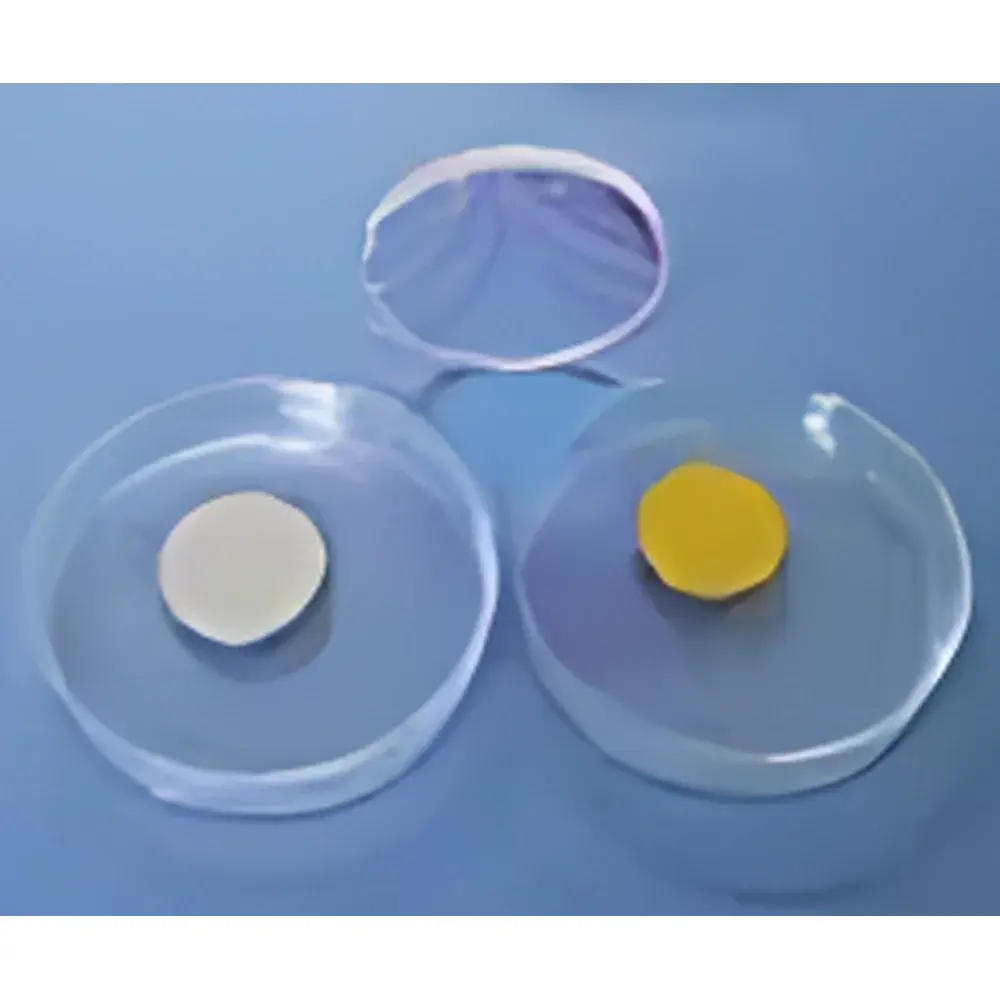
ZOLIX OMB Series Broadband Dielectric Mirror
| Brand | ZOLIX |
|---|---|
| Model | OMB Series |
| Substrate Material | BK7 |
| Surface Accuracy | λ/8 (visible), λ/4 (UV), λ/10 (IR & ultra-broadband) |
| Parallelism | ≤3 arcmin |
| Coating Type | Multi-layer dielectric |
| Reflectance | ≥97% (avg., 245–400 nm), ≥98% (avg., 400–1100 nm & 400–2000 nm), ≥97% (avg., 300–2000 nm) |
| Operating Angle of Incidence | 45° ± 3° |
| Back Surface | Polished (uncoated) |
| Diameter Options | 12.5–50 mm |
| Thickness Options | 4–10 mm |
| Wavelength Ranges | 245–400 nm (UV), 400–700 nm (VIS), 670–905 / 1200–1310 / 1408–1550 nm (NIR), 245–700 / 400–1100 / 400–2000 / 300–2000 nm (ultra-broadband) |
Overview
The ZOLIX OMB Series Broadband Dielectric Mirror is a high-performance optical component engineered for precision beam steering, cavity construction, and spectral management in demanding laser and spectroscopic applications. Unlike metallic mirrors—whose reflectance degrades significantly outside the visible range—these mirrors utilize multi-layer dielectric thin-film coatings deposited via ion-assisted electron-beam evaporation. This process yields wavelength-selective, angle-stable, and polarization-insensitive reflectance profiles with exceptionally low absorption (<0.2%) and scatter (<5 ppm). The OMB Series covers key spectral bands including ultraviolet (245–400 nm), visible (400–700 nm), near-infrared (670–1550 nm), and ultra-broadband configurations extending from deep-UV to mid-IR (300–2000 nm). Each mirror is fabricated on optically homogenous BK7 substrate material, offering excellent thermal stability (dn/dT ≈ +2.2 × 10⁻⁶/°C) and mechanical robustness for integration into vacuum-compatible, vibration-sensitive, or temperature-cycled optical benches.
Key Features
- Multi-band spectral coverage: Standard models span UV (245–400 nm), VIS (400–700 nm), NIR (670–1550 nm), and ultra-broadband variants (300–2000 nm)
- High average reflectance: ≥97% (245–400 nm), ≥98% (400–1100 nm and 400–2000 nm), with minimal polarization-dependent loss (PDL < 0.3% across 0–45° AOI)
- Precision surface figure: λ/8 RMS (OMB series), λ/4 RMS (UV imports), and λ/10 RMS (IR and ultra-broadband variants) verified via interferometric testing per ISO 10110-5
- Tight parallelism control: ≤3 arcminutes between front and back surfaces, critical for minimizing wavefront distortion in folded-path interferometers and resonators
- Back surface polished and uncoated: Enables use as a beamsplitter when combined with appropriate AR coatings or facilitates mounting without ghost reflections
- Customizable geometry: Available in diameters from 12.5 mm to 50 mm and thicknesses from 4 mm to 10 mm; standard mounting compatibility with SM1 (1.035″-40) and SM05 (0.535″-40) lens tubes
Sample Compatibility & Compliance
ZOLIX OMB mirrors are compatible with continuous-wave (CW) and pulsed laser sources up to 500 MW/cm² (10 ns, 1064 nm) and 2 J/cm² (10 ns, 355 nm), meeting ISO 21254-1 damage threshold requirements for Class 4 laser systems. All coatings are environmentally stable per MIL-C-48497A and pass 96-hour salt-spray (ASTM B117) and 1000-cycle humidity cycling (IEC 60068-2-30) tests. The mirrors conform to RoHS Directive 2011/65/EU and REACH Annex XVII restrictions on hazardous substances. For regulated laboratory environments—including those operating under GLP, GMP, or FDA 21 CFR Part 11 compliance frameworks—certificates of conformance, coating deposition logs, and interferometric test reports are available upon request.
Software & Data Management
While the OMB Series is a passive optical component, ZOLIX provides downloadable spectral reflectance data files (CSV and SDF formats) for all standard models, calibrated against NIST-traceable spectrophotometers (PerkinElmer Lambda 1050+ with integrating sphere). These datasets integrate seamlessly with optical design software including Zemax OpticStudio, CODE V, and FRED, enabling accurate system-level modeling of throughput, stray light, and polarization effects. Customers may access real-time coating performance updates, batch-specific metrology reports, and lifetime degradation projections via the ZOLIX Optical Component Portal—a secure, audit-ready platform supporting electronic record retention per ALCOA+ principles.
Applications
- Laser cavity optics for Ti:sapphire, dye, and excimer lasers requiring broadband high-reflectance end mirrors
- Beam combining and separation in multi-wavelength fluorescence microscopy and confocal imaging systems
- Reference arms in Michelson and Mach–Zehnder interferometers where phase stability and low dispersion are critical
- Spectral filtering in broadband OCT (optical coherence tomography) and FTIR (Fourier-transform infrared) spectrometers
- UV-VIS-NIR photometry calibration standards and radiometric reference surfaces
- Ultrafast pulse compression and dispersion compensation in chirped-pulse amplification (CPA) architectures
FAQ
What is the maximum incident angle tolerance for optimal reflectance performance?
The OMB Series is optimized for 45° ± 3° angle of incidence. Performance remains within ±1.5% of peak reflectance up to 45° ± 5° for most broadband variants; beyond this, angular shift in central wavelength and increased PDL must be modeled in system design.
Are custom coating designs available for non-standard wavelength ranges?
Yes—ZOLIX offers bespoke dielectric stack design and deposition services for wavelengths from 193 nm (ArF excimer) to 2000 nm, including dual-band, notch, and edge-filter configurations. Lead time is typically 6–8 weeks from specification finalization.
Do these mirrors support vacuum ultraviolet (VUV) operation below 200 nm?
Standard OMB mirrors are not rated for VUV due to oxygen absorption and carbon contamination risks; however, fluorinated fused silica substrates with MgF₂ overcoats are available under the ZOLIX VUV-MB series upon technical consultation.
How is surface flatness verified, and what metrology standard is applied?
Each mirror undergoes full-aperture phase-shifting interferometry using a Zygo Verifire™ HD system, with results traceable to NIST Standard Reference Material (SRM) 2089. Reports include PV, RMS, and Zernike decomposition per ISO 10110-5 and ANSI/OEOSC OP1.002.
Can these mirrors be cleaned using standard optical protocols?
Yes—standard solvent-based cleaning (acetone → methanol → IPA) with Class 100 cleanroom-grade lens tissue and nitrogen blow-off is recommended. Ultrasonic cleaning is not advised due to potential delamination risk in multi-layer stacks.





