
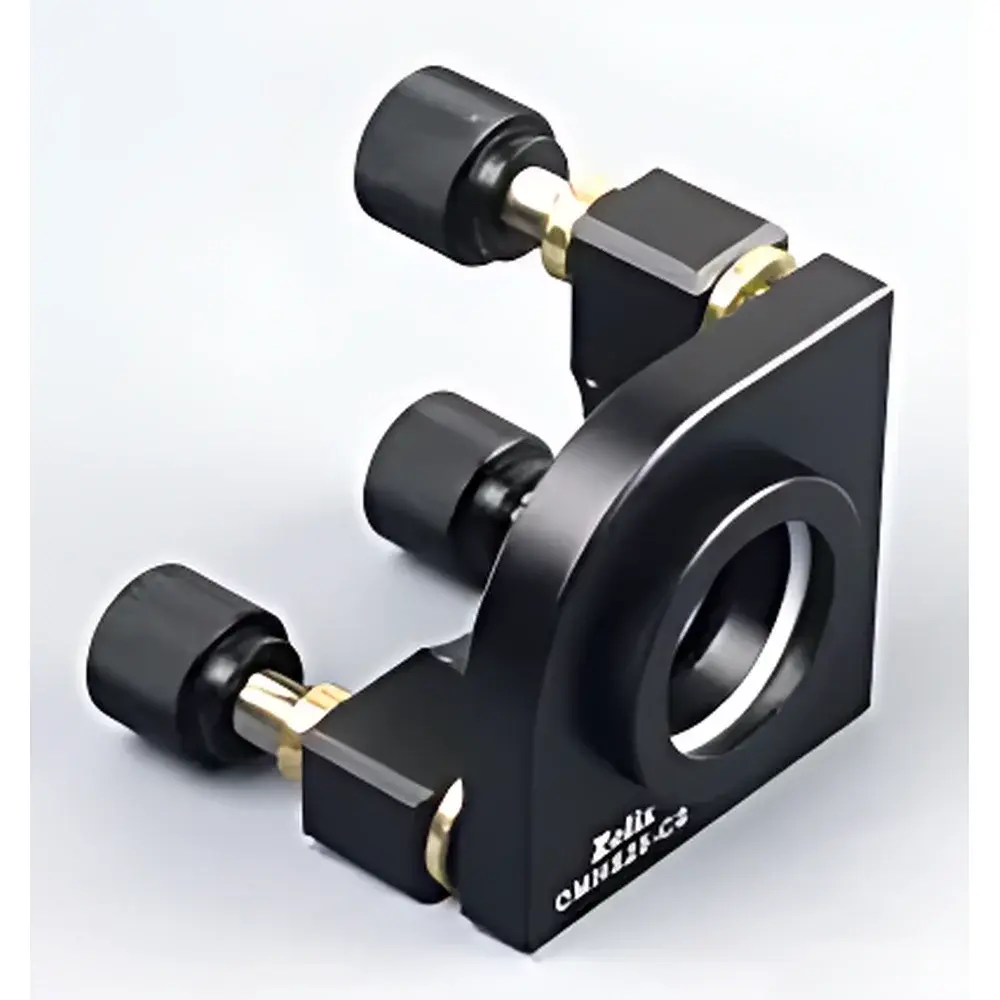
ZOLIX OMHS20(25/25.4/30)-CS Triaxial High-Stability Optical Mirror Mount
| Brand | ZOLIX |
|---|---|
| Origin | Beijing, China |
| Manufacturer Type | Direct Manufacturer |
| Product Category | Domestic |
| Model | OMHS20(25/25.4/30)-CS |
| Price | Upon Request |
| Clamp Diameter (A) | 20 mm / 25 mm / 25.4 mm / 30 mm |
| Clear Aperture (B) | 18 mm / 23 mm / 23 mm / 27 mm |
| Tilt Range | ±3° |
| Adjustment Axes | Tip/Tilt + Axial Translation |
| Mounting Interface | Dual-orientation threaded holes (M4 & M6) |
| Retention Mechanism | Spring-loaded retaining ring with PTFE-lined contact surface |
| Locking | Dual-stage mechanical lock (coarse pre-load + fine locking screw) |
Overview
The ZOLIX OMHS20(25/25.4/30)-CS is a precision-engineered triaxial optical mirror mount designed for demanding laboratory and industrial optical alignment applications. Unlike conventional two-axis tip/tilt mounts, this mount integrates a third degree of freedom—axial translation along the optical axis—enabling precise focus positioning without requiring reconfiguration of downstream components. Its mechanical architecture is based on a rigid monolithic base plate and orthogonal kinematic adjustment train, minimizing parasitic motion and thermal drift. The mount operates on a Couette-type dual-screw principle: one pair of opposing differential screws controls angular tilt in orthogonal planes (X–Y), while a central coaxial translation screw enables repeatable, backlash-free axial displacement (Z-axis) with sub-5 µm resolution under manual actuation. This configuration supports stable beam path optimization in interferometry, laser cavity alignment, spectroscopic coupling, and fiber-optic collimation setups where both angular and longitudinal degrees of freedom must be independently controlled and locked.
Key Features
- Triaxial adjustment capability: independent tip/tilt (±3° total range per axis) and axial translation (typically 0–5 mm travel, calibrated via engraved scale)
- PTFE-lined retaining ring system: non-marring clamping interface that protects coated or fragile optics (e.g., dielectric mirrors, AR-coated lenses, UV-grade fused silica) from scratching or stress-induced birefringence
- Modular aperture compatibility: four standardized variants (OMHS20-CS, OMHS25-CS, OMHS25.4-CS, OMHS30-CS) support common optic diameters—including metric (20/25 mm) and imperial (25.4 mm = 1″) standards—with corresponding clear apertures optimized to minimize vignetting
- Dual mounting orientation: symmetrically arranged M4 and M6 threaded holes on base allow horizontal or vertical installation without adapter plates, facilitating integration into multi-axis optical tables or custom optomechanical assemblies
- Two-stage mechanical locking: primary coarse lock secures base orientation; secondary fine-lock screw immobilizes each adjustment axis independently, ensuring long-term positional stability under vibration or thermal cycling (tested per ISO 10110-7 environmental robustness protocols)
- Black anodized 6061-T6 aluminum construction: provides high stiffness-to-weight ratio, corrosion resistance, and low coefficient of thermal expansion (23.6 × 10⁻⁶/K), critical for maintaining alignment over extended operation cycles
Sample Compatibility & Compliance
The OMHS20(25/25.4/30)-CS accommodates plano and spherical mirrors, beamsplitters, waveplates, and laser windows with thicknesses ranging from 1 mm to 12 mm. Its PTFE gasket ensures compatibility with soft coatings (e.g., MgF₂, Ta₂O₅/SiO₂ multilayers) and hygroscopic materials (e.g., KBr, ZnSe). All variants comply with ISO 9001:2015 manufacturing traceability requirements and meet dimensional tolerances specified in ISO 10110-1 for optical component mounting interfaces. While not certified for cleanroom use (ISO Class 5 or better), the mount’s sealed adjustment mechanisms and absence of lubricants make it suitable for Class 7–8 environments when paired with appropriate handling protocols.
Software & Data Management
This is a purely mechanical mount with no embedded electronics or digital interfaces. It does not require firmware, drivers, or software integration. However, its repeatable positioning performance supports traceable alignment workflows compliant with GLP and GMP documentation practices: users may record axial translation settings and tilt angles using calibrated micrometer dials (optional accessories), and maintain audit trails in lab notebooks or LIMS systems per FDA 21 CFR Part 11 guidelines for manual instrumentation. ZOLIX provides downloadable CAD models (STEP/IGES) and dimensional drawings with GD&T annotations for integration into optical design software (e.g., Zemax OpticStudio, CODE V, FRED).
Applications
- Laser resonator alignment in DPSS and ultrafast oscillator cavities
- Fiber-to-free-space coupling optimization in telecom and quantum optics testbenches
- Interferometric reference arm stabilization in Michelson and Mach–Zehnder configurations
- Spectrometer input/output slit and grating alignment in UV-VIS-NIR benchtop systems
- Multi-wavelength beam combining setups requiring simultaneous angular and focal plane registration
- Educational optics laboratories where students must develop tactile understanding of six-degree-of-freedom alignment principles
FAQ
What is the maximum optic thickness supported by the retaining ring?
The standard retaining ring accommodates optics up to 12 mm thick; custom rings for thicker substrates are available upon request.
Is the axial translation calibrated, and what is its resolution?
The translation screw features a 0.5 mm pitch and is marked with 10-division vernier scale, enabling manual estimation to ±5 µm under consistent torque application.
Can this mount be used in vacuum environments?
Yes—when specified with vacuum-compatible PTFE gaskets and dry-lubricated screws (option VAC), it meets ISO 10110-7 outgassing requirements for UHV-compatible optical hardware (1×10⁻⁹ mbar base pressure).
Do you offer motorized versions of this mount?
ZOLIX does not currently offer integrated motorization for the OMHS series; however, third-party piezoelectric or stepper-driven actuators can be retrofitted using the standardized M4/M6 mounting pattern.
How is thermal drift mitigated in long-duration experiments?
The monolithic aluminum base, low-CTE material selection, and symmetric thermal mass distribution reduce gradient-induced misalignment; typical drift is ≤0.5 arcsec/hour at ±1°C ambient fluctuation (measured per ISO 10110-7 Annex B).




