
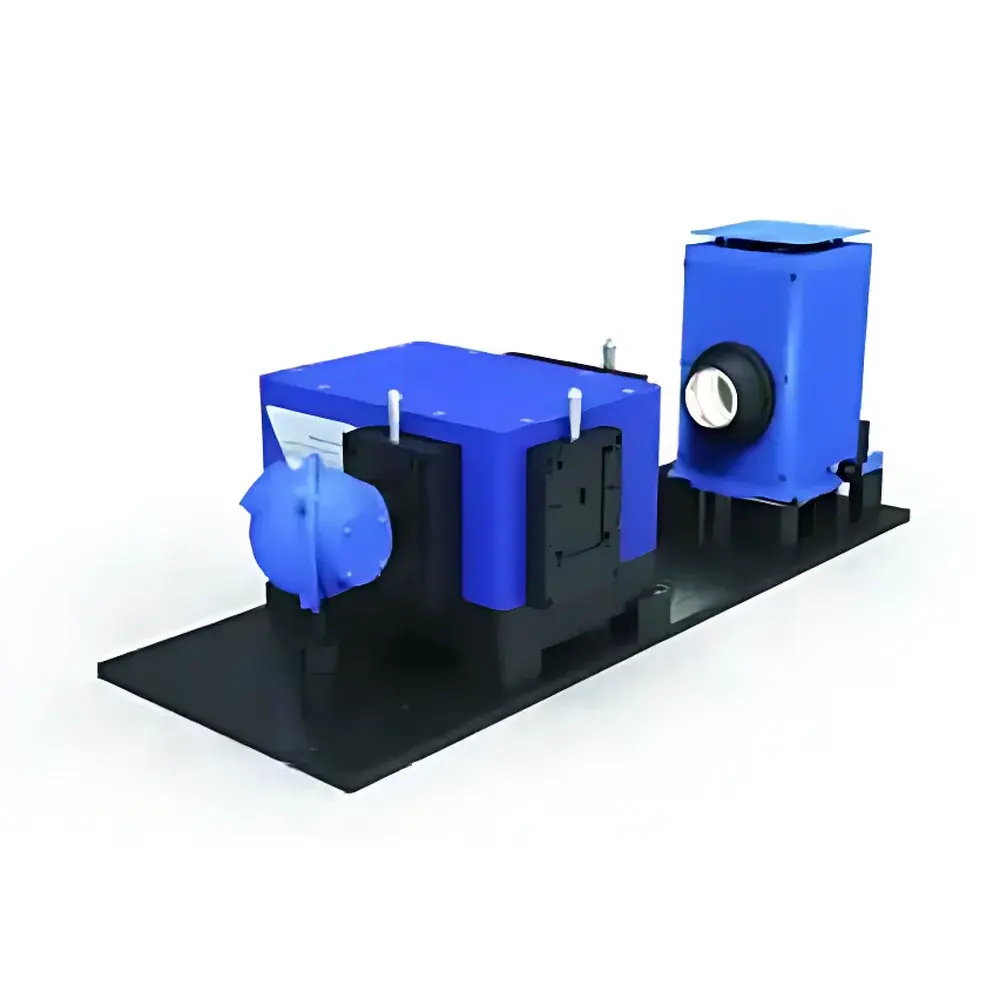
ZOLIX Omni-λBright 600 Integrating Sphere-Based Tunable Monochromatic Light Source
| Brand | ZOLIX |
|---|---|
| Origin | Beijing, China |
| Manufacturer Type | OEM Manufacturer |
| Product Origin | Domestic (China) |
| Model | Omni-λBright 600 |
| Light Source Type | 75 W Xenon Arc Lamp |
| Illumination Mode | Internal Illumination Configuration |
| Output Port Diameter | 25 mm |
| Spectral Range | 260–1000 nm |
| Spectral Bandwidth | 1–22 nm (continuously adjustable) |
| Wavelength Accuracy | ±0.2 nm |
| Wavelength Repeatability | ±0.1 nm |
| Irradiance Uniformity | ≥98% (measured at integrating sphere exit port) |
| Power Stability | ≤0.5% RMS over 8 hours |
| Minimum Spot Size | 1 mm (collimated free-space output) |
| Optical Axis Height | 160 mm (185 mm including base plate and rubber feet) |
| Dimensions (L×W×H) | 870 × 320 × 335 mm |
| Weight | 30 kg |
| Communication Interface | USB 2.0 |
| Standard Configuration | Monochromator, 75 W xenon lamp housing, six-position filter wheel, 25 mm exit integrating sphere, control software SDK |
Overview
The ZOLIX Omni-λBright 600 is an engineered optical calibration and characterization system designed for high-fidelity spectral irradiance delivery in metrology-grade photodetector evaluation. It integrates a 75 W short-arc xenon lamp with a precision Czerny–Turner monochromator, a motorized six-position interference filter wheel, and a calibrated 25 mm exit integrating sphere. The system operates on the principle of spatial homogenization via multiple diffuse reflections within a highly reflective (≥98% BaSO₄-coated) spherical cavity, ensuring exceptional spatial uniformity (≥98% across the exit aperture) and angular isotropy of output irradiance. Unlike collimated or fiber-coupled alternatives, the internal illumination architecture minimizes stray light and eliminates coupling losses—critical for absolute responsivity calibration of area-sensitive devices such as CCD/CMOS image sensors, UV–NIR photodiodes, and industrial camera modules. Its 260–1000 nm spectral coverage spans deep ultraviolet through near-infrared, supporting compliance-driven testing under ISO 15739 (electronic still-picture imaging), ASTM E308 (computing colorimetric data), and JIS Z 8722 (spectral reflectance measurement).
Key Features
- Integrating sphere output with ≥98% spatial uniformity across 25 mm exit port, validated per ISO 9050 and CIE Publication 127
- Continuously tunable spectral bandwidth from 1 nm to 22 nm (FWHM), enabling resolution-matched irradiance delivery for narrowband sensor response profiling
- Wavelength accuracy of ±0.2 nm and repeatability of ±0.1 nm—traceable to NIST-calibrated reference lamps and verified during factory acceptance testing
- Long-term irradiance stability ≤0.5% RMS over 8-hour continuous operation, achieved via active lamp current regulation and thermal management of monochromator optics
- Modular hardware architecture supporting optional upgrades: motorized slit width control, external shutter synchronization, and NIST-traceable radiometric calibration certificates
- USB 2.0 interface with deterministic command-response latency (<15 ms), compatible with LabVIEW™, Python (PyVISA), and MATLAB® environments
Sample Compatibility & Compliance
The Omni-λBright 600 is optimized for planar optoelectronic components requiring spatially uniform, spectrally defined irradiance. It accommodates standard sensor packages—including bare die on probe stations, surface-mount photodiodes, and full-frame CMOS/CCD arrays up to 1″ diagonal—via its fixed optical axis height (160 mm) and unobstructed front-access geometry. All factory calibration data—including wavelength accuracy maps, spectral power distribution (SPD) curves, and uniformity profiles across 260–1000 nm—are documented in ISO/IEC 17025-compliant test reports. The system supports GLP/GMP-aligned workflows through audit-ready logging (timestamped irradiance values, filter position history, wavelength sweep metadata) and optional 21 CFR Part 11-compliant software modules for electronic signature and data integrity enforcement.
Software & Data Management
The included ZOLIX LightControl SDK provides native C/C++, .NET, and Python APIs for full instrument orchestration: automated wavelength sweeps, dynamic bandwidth adjustment, synchronized filter selection, and real-time irradiance monitoring. Raw spectral irradiance data is exported in HDF5 format with embedded SI-unit metadata (W·m⁻²·nm⁻¹), enabling direct ingestion into radiometric analysis platforms such as Ocean Insight’s OceanView or Thorlabs’ ThorCam. Batch calibration routines generate per-wavelength correction factors referenced to NIST SRM 2032 (deuterium lamp) and SRM 1930 (tungsten halogen lamp). All firmware updates are digitally signed and delivered via secure HTTPS endpoints; no cloud dependency or telemetry collection is implemented.
Applications
- Quantum efficiency (QE) mapping of scientific-grade CMOS and sCMOS sensors
- Spectral responsivity validation of UV-enhanced photomultiplier tubes (PMTs) and silicon carbide (SiC) UV detectors
- Linearity and saturation threshold characterization of automotive ADAS camera modules under controlled spectral excitation
- ISO 12233 slanted-edge MTF testing using monochromatic illumination to isolate chromatic aberration effects
- Calibration of field-portable spectroradiometers against primary standards in accredited metrology labs
- Accelerated aging studies of optical coatings and encapsulants under controlled UV–VIS spectral stress profiles
FAQ
Is the integrating sphere output radiometrically calibrated?
Yes—each unit ships with a NIST-traceable spectral irradiance calibration certificate covering 260–1000 nm at 1 nm intervals, measured using a calibrated double-monochromator spectroradiometer.
Can the system be integrated into a vacuum or nitrogen-purged environment?
The monochromator and lamp housing are sealed units; however, the integrating sphere exit port requires atmospheric transmission. Optional quartz window kits (UV-grade fused silica, AR-coated) are available for inert-gas purging.
What is the minimum measurable irradiance level with this system?
At 550 nm with 1 nm bandwidth and maximum lamp output, the system delivers ≥1.2 mW·cm⁻² at the sphere exit—sufficient for low-noise QE measurements down to 10⁻⁴ A/W without external amplification.
Does the software support automated compliance reporting for ISO/IEC 17025 audits?
Yes—the SDK includes configurable report templates compliant with ISO/IEC 17025 clause 7.8.2, exporting all raw data, uncertainty budgets, and environmental condition logs in PDF/A-2 format.
Are replacement xenon lamps user-serviceable?
Lamp replacement requires optical realignment and recalibration. ZOLIX recommends factory service; however, lamp modules are field-replaceable with alignment jigs and post-installation verification protocols provided under technical support contract.




