
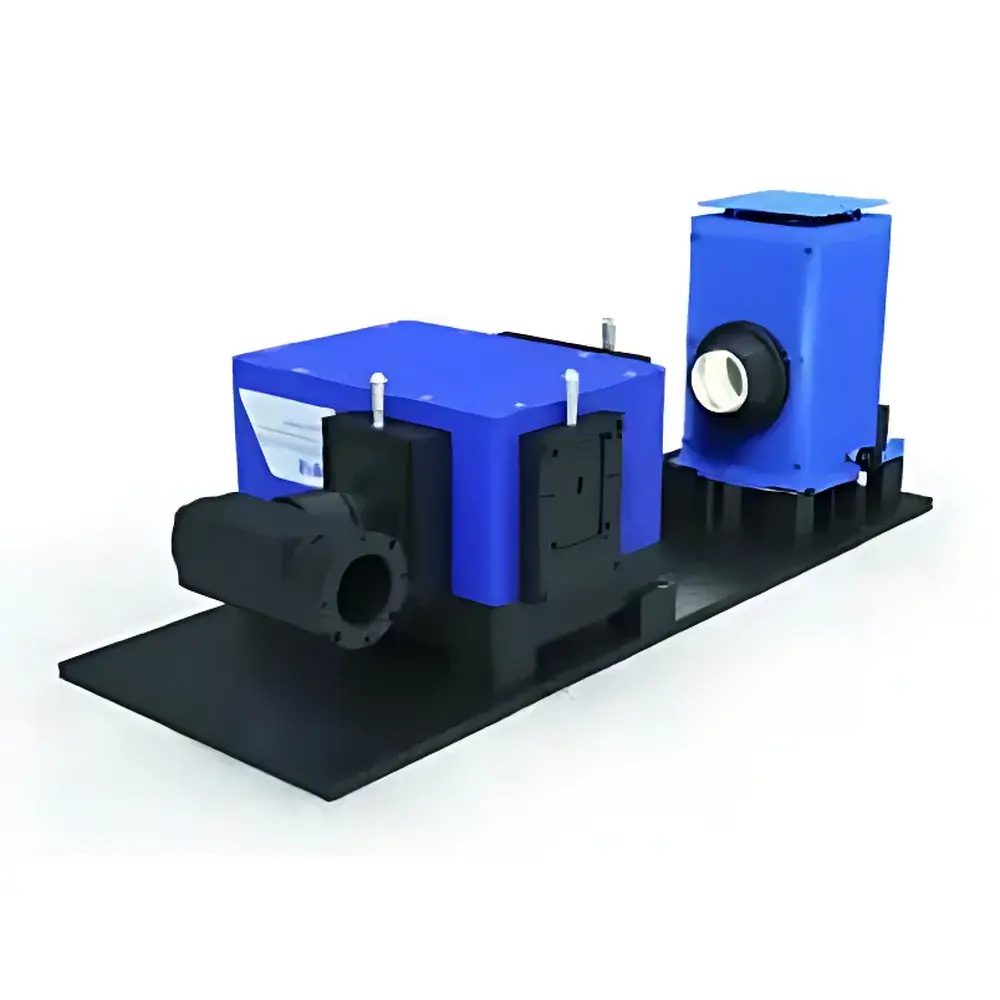
ZOLIX Omni-λBright 900 Spatially Adjustable Monochromatic Light Source
| Brand | ZOLIX |
|---|---|
| Origin | Beijing, China |
| Manufacturer Type | OEM Manufacturer |
| Product Origin | Domestic (China) |
| Model | Omni-λBright 900 |
| Light Source Type | 75 W Xenon Arc Lamp |
| Illumination Mode | Internal Illumination Configuration |
| Optical Output | Fiber-Coupled & Free-Space Adjustable Beam |
| Spectral Range | 260–1000 nm |
| Spectral Bandwidth | 1–22 nm (continuously adjustable) |
| Wavelength Accuracy | ±0.2 nm |
| Wavelength Repeatability | ±0.1 nm |
| Minimum Spot Size | 1 mm (focused output) |
| Power Stability | ≤0.5% RMS (over 8 hours) |
| Beam Height | 160 mm (185 mm including base plate and rubber feet) |
| Dimensions (L×W×H) | 870 × 320 × 335 mm |
| Weight | 30 kg |
| Interface | USB 2.0 |
| Standard Accessories | Monochromator, 75 W Xenon lamp housing, 6-position motorized filter wheel, beam-focusing optical path converter |
| Optional Accessories | SHT-9002 electronic shutter, EMSLIT 3 mm motorized entrance slit, OMSLIT 3 mm motorized exit slit |
Overview
The ZOLIX Omni-λBright 900 is a high-precision, spatially adjustable monochromatic light source engineered for quantitative spectral photometry and optoelectronic characterization in research and industrial laboratories. It integrates a thermally stabilized 75 W xenon arc lamp with a Czerny–Turner monochromator platform, enabling continuous wavelength selection across the deep UV to near-infrared range (260–1000 nm). Unlike fixed-output broadband or LED-based systems, the Omni-λBright 900 delivers true monochromatic irradiance via grating dispersion and motorized slit control—ensuring spectral purity, minimal stray light (<10⁻⁴), and traceable wavelength calibration. Its defining feature is the spatially reconfigurable optical path: the included focusing light-path converter enables precise collimation or tight focusing (down to 1 mm spot diameter at sample plane), while maintaining mechanical stability and alignment repeatability. This architecture supports both free-space illumination and fiber-coupled delivery, making it suitable for integration into custom optical benches, vacuum chambers, or automated test stations.
Key Features
- Thermally regulated 75 W short-arc xenon lamp with ≥2,000-hour lifetime and integrated igniter and power supply
- Czerny–Turner monochromator with holographic concave grating (1200 g/mm standard), optimized for throughput and resolution across UV–VIS–NIR
- Continuously variable spectral bandwidth (1–22 nm), controlled via synchronized motorized entrance and exit slits
- Wavelength accuracy of ±0.2 nm and repeatability of ±0.1 nm, verified per NIST-traceable calibration procedures
- Spatial beam manipulation system: interchangeable optical modules enable collimated, focused (1 mm min. spot), or homogenized output configurations
- Motorized 6-position filter wheel (standard) for harmonic suppression, order-sorting, or neutral density attenuation
- USB 2.0 interface compliant with ZOLIX LightMaster™ software for remote control, script-based scanning, and real-time power monitoring
- Rigid aluminum alloy chassis with vibration-damped base plate (185 mm total height including isolating rubber feet)
Sample Compatibility & Compliance
The Omni-λBright 900 accommodates diverse sample geometries and environmental requirements: flat substrates (e.g., solar cells, photodetectors), curved optics (lenses, filters), liquid electrochemical cells (PEC), and biological tissue analogs (for ocular safety testing). Its internal illumination design eliminates external beam steering complexity while preserving polarization integrity when used with optional Glan–Taylor polarizers. The system meets key international metrological and safety standards: spectral data complies with ISO/IEC 17025 requirements for calibration laboratories; optical output power measurements are traceable to NIST SRM 2242 (silicon photodiode standards); and mechanical construction adheres to IEC 61000-6-3 (EMC emission limits) and IEC 61010-1 (safety for laboratory equipment). For regulated environments, optional audit trail logging and user access controls align with FDA 21 CFR Part 11 expectations when paired with validated LightMaster™ software configurations.
Software & Data Management
Control and data acquisition are managed through ZOLIX LightMaster™ v4.x—a Windows-based application supporting full instrument parameterization (wavelength, slit width, filter position, shutter state) and automated spectral scans. Raw intensity values are recorded as absolute irradiance (W/cm²/nm) or relative photon flux (photons/s/nm), with built-in correction for grating efficiency and lamp spectral output. All measurement sessions generate timestamped .csv and .xlsx files containing wavelength arrays, calibrated power readings, and metadata (slit settings, filter ID, lamp hours). The software supports batch processing, spectral derivative calculation, and export to MATLAB, Python (via Pandas), or LabVIEW via DLL interface. Firmware updates and calibration certificate uploads are handled through secure USB-authenticated workflows, ensuring long-term data integrity and instrument traceability.
Applications
- External quantum efficiency (EQE) and incident photon-to-current conversion efficiency (IPCE) mapping of photovoltaic devices and photoelectrochemical (PEC) cells
- Spectral responsivity calibration of photodiodes, CMOS/CCD sensors, and emerging 2D-material-based detectors
- UV–VIS–NIR transmittance, reflectance, and absorbance measurements of optical coatings, lenses, and protective eyewear per ANSI Z87.1 and EN 170
- Time-resolved photocurrent analysis under monochromatic excitation in conjunction with lock-in amplifiers or source-measure units
- Photochemical reaction initiation with wavelength-specific activation energy thresholds (e.g., TiO₂ photocatalysis)
- Reference source validation for spectroradiometer and hyperspectral imager calibration protocols
FAQ
What is the minimum achievable spot size, and how is it maintained across the spectral range?
The system achieves a diffraction-limited focused spot of ≤1 mm (FWHM) at the sample plane using the included focusing light-path converter. Spot size remains stable across 260–1000 nm due to achromatic lens design and real-time refocusing compensation embedded in the optical train.
Can the Omni-λBright 900 be integrated into a vacuum or inert-gas environment?
Yes—the monochromator body and lamp housing are sealed and compatible with dry nitrogen purging; optional CF-flanged viewport adapters and vacuum-rated electrical feedthroughs are available upon request.
Is spectral irradiance output certified, and what documentation accompanies shipment?
Each unit ships with a factory calibration report including wavelength accuracy/repeatability verification (at 5 reference lines: Hg 253.7, 365.0, 404.7, 435.8, 546.1 nm), spectral power distribution curves (260–1000 nm), and slit function characterization—traceable to national standards.
How does the system handle higher-order diffraction artifacts in UV measurements?
The standard 6-position motorized filter wheel includes order-sorting filters (e.g., UV-transmitting BG39, VIS-blocking Schott UG11) that suppress second- and third-order contributions below 400 nm without sacrificing throughput.
What maintenance is required for long-term operational stability?
Lamp replacement every ~2,000 hours; annual recalibration recommended; optical surfaces require cleaning only if contamination is observed—no routine alignment adjustments are needed due to kinematic mount design.




