
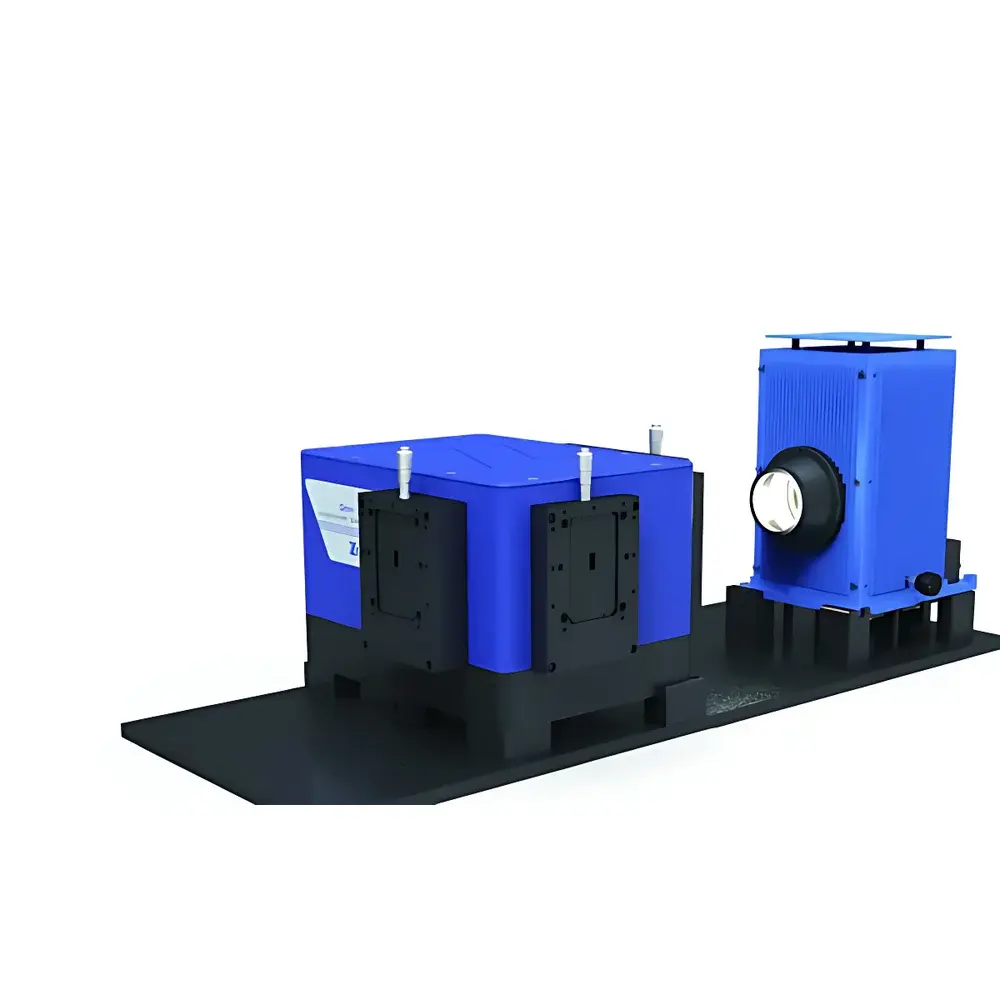
ZOLIX Omni-λBright Series Tunable Monochromatic Light Source
| Brand | ZOLIX |
|---|---|
| Origin | Beijing, China |
| Manufacturer Type | Original Equipment Manufacturer (OEM) |
| Product Category | Domestic |
| Model | Omni-λBright |
| Light Source Type | 75 W Xenon Arc Lamp |
| Illumination Mode | Internal Illumination Configuration |
| Optical Core | 200 mm Focal Length Imaging Spectrograph |
| Spectral Range | 260–1100 nm |
| Output Power Density Enhancement | >2× vs. conventional 75 W xenon systems |
| Stray Light Suppression | <1×10⁻⁵ |
| Wavelength Repeatability | ±0.1 nm |
| Bandwidth Tunability | 0.2–20 nm (continuous) |
| Numerical Aperture | f/3.5 |
| Ozone-Free Lamp | Yes (UV-cutoff quartz envelope) |
Overview
The ZOLIX Omni-λBright Series Tunable Monochromatic Light Source is an engineered optical instrument designed for high-fidelity spectral irradiance delivery in laboratory-scale photometric, quantum efficiency, and optoelectronic characterization applications. It operates on the principle of monochromatization via a high-throughput imaging spectrograph coupled with a stabilized 75 W ozone-free xenon arc lamp — a broadband source whose spectral irradiance closely approximates AM1.5G solar irradiance from 260 nm to 1100 nm. Unlike conventional monochromators relying on refractive optics or non-imaging monochromators, the Omni-λBright integrates a proprietary all-reflective, aberration-corrected optical path that eliminates chromatic focal shift across the full UV-VIS-NIR range. This ensures diffraction-limited focusing of monochromatic output onto the entrance slit of downstream detectors or sample planes — critical for spatially resolved measurements such as quantum efficiency mapping or micro-spectroscopic calibration.
Key Features
- All-reflective optical design: Eliminates chromatic aberration; maintains consistent focus from 260 nm to 1100 nm at the spectrograph entrance slit.
- Imaging spectrograph core: 200 mm focal length, f/3.5 numerical aperture, optimized for point-to-point light transfer and minimal spot distortion at the exit port.
- Enhanced collection efficiency: Proprietary ellipsoidal lamp housing increases effective radiant flux coupling into the spectrograph by >90% — more than double the throughput of conventional front-lens/rear-mirror xenon lamp housings (typically 40–45%).
- Ozone-free xenon lamp: Quartz envelope with integrated UV cutoff suppresses ozone generation below 242 nm, enabling safe operation in standard laboratory environments without forced ventilation or ozone scrubbing.
- Continuous bandwidth tuning: Adjustable spectral bandwidth from 0.2 nm to 20 nm via motorized exit slit control — supporting both high-resolution spectroscopy and broad-band irradiance calibration.
- High wavelength repeatability: ±0.1 nm over repeated scans, verified under stable thermal conditions and calibrated against NIST-traceable emission lines.
- Stray light suppression: <1×10⁻⁵ (measured at 500 nm with 400 nm blocking filter), achieved through multi-stage baffling, blackened internal surfaces, and optimized grating blaze geometry.
Sample Compatibility & Compliance
The Omni-λBright is compatible with standard optical breadboards, fiber-coupled interfaces (SMA905, FC/PC), and vacuum-compatible sample chambers when equipped with optional quartz viewport windows. Its spectral stability (±0.3% RMS intensity drift over 1 hour, 25 °C ambient) and radiometric reproducibility meet requirements for ISO/IEC 17025-accredited photodetector calibration labs. The system supports traceable calibration workflows aligned with ASTM E275, ISO 9050, and IEC 60904-8 for quantum efficiency and spectral responsivity measurements. While not FDA-certified as a medical device, its hardware architecture and firmware logging capabilities are configurable to support 21 CFR Part 11-compliant data audit trails when integrated with validated third-party acquisition software.
Software & Data Management
Control is implemented via ZOLIX’s cross-platform OmniStudio software suite (Windows/macOS/Linux), offering native USB 2.0 and Ethernet interfaces. The application provides synchronized wavelength scanning, slit width modulation, lamp power ramping, and real-time intensity monitoring. All parameter sets — including grating position, slit dimensions, lamp current, and dwell time — are saved in human-readable XML metadata files. Export formats include CSV (wavelength/intensity), HDF5 (for multi-dimensional scan stacks), and industry-standard JCAMP-DX for spectral interchange. Optional Python SDK enables integration into automated test sequences compliant with GLP/GMP documentation standards, including timestamped parameter logs and checksummed raw data archives.
Applications
- Quantum efficiency (QE) and incident photon-to-current efficiency (IPCE) measurement of photovoltaic devices per IEC 60904-8 and ASTM E1021.
- Spectral responsivity calibration of photodiodes, CCD/CMOS image sensors, and scientific cameras.
- Excitation source for steady-state and time-resolved fluorescence spectroscopy systems.
- Surface photovoltage spectroscopy (SPS) and photoelectrochemical (PEC) cell characterization.
- Transmittance/reflectance/absorbance (T/R/A) measurements using lock-in or dual-beam configurations.
- Optical lens and filter spectral transmittance verification across UV-VIS-NIR bands.
- Optical safety testing of protective eyewear per EN 170 and ANSI Z87.1 standards.
- Radiometric validation of integrating sphere-based light measurement systems.
FAQ
What is the spectral range of the Omni-λBright system?
The usable spectral output spans 260 nm to 1100 nm, limited primarily by the transmission characteristics of the included fused silica optics and ozone-free xenon lamp envelope.
Is the system compatible with vacuum or inert-gas environments?
Yes — the base unit is sealed and can be mounted externally to vacuum chambers via optional quartz viewport adapters; lamp housing requires ambient air cooling and must remain outside evacuated enclosures.
Can the output be fiber-coupled?
Yes — the exit port accepts standard SMA905 or FC/PC connectors; coupling efficiency exceeds 75% with 400 µm core multimode fiber when aligned using the included kinematic mount.
How is wavelength accuracy maintained over time?
The spectrograph uses a thermally stabilized holographic grating and closed-loop stepper motor control; factory calibration is traceable to mercury and deuterium spectral lines, with user-accessible recalibration routines.
Does the system support automated compliance reporting for ISO/IEC 17025 labs?
While the hardware itself is not accredited, its deterministic control architecture, full parameter logging, and exportable metadata enable integration into accredited lab information management systems (LIMS) meeting ISO/IEC 17025 clause 7.7 requirements.



