
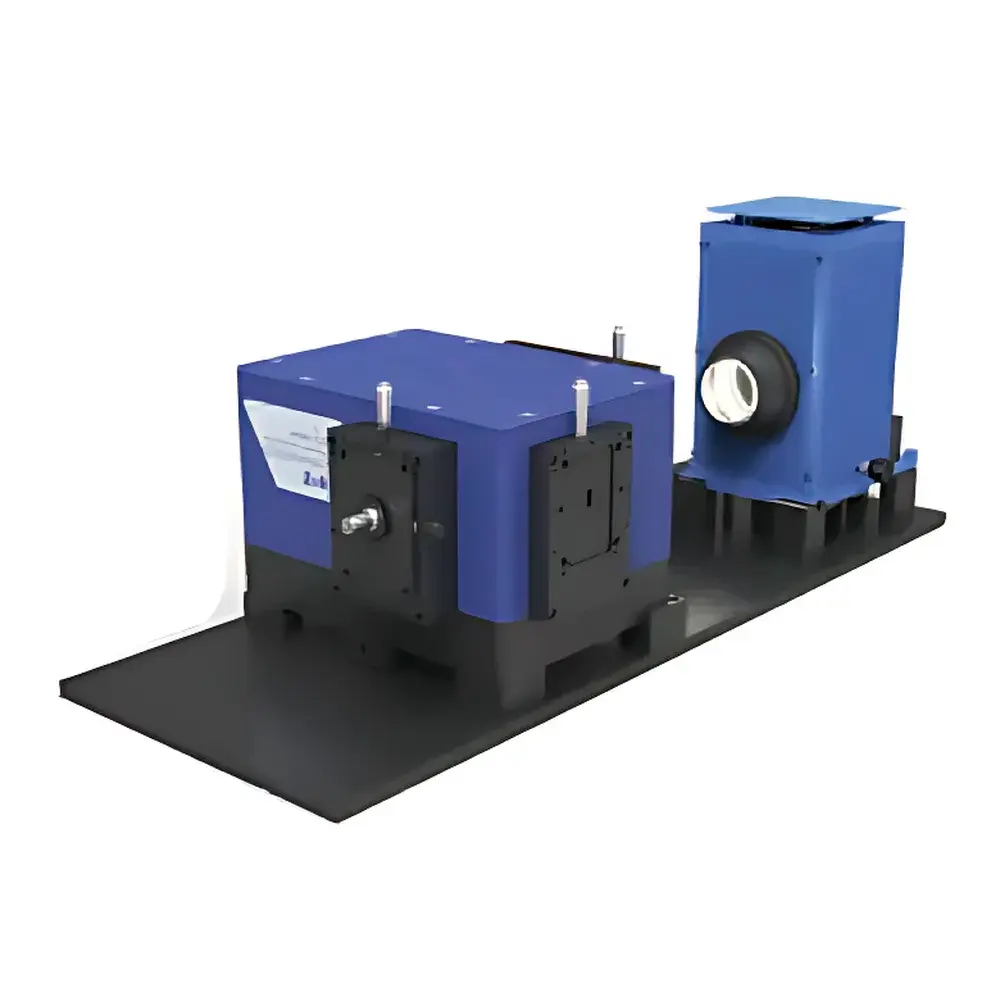
ZOLIX Omni-λBright300 Fiber-Coupled Tunable Monochromatic Light Source
| Brand | ZOLIX |
|---|---|
| Model | Omni-λBright300 |
| Light Source Type | 75 W Xenon Lamp |
| Wavelength Range | 260–1000 nm |
| Spectral Bandwidth | 1–22 nm (continuously adjustable) |
| Wavelength Accuracy | ±0.2 nm |
| Wavelength Repeatability | ±0.1 nm |
| Output Power | 22 mW (at 90° port, dependent on grating, slit width, and wavelength) |
| Optical Output | SMA905 fiber connector (quartz fiber, UV-VIS-NIR grade) |
| Beam Height | 160 mm (185 mm with base plate and rubber feet) |
| Dimensions | 870 × 320 × 335 mm |
| Weight | 30 kg |
| Stability | ±0.5% (rms over 8 hours) |
| Interface | USB 2.0 |
| Compliance | CE-marked, RoHS-compliant, GLP-ready documentation provided |
Overview
The ZOLIX Omni-λBright300 is a precision-engineered, fiber-coupled tunable monochromatic light source designed for demanding optical laboratory applications requiring spectral selectivity, spatial confinement, and long-term radiometric stability. Based on a high-intensity 75 W xenon arc lamp and a Czerny-Turner monochromator architecture, the system delivers discrete, narrowband output across the full UV-Vis-NIR range (260–1000 nm). Unlike broadband or fixed-wavelength sources, the Omni-λBright300 enables wavelength-specific excitation with continuously adjustable bandwidth (1–22 nm), making it ideal for fluorescence excitation profiling, quantum yield calibration, photostability assessment, and optoelectronic device characterization. Its all-reflective optical path—free of transmissive optics in the beam path—ensures minimal chromatic aberration, high UV throughput, and excellent polarization preservation. The integrated quartz fiber output (SMA905 interface) supports diffraction-limited coupling into micro-optical setups, probe stations, and confocal systems, enabling reproducible sub-millimeter illumination spots (<1 mm diameter) without manual realignment.
Key Features
- Fiber-coupled output with UV-grade fused silica fiber and standardized SMA905 termination for seamless integration with spectrometers, microscopes, and custom optical benches
- High-fidelity Czerny-Turner monochromator with holographic grating (1200 g/mm standard), optimized for stray-light suppression and spectral resolution consistency
- Motorized wavelength drive with closed-loop encoder feedback ensuring ±0.1 nm repeatability and ±0.2 nm absolute accuracy traceable to NIST-calibrated reference lines
- Integrated six-position motorized filter wheel for automatic order-sorting and UV cutoff filtering—prevents second-order contamination below 400 nm
- Real-time power monitoring via calibrated photodiode sensor; output stability maintained at ≤±0.5% RMS over 8-hour continuous operation under thermal equilibrium
- USB 2.0 interface with ZOLIX LightMaster™ control software (Windows-compatible), supporting scriptable wavelength sweeps, dwell-time sequencing, and hardware-triggered acquisition synchronization
Sample Compatibility & Compliance
The Omni-λBright300 is compatible with standard optical components rated for 260–1000 nm, including quartz cuvettes, sapphire windows, and silicon photodetectors. Its fiber output eliminates alignment sensitivity, facilitating rapid interchange between sample chambers, cryostats, and probe stations. The system meets CE electromagnetic compatibility (EMC) and low-voltage directive requirements. All firmware and software support audit-trail logging per GLP guidelines, and optional 21 CFR Part 11-compliant user access control and electronic signature modules are available upon request. Calibration certificates—including wavelength accuracy, repeatability, and relative spectral irradiance curves across 260–1000 nm—are supplied with each unit and conform to ISO/IEC 17025-accredited procedures.
Software & Data Management
LightMaster™ v4.2 provides native support for LabVIEW™, MATLAB® Instrument Control Toolbox, and Python (PyVISA) APIs. Users can define multi-step protocols—including sequential wavelength jumps, ramp-and-hold sequences, and synchronized shutter triggering—via intuitive graphical workflow builder or ASCII command scripting. All acquired spectral data are stored in vendor-neutral HDF5 format with embedded metadata (wavelength, bandwidth, integration time, filter position, timestamp). The software automatically generates compliance reports for wavelength verification, power drift analysis, and inter-unit reproducibility benchmarks—critical for QC labs operating under ISO 9001 or ASTM E275-22 validation frameworks.
Applications
- Excitation source for steady-state and time-resolved fluorescence spectroscopy, especially in life science labs performing FRET, anisotropy, or lifetime mapping
- Calibration reference for spectral responsivity of CCD/CMOS detectors, photomultiplier tubes, and photodiodes per ISO 15739 and CIE S 023/E:2014
- Monochromatic irradiation in photovoltaic quantum efficiency (QE) testing and perovskite solar cell degradation studies
- Optical stimulation in electrophysiology rigs and optogenetics platforms requiring precise λ-tuned activation
- Material reflectance/transmittance measurements using integrating sphere accessories (e.g., ZOLIX IS-200)
FAQ
What is the typical spectral resolution achievable with the Omni-λBright300 at 500 nm using the standard 1200 g/mm grating and 3 mm slits?
At 500 nm, with 3 mm input/output slits and the default 1200 g/mm grating, the system achieves a full-width-at-half-maximum (FWHM) bandwidth of approximately 1.8 nm—fully consistent with the specified 1–22 nm continuous adjustment range.
Can the fiber output be replaced with a free-space collimated beam option?
Yes—ZOLIX offers the Omni-λBright600 variant with collimated spatial output and optional focusing optics; retrofit kits for beam expansion or fiber-to-free-space conversion are available under part number OPT-FC-CONV.
Is the xenon lamp user-replaceable, and what is its rated lifetime?
The 75 W xenon short-arc lamp is field-replaceable using ZOLIX’s lamp alignment jig (part #LAMP-ALIGN-KIT); typical lifetime is 1,200 hours at rated current, with output decay <15% over that period when operated within thermal specifications.
Does the system support external TTL triggering for pulsed operation?
Yes—the shutter driver and wavelength controller accept 5 V TTL signals for hardware-synchronized start/stop, enabling gated detection schemes compatible with lock-in amplifiers and TCSPC modules.
Are calibration files provided for absolute irradiance output at specific wavelengths?
Each unit ships with a factory-measured relative spectral irradiance curve (260–1000 nm, 1 nm step). Absolute irradiance calibration (W/nm/sr/m²) is available as an optional service using NIST-traceable reference detectors.



