
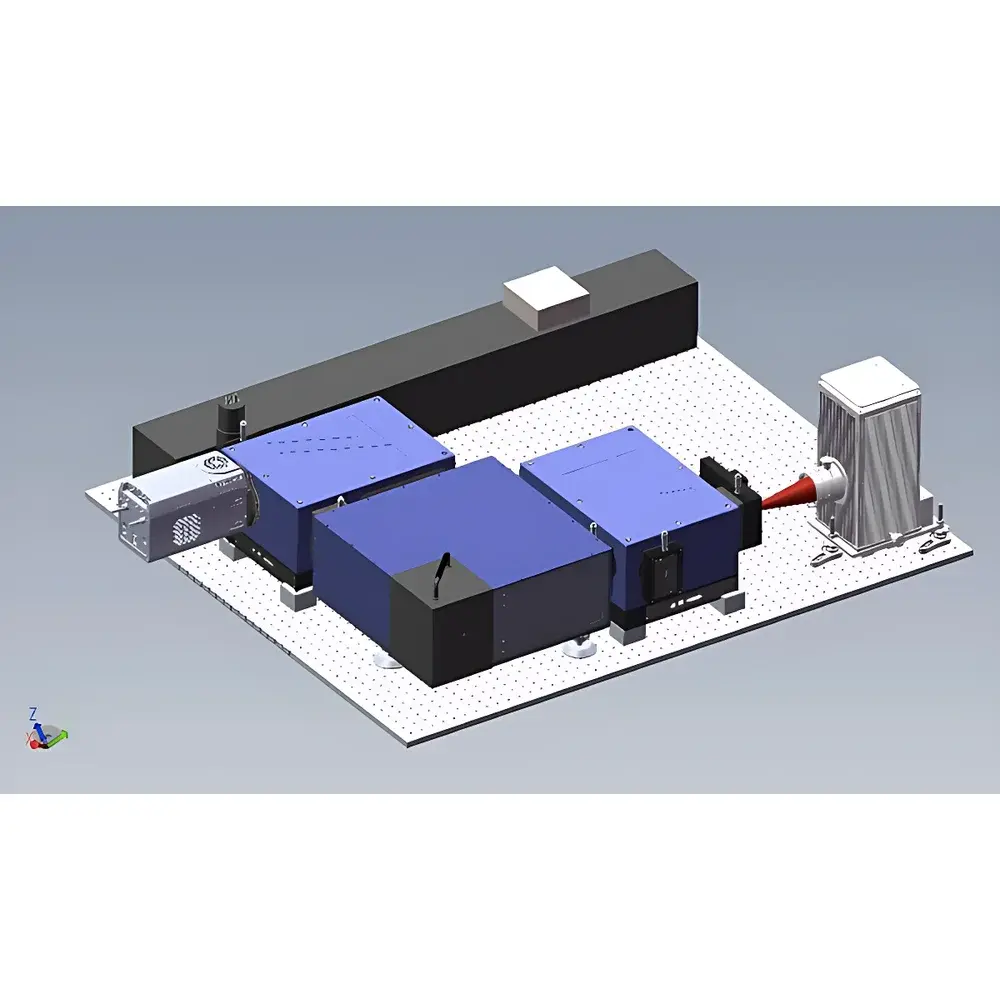
ZOLIX OmniFluo Modular Fluorescence Spectroscopy System
| Brand | ZOLIX |
|---|---|
| Origin | Beijing, China |
| Manufacturer Type | Direct Manufacturer |
| Product Category | Domestic |
| Model | OmniFluo |
| Price Range | USD 28,000–42,500 (FOB) |
| Dispersive Element | Holographic Grating |
| Slit Width (Spectral Bandpass) | 0.01–3 mm |
| Spectral Resolution | ±0.05 nm |
| Sensitivity | >3000:1 (Water Raman S/N ≥1000:1) |
| Wavelength Accuracy | ±0.15 nm |
| Spectral Range | 200–2500 nm |
| Excitation Sources | 150 W / 500 W Xenon Arc Lamp with Monochromator (Bandwidth 0.1–30 nm) |
| Optional Lasers | 266, 325, 375, 405, 442, 532, 785, 1064 nm |
| Detector Options | Cooled CCD (2000×256, 200–1000 nm), Cooled InGaAs Array (512×1, 800–2200 nm), PMT (200–870 nm), Cooled Single-Element InGaAs (800–2500 nm) |
| Signal Processing | Photon Counting or Lock-in Amplification |
| Optional Modules | Quantum Yield Measurement, Electroluminescence (EL), Cryogenic Sample Stage (≤10 K) |
| Emission Spectrum Correction | Built-in Absolute Intensity Calibration Function |
Overview
The ZOLIX OmniFluo Modular Fluorescence Spectroscopy System is a high-performance, research-grade platform engineered for precision molecular fluorescence characterization across physics, materials science, life sciences, and environmental analytics. Based on the fundamental principle of photoluminescence excitation and emission detection—where samples are irradiated with monochromatic light and the resulting fluorescent photons are dispersed and quantified via grating-based spectroscopy—the OmniFluo system delivers exceptional flexibility and metrological rigor. Unlike conventional benchtop fluorometers with fixed optical paths and limited spectral reach, this modular architecture integrates the ZOLIX Omni-λ series imaging spectrometers, high-stability excitation sources, and cryogenically cooled detectors to support both steady-state and time-resolved fluorescence measurements. Its broad 200–2500 nm spectral coverage enables seamless analysis of wide-bandgap semiconductors (e.g., GaN, AlN), organic emitters, quantum dots, biological pigments (chlorophyll, carotenoids), and rare-earth-doped phosphors—all within a single, reconfigurable platform.
Key Features
- Modular optical architecture allowing field-upgradable configurations for PL, PLE, Raman, transmittance/reflectance, and detector radiometric calibration
- High-fidelity spectral resolution of ±0.05 nm with wavelength accuracy better than ±0.15 nm—validated against NIST-traceable emission standards
- Dual excitation pathways: continuously tunable xenon lamp source (150 W or 500 W) with adjustable bandwidth (0.1–30 nm), plus optional discrete-wavelength lasers (266–1064 nm)
- Multi-detector compatibility including thermoelectrically cooled back-illuminated CCD (200–1000 nm), extended-range InGaAs array (800–2200 nm), and single-channel PMT or InGaAs detectors (up to 2500 nm)
- Integrated absolute emission spectrum correction algorithm enabling quantitative inter-laboratory comparability per ISO 17025 and ASTM E275 guidelines
- Compact footprint with optimized optical layout—designed for integration into gloveboxes, cryostats, or vacuum chambers without compromising alignment stability
Sample Compatibility & Compliance
The OmniFluo accommodates solid, liquid, and powder samples in standard cuvettes, microscope slides, or custom mounts—including low-temperature stages operating down to 10 K. Its open optical design supports in situ measurements under inert atmosphere or controlled humidity. All firmware and hardware comply with CE marking requirements for electromagnetic compatibility (EN 61326-1) and safety (EN 61010-1). Data acquisition modules support audit-trail logging and user-access controls aligned with GLP/GMP workflows. While not FDA-cleared as a diagnostic device, the system meets analytical performance criteria referenced in USP and ICH Q2(R2) for method validation in pharmaceutical photostability and impurity profiling applications.
Software & Data Management
Controlled via ZOLIX SpectraMaster™ v4.x—a Windows-based application supporting instrument orchestration, spectral acquisition, real-time background subtraction, and multi-dimensional data visualization (excitation-emission matrices, lifetime decay fitting, quantum yield calculation). Raw spectra are exported in standardized ASCII or HDF5 format; metadata includes timestamp, slit width, integration time, detector gain, and calibration traceability. The software implements role-based user permissions and electronic signature capability compliant with 21 CFR Part 11 when deployed with networked authentication servers. Batch processing scripts (Python API available) enable automated QA/QC routines across production lots or high-throughput screening campaigns.
Applications
- Materials Science: Band-edge luminescence mapping of perovskites, defect-state analysis in SiC and Ga₂O₃, exciton binding energy determination in 2D TMDCs
- Life Sciences: Chlorophyll-a fluorescence induction kinetics (OJIP), FRET efficiency quantification in labeled proteins, autofluorescence profiling of tissue sections
- Environmental Analysis: Polycyclic aromatic hydrocarbon (PAH) identification in soil extracts, dissolved organic matter (DOM) characterization via EEM-PARAFAC decomposition
- Photonics R&D: OLED/PeLED electroluminescence spectral stability testing, LED phosphor quantum yield benchmarking under calibrated integrating sphere conditions
- Cryogenic Spectroscopy: Zero-phonon line resolution of NV⁻ centers in diamond at 4 K, Stark splitting studies in rare-earth-doped crystals
FAQ
What excitation sources are included by default?
The base configuration includes a 150 W xenon arc lamp coupled to an Omni-λ monochromator. A 500 W lamp and laser modules are available as factory-installed options.
Can the system perform absolute quantum yield measurements?
Yes—when equipped with the optional integrating sphere accessory and calibrated reference standards, the system supports quantum yield determination per ASTM E2494-22 using both direct and relative methods.
Is cryogenic operation supported natively?
The platform is mechanically and optically designed for integration with closed-cycle cryostats (e.g., Janis ST-500, BlueFrog). The ≤10 K low-temperature option includes vibration-isolated mounting, cold-shielded optics, and thermal contraction compensation.
How is spectral calibration maintained over time?
Wavelength calibration is performed using Hg/Ar/Ne emission line standards; intensity calibration uses NIST-traceable tungsten halogen and deuterium lamps. Both procedures are script-automatable and logged with full version control.
Does the system support time-resolved fluorescence measurements?
Time-domain capability requires optional TCSPC electronics (e.g., Becker & Hickl DCS-120) or gated ICCD integration—both compatible via TTL synchronization ports and third-party SDKs.
Related Products




