
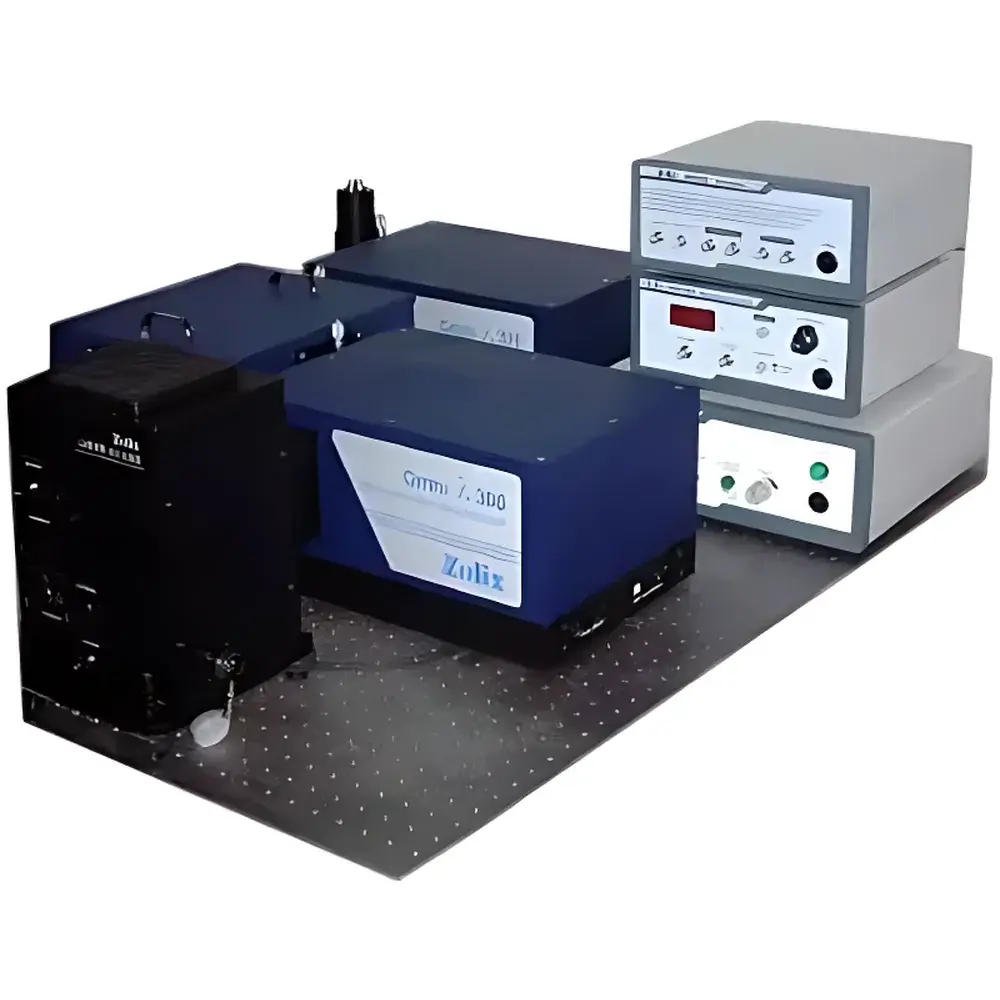
ZOLIX OmniFluo Series Modular Molecular Fluorescence Spectrometer
| Brand | ZOLIX |
|---|---|
| Origin | Beijing, China |
| Manufacturer Type | Direct Manufacturer |
| Product Origin | Domestic (China) |
| Model | OmniFluo Series |
| Price Range | USD 28,000 – 43,000 (FOB) |
| Dispersive Element | Holographic Grating & Interference Filters |
| Slit Width (Spectral Bandpass) | Adjustable, 0.1–5.0 mm |
| Spectral Resolution | 0.1 nm (FWHM @ 546.1 nm) |
| Sensitivity | 3000:1 (Signal-to-Noise Ratio, RMS, water Raman peak at 350 nm excitation, 5 nm bandwidth, 1 s integration) |
| Wavelength Accuracy | ±0.2 nm (Emission), ±0.25 nm (Excitation) |
Overview
The ZOLIX OmniFluo Series is a modular, research-grade molecular fluorescence spectrometer engineered for high-fidelity steady-state and time-resolved photoluminescence characterization. Based on the principle of photonic excitation followed by spontaneous emission detection—governed by the Jablonski diagram—the system enables quantitative measurement of fluorescence quantum yield, lifetime kinetics, spectral shifts, and anisotropy across solid, liquid, and thin-film samples. Its optical architecture strictly isolates excitation pathways from emission collection using orthogonal (90°) geometry and dual-stage spectral filtering, minimizing stray light contamination and ensuring accurate quantification even when fluorescence intensity is as low as 0.1% of incident excitation power. Designed for rigorous academic and industrial R&D environments—including optoelectronic materials development, pharmaceutical photostability testing, and environmental pollutant screening—the OmniFluo platform meets foundational requirements for trace-level fluorophore detection in compliance with ISO 17025-accredited laboratories.
Key Features
- Modular optical bench design mounted on a rigid, vibration-damped optical table—pre-aligned during factory calibration to eliminate field realignment needs
- TLSE1805i-X150 tunable monochromator excitation source with 150 W xenon lamp, delivering continuous wavelength selection from 250–1500 nm (optional 200 nm UV extension)
- Double-grating fluorescence spectrometer with selectable gratings (e.g., 1200 g/mm) enabling spectral resolution down to 0.1 nm FWHM and adjustable spectral bandwidth (0.1–8 nm)
- Photon-counting PMT detector (200–850 nm) coupled with DCS200PC single-photon counting module (100 Mcps max count rate) for ultra-low-light detection
- Integrated large-volume sample chamber accommodating cuvettes, powders, films, and cryogenic accessories—including optional closed-cycle refrigeration down to 2 K
- Expandable architecture supporting PL quantum yield measurement, polarization-resolved spectroscopy, Raman mode (with notch filters), transmission/reflectance, and detector calibration protocols
Sample Compatibility & Compliance
The OmniFluo Series supports diverse sample formats: standard 1-cm quartz cuvettes, solid substrates (e.g., perovskite thin films, OLED stacks), suspended nanoparticles, and biological tissues. All optical components comply with RoHS directives and are certified for Class 3R laser safety when operated with optional laser diode excitation modules. The system’s mechanical and electronic design aligns with IEC 61000-6-3 (EMC immunity) and IEC 61010-1 (electrical safety). Data acquisition workflows support audit-trail-enabled operation under GLP/GMP frameworks, and software export formats (ASCII, CSV, JCAMP-DX) conform to ASTM E1421 and ISO/IEC 17025 documentation standards.
Software & Data Management
ZOLIX FluoroSoft v4.2 provides full instrument control via USB 3.0 or Ethernet interface. It supports customizable experimental sequences—including multi-wavelength excitation scans, synchronous wavelength sweeps, and gated photon counting—and stores metadata (lamp hours, grating position, slit width, integration time) with every spectrum. Advanced processing tools include baseline correction (asymmetric least squares), peak deconvolution (Gaussian/Lorentzian fitting), spectral subtraction, ratio mapping, and quantum yield calculation using calibrated reference standards (e.g., quinine sulfate in 0.1 M H2SO4). Raw data files retain full bit-depth fidelity and are compatible with third-party analysis platforms such as MATLAB, OriginPro, and Python-based spectroscopic libraries (e.g., specutils).
Applications
- Optoelectronic materials: Characterization of quantum dots, metal halide perovskites, organic semiconductors, and phosphors for display and lighting applications
- Life sciences: Quantitative analysis of intrinsic fluorophores (NADH, FAD, tryptophan), extrinsic dyes (FITC, Cy5), and chlorophyll/carotenoid ratios in plant physiology studies
- Pharmaceutical QA/QC: Photostability assessment per ICH Q1B guidelines; identification of fluorescent degradation products in APIs
- Environmental monitoring: Detection of polycyclic aromatic hydrocarbons (PAHs), humic substances, and microplastic-associated fluorophores in aqueous matrices
- Cryogenic spectroscopy: Temperature-dependent luminescence mapping of defect centers (e.g., NV⁻ in diamond) and excitonic behavior in 2D materials
FAQ
What excitation sources are compatible with the OmniFluo system?
The standard configuration includes the TLSE1805i-X150 tunable monochromator with 150 W xenon lamp. Optional excitation modules include CW and pulsed laser diodes (375–1064 nm), LED arrays, and arc lamps—each interfaced via standardized SMA905 fiber coupling.
Can the system perform absolute quantum yield measurements?
Yes—when equipped with the integrated integrating sphere accessory (ZOLIX QY-Kit), the system calculates absolute photoluminescence quantum yield (PLQY) per ASTM E2960, using calibrated reference standards traceable to NIST.
Is the software compliant with FDA 21 CFR Part 11 requirements?
FluoroSoft v4.2 supports user role-based access control, electronic signatures, and immutable audit trails—enabling validation for regulated environments upon completion of site-specific IQ/OQ/PQ protocols.
What is the maximum spectral range achievable with optional configurations?
With extended NIR detector modules (InGaAs array, 800–2500 nm) and appropriate gratings, the system covers 200–2500 nm in emission mode, fully supporting upconversion and NIR-II fluorescence studies.
How is stray light suppressed in fluorescence detection?
Stray light rejection is achieved through orthogonal excitation/emission geometry, order-sorting filters, double-grating monochromator design, and real-time background subtraction algorithms embedded in FluoroSoft.




