
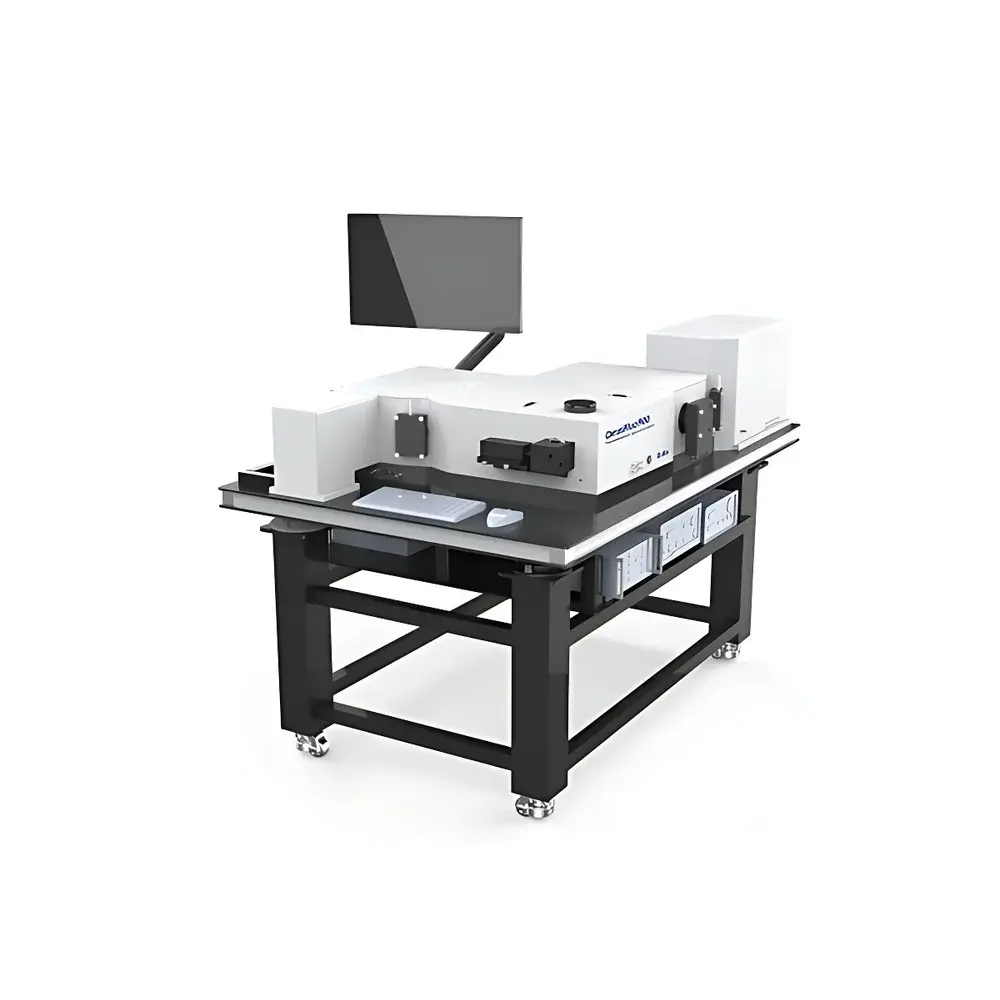
ZOLIX OmniFluo960 Steady-State and Time-Resolved Fluorescence Spectrometer
| Brand | ZOLIX |
|---|---|
| Origin | Beijing, China |
| Manufacturer Type | Original Equipment Manufacturer (OEM) |
| Model | OmniFluo960 |
| Dispersion Element | Holographic Grating |
| Slit Width (Spectral Bandpass) | 0.01–3 mm (excitation), 0.023–7 mm (emission) |
| Spectral Resolution | ≤ 0.08 nm |
| Sensitivity | Water Raman Signal-to-Noise Ratio ≥ 10,000:1 (at 350 nm excitation, 370–450 nm scan, 5 nm slit, 1 s integration) |
| Wavelength Accuracy | ±0.2 nm |
| Wavelength Repeatability | ±0.1 nm |
| Focal Length | 320 mm |
| Stray Light | ≤ 1×10⁻⁵ |
| Detector Options | CR131 (cooled red-sensitive PMT, 185–900 nm), R928, R13456, H10330C-75, R5509-73 |
| Standard Sample Chamber | SAC-FLS with cuvette, powder & solid sample holders |
| Automated Light Shield | Yes |
| Dark Count | ≤ 100 CPS (at –10°C) |
Overview
The ZOLIX OmniFluo960 is a high-performance, modular steady-state and time-resolved fluorescence spectrometer engineered for quantitative molecular photophysics research. It operates on the principle of wavelength-selective excitation and emission detection using double monochromator architecture—comprising an Omni-λ3027i 320 mm focal length imaging spectrometer for both excitation and emission pathways—with holographic blazed gratings optimized for UV–NIR spectral coverage (185–1700 nm, depending on detector selection). The system integrates a high-stability 75 W xenon arc lamp (Gloria75X) as primary broadband excitation source, configurable multi-wavelength laser diodes or LEDs for selective excitation, and a thermoelectrically cooled red-sensitive photomultiplier tube (CR131) delivering sub-100 CPS dark counts at –10°C. Its optical design minimizes stray light (<1×10⁻⁵) and achieves ≤0.08 nm spectral resolution under standard conditions—enabling precise discrimination of vibronic structure in organic fluorophores, quantum dots, and lanthanide complexes. The instrument supports both continuous-wave (CW) intensity-based measurements and time-correlated single-photon counting (TCSPC) with picosecond temporal resolution when coupled to compatible multichannel scalar or TCSPC electronics.
Key Features
- Modular dual-monochromator platform with independently adjustable excitation and emission slits (0.01–3 mm and 0.023–7 mm, respectively) for optimal signal-to-noise and spectral fidelity
- High-throughput optical path incorporating optimized Littrow-mounted blazed gratings: 1200 g/mm (BLZ@300 nm) and 600 g/mm (BLZ@500 nm), enabling flexible trade-offs between resolution and throughput
- Automated light-shielding mechanism prevents detector saturation during sample exchange, preserving PMT longevity and measurement reproducibility
- Expandable detector ecosystem supporting interchangeable PMTs (R928, R13456), InGaAs detectors (H10330C-75), and extended-range silicon devices (R5509-73) for seamless UV–SWIR coverage
- Standard SAC-FLS sample chamber accommodates cuvettes (10 mm path), powders, thin films, and solids; optional accessories include motorized rotation stages, magnetic stirrers, and temperature-controlled mounts
- Wavelength accuracy of ±0.2 nm and repeatability of ±0.1 nm—certified via internal Hg/Ne spectral line referencing—ensures traceable calibration compliant with ISO/IEC 17025 laboratory requirements
Sample Compatibility & Compliance
The OmniFluo960 accepts liquid, solid, and powdered samples across diverse physical forms—including microvolume solutions in quartz cuvettes, spin-coated perovskite films, freeze-dried protein powders, and encapsulated nanocrystals. Its large-volume sample chamber facilitates integration with third-party cryostats (e.g., Oxford Instruments OptistatDN) and variable-temperature stages for temperature-dependent quantum yield and lifetime mapping from 4 K to 500 K. All firmware and data acquisition modules adhere to GLP-compliant audit trail protocols, with timestamped parameter logging, user-access control, and electronic signature support aligned with FDA 21 CFR Part 11 requirements for regulated environments. Spectral calibration procedures follow ASTM E275 and ISO 17025 guidelines, while water Raman SNR validation conforms to IUPAC-recommended methodology for sensitivity benchmarking.
Software & Data Management
Control and analysis are performed via ZOLIX FluoroScan v4.x—a native Windows application built on .NET Framework with real-time spectrum preview, automated wavelength scanning, kinetic decay fitting (multi-exponential, stretched exponential, distributed lifetime models), and absolute quantum yield calculation using integrating sphere coupling. Raw TCSPC histograms and steady-state spectra are saved in vendor-neutral HDF5 format, ensuring compatibility with Igor Pro, MATLAB, Python (via h5py), and OriginLab. Built-in report generation supports customizable templates compliant with journal submission standards (e.g., ACS, RSC, IOP). Audit logs record every hardware setting change, user login event, and calibration action with SHA-256 hashing for integrity verification—fully satisfying GMP documentation traceability mandates.
Applications
- Quantitative photoluminescence quantum yield (PLQY) determination of emissive materials for OLEDs, PeLEDs, and down-conversion phosphors
- Time-resolved emission spectroscopy (TRES) of excited-state proton transfer, energy transfer kinetics, and triplet–triplet annihilation dynamics
- Temperature-dependent luminescence studies of thermally activated delayed fluorescence (TADF) emitters
- Laser-induced fluorescence (LIF) for microfluidic flow cytometry and combustion diagnostics
- Electroluminescence (EL) spectral characterization of operating devices under bias
- Stability assessment of fluorescent biosensors under photobleaching stress (integrated irradiance monitoring)
FAQ
What is the minimum detectable lifetime using the OmniFluo960 in TCSPC mode?
The system achieves instrumental response function (IRF) widths <25 ps when paired with a 405 nm pulsed diode laser and CR131 detector—enabling reliable resolution of lifetimes ≥50 ps with χ² ≈ 1.0 fitting residuals.
Can the OmniFluo960 measure absolute quantum yield without external standards?
Yes—when equipped with an integrating sphere accessory (optional), the system performs reference-free QY calculation using dual-spectrum acquisition (excitation-scattered + emission) and spectral deconvolution algorithms validated per CIE 127:2007.
Is remote operation supported for unattended overnight measurements?
All hardware interfaces use TCP/IP and USB 3.0 protocols with full API access (C++/Python SDK included); scheduled experiments can be triggered via cron jobs or LabVIEW integration with email/SMS alerting on completion or error.
How does the system handle spectral calibration drift during long-term thermal cycling?
An onboard Hg/Ne mini-lamp provides automated wavelength recalibration every 30 minutes or per scan cycle, correcting for thermal expansion-induced grating misalignment with sub-pixel CCD registration.
Are there regulatory certifications for use in pharmaceutical QC labs?
The instrument meets electromagnetic compatibility (EMC) requirements per IEC 61326-1 and safety standards per IEC 61010-1; full 21 CFR Part 11 validation packages—including IQ/OQ/PQ documentation—are available upon request for GxP environments.





