
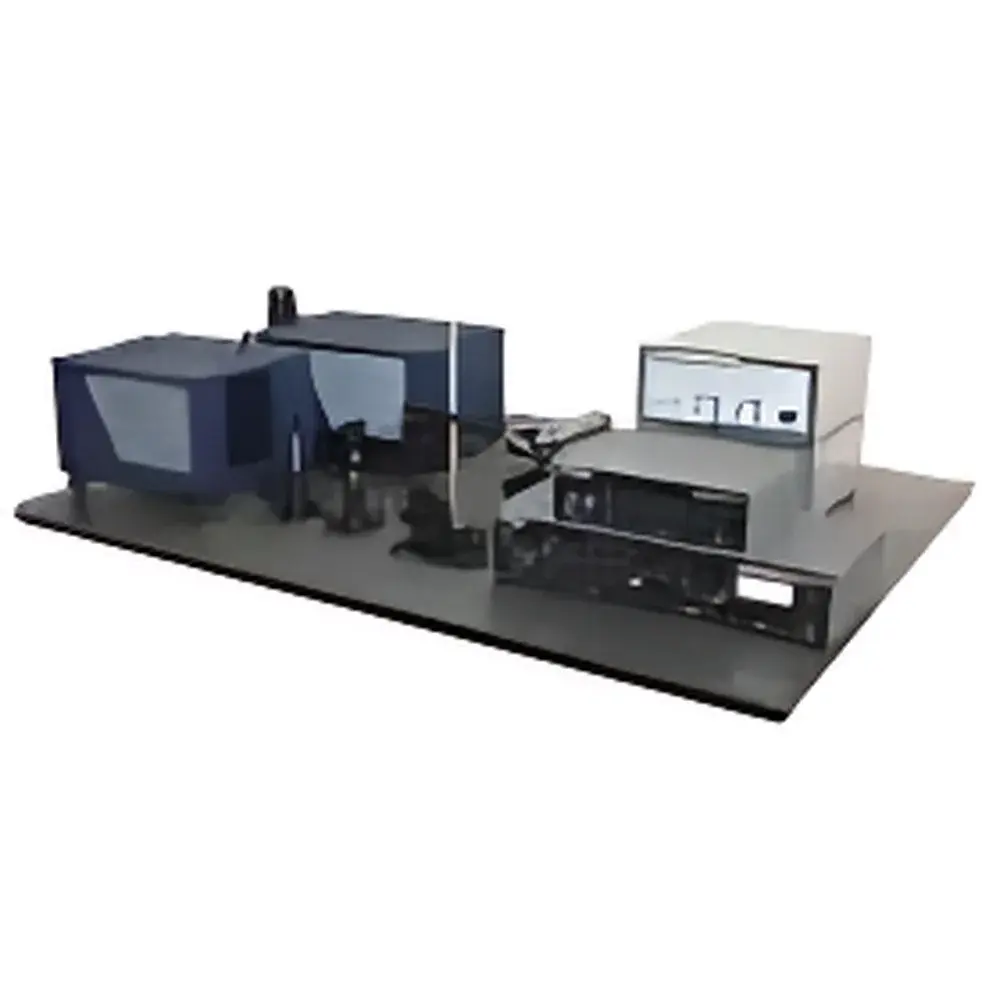
ZOLIX OmniPL Series Modular Photoluminescence Spectroscopy System
| Brand | ZOLIX |
|---|---|
| Origin | Beijing, China |
| Manufacturer Type | Direct Manufacturer |
| Product Origin | Domestic (China) |
| Model | OmniPL Series |
| Price Range | USD 28,000 – 42,500 |
| Dispersive Elements | Holographic Grating & Bandpass Filters |
| Slit Width (Spectral Bandpass) | Adjustable, 10–2000 µm |
| Spectral Resolution | < 0.2 nm (@ 1200 g/mm grating) |
| Signal-to-Noise Ratio | 3000:1 |
| Wavelength Accuracy | ±0.2 nm |
| Wavelength Repeatability | ±0.1 nm |
| Excitation Source | HeCd Laser (325 nm, 20 mW) |
| Rayleigh Cutoff Filter | OD > 6 |
| Spectral Detection Range | 300–850 nm (expandable to 2500 nm) |
| Detector | Scientific-grade, thermoelectrically cooled back-illuminated CCD (300–1000 nm) |
| Optional Cryogenic Stage | Closed-cycle cryostat, 2 K minimum operating temperature |
| Software | Fully programmable acquisition protocol engine with spectral arithmetic, batch processing, and audit-trail logging |
Overview
The ZOLIX OmniPL Series Modular Photoluminescence Spectroscopy System is a research-grade, configurable platform engineered for high-fidelity steady-state photoluminescence (PL) characterization of optoelectronic and quantum materials. Operating on the principle of optical excitation followed by spectrally resolved emission detection, the system enables quantitative analysis of radiative recombination pathways, defect-related transitions, excitonic behavior, and band-edge shifts in semiconductors, perovskites, 2D materials, and phosphor compounds. The core architecture integrates a stabilized 325 nm HeCd laser source, a high-throughput sample chamber with precision optical alignment, a Czerny–Turner monochromator equipped with selectable gratings and interference filters, and a deep-cooled back-illuminated CCD detector optimized for UV–NIR sensitivity. Designed for reproducibility under laboratory conditions, the system meets foundational requirements for material qualification in R&D environments aligned with ISO/IEC 17025–compliant workflows.
Key Features
- Modular optical design enabling field-upgradable configurations—from basic UV–vis PL to extended NIR spectroscopy (up to 2500 nm) via grating exchange and detector substitution
- High spectral fidelity: < 0.2 nm resolution at 1200 g/mm grating density, supported by sub-pixel wavelength calibration and real-time slit-width feedback control
- Low-noise detection architecture: Thermoelectrically cooled back-illuminated CCD with quantum efficiency >90% at 600 nm and dark current < 0.001 e⁻/pix/s at –60°C
- Integrated Rayleigh rejection: OD > 6 edge filters suppress elastic scattering without compromising signal throughput or spectral integrity
- Cryogenic compatibility: Direct mounting interface for closed-cycle refrigerators (2 K base temperature), enabling temperature-dependent PL mapping across quantum-confined systems
- Hardware-synchronized timing: Precise gating between excitation pulse (if using pulsed sources) and detector integration window, supporting lifetime-resolved extensions
Sample Compatibility & Compliance
The OmniPL Series accommodates solid-state samples—including wafers, thin films, powders, colloidal suspensions, and single crystals—via interchangeable sample holders (standard quartz cuvette stage, vacuum-compatible cold finger mount, and magnetic sample chuck). Optical path geometry supports normal-incidence excitation and collection, as well as variable-angle configurations for anisotropic emitters. All optical components comply with RoHS directives; mechanical enclosures meet IP20 environmental classification. The system’s calibration traceability aligns with NIST-traceable spectral standards (e.g., Hg/Ar lamp lines), and wavelength accuracy (±0.2 nm) satisfies ASTM E275 and ISO 17025 criteria for certified reference material validation. For regulated environments, software modules support 21 CFR Part 11-compliant user authentication, electronic signatures, and immutable audit trails.
Software & Data Management
ZOLIX PLStudio™ v4.x provides a deterministic acquisition environment built on LabVIEW Real-Time and .NET Framework. It features scriptable experiment sequencing, multi-channel spectral acquisition (including simultaneous reference channel monitoring), and non-linear baseline correction algorithms compliant with USP . Data files are stored in HDF5 format with embedded metadata (excitation parameters, slit width, grating ID, detector temperature, calibration timestamp). Spectral arithmetic includes ratioing, subtraction, convolution, and derivative calculation—enabling band deconvolution and Stokes shift quantification. Export options include CSV, ASCII, and JCAMP-DX for interoperability with third-party analysis tools (OriginPro, MATLAB, Igor Pro). All processing steps are logged with ISO/IEC 17025–aligned provenance tracking.
Applications
- Bandgap determination and exciton binding energy analysis in GaN, ZnO, MoS₂, and halide perovskites
- Quantum yield estimation via integrating sphere coupling (optional accessory)
- Defect state mapping in wide-bandgap semiconductors using low-temperature PL thermodynamics
- LED phosphor screening and degradation kinetics under thermal stress cycling
- Time-resolved PL precursor (when paired with TCSPC module) for carrier lifetime extraction in nanostructured emitters
- Strain-induced spectral shifts in heteroepitaxial layers via micro-PL raster scanning
FAQ
Can the OmniPL system be upgraded for time-resolved PL measurements?
Yes—through integration with optional time-correlated single-photon counting (TCSPC) hardware and synchronized pulsed laser sources (e.g., picosecond diode lasers). The software supports lifetime decay fitting using iterative reconvolution methods.
Is NIST-traceable calibration included with the system?
A factory-installed Hg/Ar spectral calibration lamp is supplied, and full calibration reports with uncertainty budgets (k = 2) are provided. On-site recalibration services are available under ZOLIX’s ISO/IEC 17025-accredited program.
What vacuum or inert-gas compatibility does the sample chamber offer?
The standard chamber supports ambient air or nitrogen purge. Optional vacuum-tight versions (10⁻³ mbar base pressure) and glove-box integration kits are available for oxygen-sensitive samples.
Does the software support automated batch processing for high-throughput screening?
Yes—PLStudio includes a macro recorder and Python API for custom automation scripts, enabling unattended spectral acquisition across wafer maps or multi-sample trays.
Are OEM integration options available for embedding the OmniPL optics into custom platforms?
ZOLIX offers OEM optical engine variants with TTL-triggered detectors, compact monochromator modules, and SDK documentation for seamless integration into industrial inspection or metrology systems.
Related Products






