
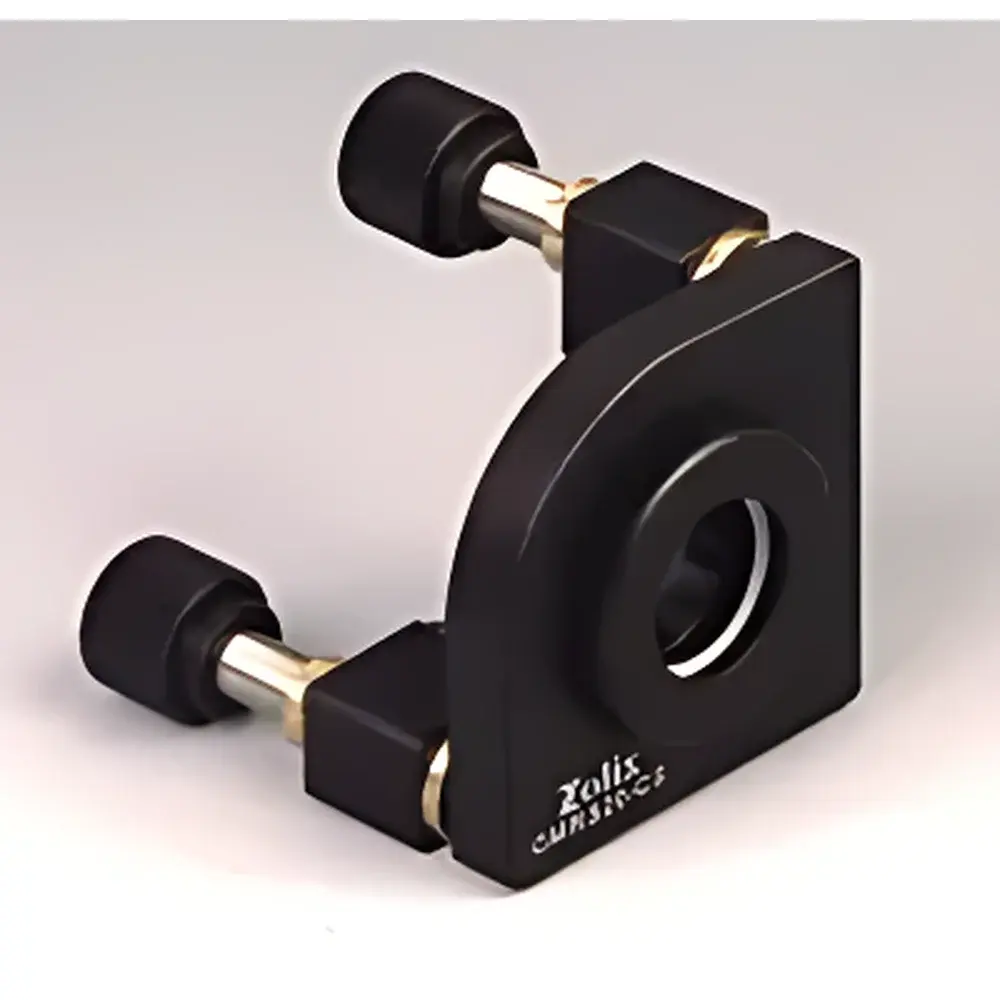
ZOLIX OMRS12.7/20/25/25.4/30-CS Two-Axis High-Stability Mirror Mount
| Brand | ZOLIX |
|---|---|
| Origin | Beijing, China |
| Manufacturer Type | Original Equipment Manufacturer (OEM) |
| Product Origin | Domestic (China) |
| Model | OMRS12.7-CS / OMRS20-CS / OMRS25-CS / OMRS25.4-CS / OMRS30-CS |
| Clamping Diameter A | 12.7 mm / 20 mm / 25 mm / 25.4 mm / 30 mm |
| Clear Aperture B | 11 mm / 18 mm / 23 mm / 23 mm / 28 mm |
| Angular Adjustment Range | ±3° (Pitch & Yaw) |
| Center Height D | 25 mm (OMRS12.7–25.4-CS), 27.5 mm (OMRS30-CS) |
| Front Plate Width E | 50 mm (OMRS12.7–25.4-CS), 55 mm (OMRS30-CS) |
| Total Width F | 53 mm (OMRS12.7–25.4-CS), 58 mm (OMRS30-CS) |
Overview
The ZOLIX OMRS12.7/20/25/25.4/30-CS series comprises precision-engineered two-axis mirror mounts designed for high-stability optical alignment in demanding laboratory and industrial applications. Each variant is constructed using stress-relieved aluminum alloy with black anodized surface treatment to ensure dimensional stability, thermal consistency, and resistance to oxidation under controlled environmental conditions. The mount operates on a dual-micrometer actuation principle—separate fine-pitch screws (typically 100 TPI) control independent pitch and yaw adjustments, enabling sub-arcminute angular resolution without inducing lateral shift or tilt-induced beam walk-off. Its kinematic design isolates the mirror substrate from base deformation, minimizing drift during thermal cycling or mechanical vibration. These mounts are intended for integration into laser cavities, interferometric setups, spectroscopic beam paths, and automated optical benches where long-term pointing stability and repeatable repositioning are critical.
Key Features
- Two orthogonal adjustment axes (pitch and yaw) with independent micrometer-driven actuators for precise angular control.
- Clamping mechanism compatible with standard optic diameters: 12.7 mm, 20 mm, 25 mm, 25.4 mm (1 inch), and 30 mm—each model optimized for its designated optic size.
- Clear aperture ranging from 11 mm to 28 mm ensures minimal vignetting for collimated or moderately convergent beams.
- Center height fixed at 25 mm across most variants (27.5 mm for OMRS30-CS), facilitating consistent optical axis alignment in stacked or modular optical systems.
- Rigid front plate (50 mm or 55 mm width) and low-profile total width (53–58 mm) support dense packaging in space-constrained optical layouts.
- Black anodized finish provides uniform surface emissivity and reduces stray light reflection in sensitive detection environments.
Sample Compatibility & Compliance
The OMRS-CS series accommodates uncoated, dielectric-coated, metallic, and broadband anti-reflection coated mirrors up to 6 mm thickness (standard clamping depth). It supports plano, concave, and convex substrates with surface flatness ≤λ/10 and surface quality ≤20–10 scratch-dig per MIL-PRF-13830B. While not certified to ISO 9001 or CE as a standalone component, the mounts are manufactured under documented quality control procedures aligned with general laboratory equipment traceability requirements. They are routinely deployed in setups compliant with ISO/IEC 17025-accredited calibration laboratories and meet mechanical interface expectations defined in ANSI/OEOSC OP1.002 for optical mounting hardware interoperability.
Software & Data Management
These are purely mechanical mounts with no embedded electronics or firmware; therefore, no software driver, API, or data logging capability is provided. However, their deterministic mechanical response enables seamless integration with motorized translation stages and motion controllers (e.g., Thorlabs Kinesis, Newport Motion Control Suite) when retrofitted with stepper-motorized actuators (not included). Adjustment repeatability is verified via optical lever arm measurement using position-sensitive detectors (PSDs) or quadrant photodiodes, supporting traceable alignment protocols required in GLP-compliant optical validation workflows.
Applications
- Laser cavity mirror alignment in CW and pulsed solid-state, diode, and fiber laser systems.
- Beam steering and path correction in Michelson, Mach–Zehnder, and Sagnac interferometers.
- Input/output coupling optimization in Raman spectrometers and FTIR sampling interfaces.
- Stabilization of reference beams in atomic physics experiments involving magneto-optical traps (MOTs) and optical lattices.
- Alignment fixtures in optical coherence tomography (OCT) source and detection arms.
- Modular optomechanical prototyping on breadboards adhering to standard 1/4″-20 or M6 tapped hole patterns.
FAQ
What is the angular resolution achievable with the micrometer adjustments?
Typical resolution is ~10 arcseconds per division (0.0025 mm linear displacement × optical lever gain), assuming standard 100 TPI screws and 1-inch mirror substrate distance from pivot.
Can these mounts be vacuum-compatible?
Standard versions are not vacuum-rated due to lubricant presence and anodization porosity; however, vacuum-compatible variants (with dry-film lubricants and sealed threads) can be supplied upon request with lead-time extension.
Is center height referenced to the optical axis or mechanical base?
Center height D is measured from the base mounting surface to the nominal optical axis passing through the center of the clamped mirror’s reflective surface.
Are replacement clamping rings available separately?
Yes—ZOLIX offers interchangeable retaining rings for each model (part numbers OMRS-R12.7, OMRS-R20, etc.) to accommodate variations in optic thickness or edge geometry.
Do these mounts meet RoHS or REACH requirements?
Yes—the aluminum alloy and anodization process comply with EU Directive 2011/65/EU (RoHS2) and Regulation (EC) No 1907/2006 (REACH) Annex XVII substance restrictions. Material declarations are available upon formal inquiry.





