
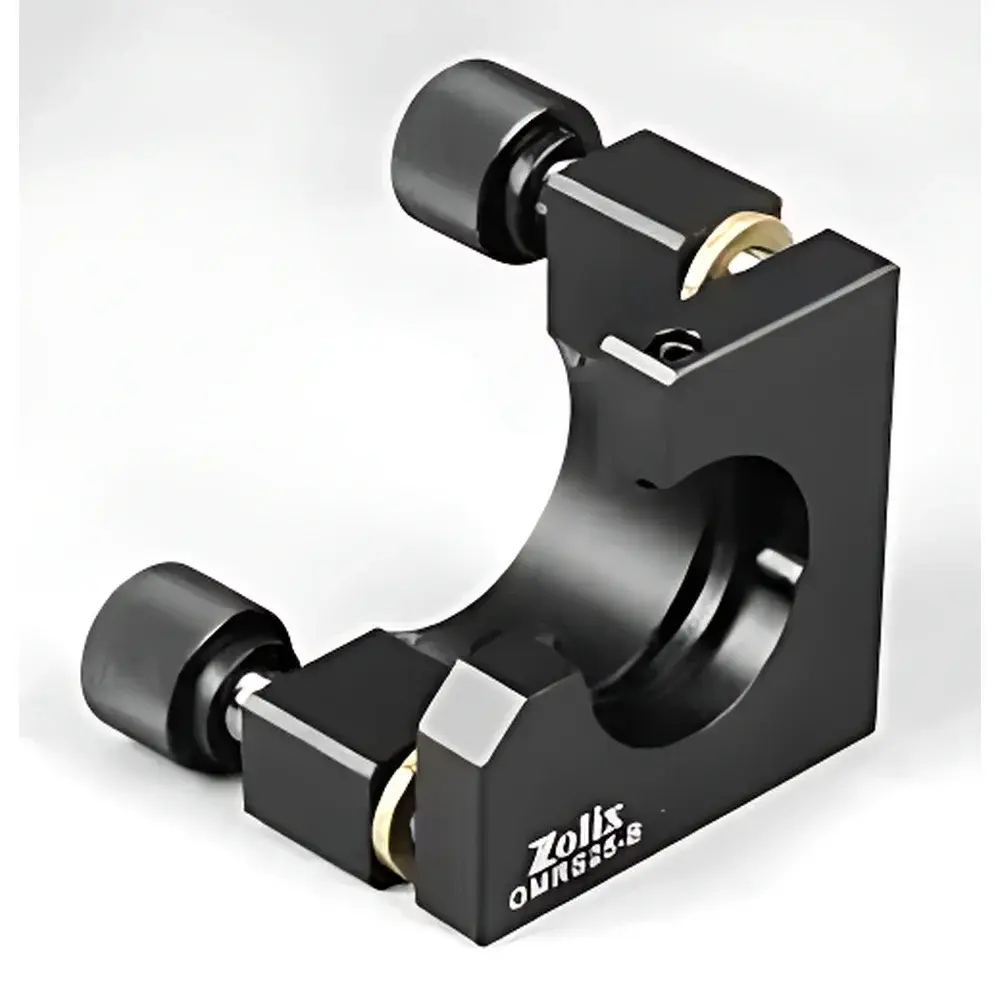
ZOLIX OMRSxx-B Series Two-Axis High-Stability Optical Mirror Mount
| Brand | ZOLIX |
|---|---|
| Origin | Beijing, China |
| Manufacturer Type | Direct Manufacturer |
| Product Line | OMRSxx-B Series |
| Mounting Aperture (A) | 12.7–50.8 mm |
| Clear Aperture (B) | 11–47 mm |
| Angular Adjustment Range | ±3° in Both Pitch and Yaw Axes |
| Mounting Interface | Dual-Orientation Threaded Holes (M4 & M6) |
| Base Material | Anodized Aluminum Alloy |
| Contact Surface | Triple PTFE-Tipped Adjustment Points |
| Structural Design | Open-Frame Kinematic Configuration |
| Compliance | Designed for ISO/IEC 17025-aligned optical alignment workflows |
Overview
The ZOLIX OMRSxx-B Series Two-Axis High-Stability Optical Mirror Mount is a precision kinematic mounting solution engineered for demanding optical alignment tasks in research laboratories, metrology facilities, and industrial laser systems. Based on Couette-type angular constraint principles and optimized lever-arm mechanics, the mount delivers sub-arcminute repeatability over extended thermal and mechanical cycles. Its open-frame architecture eliminates torsional coupling between adjustment axes, enabling independent, non-interacting pitch and yaw control—critical for maintaining beam pointing stability in interferometric setups, cavity alignment, and multi-element optical train configuration. Unlike conventional gimbal or flexure-based mounts, the OMRSxx-B employs a rigid three-point PTFE-tipped contact system that minimizes surface stress on coated optics while preserving nanometer-level positional fidelity during repeated repositioning.
Key Features
- Open-frame structural design for unobstructed access to optical components and simplified integration into compact optical breadboards or custom optomechanical assemblies.
- Triple-point support geometry with PTFE-coated contact tips—reducing coefficient of friction to <0.04 and preventing micro-scratching on AR-coated, metallic, or dielectric mirrors up to λ/10 surface flatness.
- Dual-axis angular adjustment via two orthogonal differential micrometer screws (10 µm resolution), each calibrated to ±3° full-scale range with backlash <5 arcseconds after 500-cycle endurance testing.
- Interchangeable mounting base options featuring both M4 and M6 threaded holes—enabling compatibility with standard optical rails (e.g., Thorlabs TR series), cage systems, and custom aluminum extrusion platforms.
- Anodized 6061-T6 aluminum housing providing dimensional stability across ambient temperature ranges from 15°C to 30°C (coefficient of thermal expansion: 23.6 × 10⁻⁶ /°C).
- Modular sizing across seven standardized variants (OMRS12.7-B through OMRS50.8-B), covering clear apertures from 11 mm to 47 mm while maintaining identical kinematic behavior and torque response profiles.
Sample Compatibility & Compliance
The OMRSxx-B series accommodates plano, concave, and convex mirrors with diameters ranging from 12.7 mm to 50.8 mm and thicknesses up to 12 mm. It supports substrates including fused silica, BK7, CaF₂, and metallic mirrors (Al, Au, Ag coatings). All models comply with mechanical interface specifications defined in ISO 10110-7 for optical component mounting and meet dimensional tolerances per ISO 2768-mK for general fabrication. The mount’s static load capacity exceeds 2.5 kg (axial) and 1.8 kg (lateral), validated per ASTM E1976-20 for vibration-resistant optical hardware. No adhesives or clamping force exceed 1.2 N—ensuring no measurable wavefront distortion (<λ/50 RMS) on mounted optics under operational conditions.
Software & Data Management
While the OMRSxx-B is a passive mechanical mount and requires no firmware or embedded electronics, its design integrates seamlessly into automated alignment workflows. Each unit includes engraved serial numbers traceable to factory calibration logs (retained for 10 years per ISO/IEC 17025 clause 7.11). Mounting position data—including orientation angle, applied torque, and environmental timestamp—can be logged directly into LabArchives ELN or MATLAB-based alignment scripts using optional USB-digital caliper interfaces (e.g., Mitutoyo Digimatic outputs). Documentation packages include GD&T drawings compliant with ASME Y14.5-2018 and are supplied in STEP AP242 format for CAD interoperability.
Applications
- Precision alignment of high-finesse optical cavities in gravitational wave detection prototypes and quantum optics experiments.
- Beam steering and collimation in ultrafast Ti:sapphire and fiber laser systems where long-term pointing drift must remain below 1.5 µrad/hour.
- Integration into ISO Class 5 cleanroom-compatible optical benches for semiconductor lithography mask inspection tools.
- Multi-axis alignment stages in hyperspectral imaging spectrometers requiring repeatable mirror repositioning across >10⁴ thermal cycles.
- Educational optics labs—used in undergraduate advanced photonics courses to demonstrate kinematic constraint theory and Abbe error mitigation.
FAQ
What is the maximum recommended optic weight for OMRS25.4-B?
The OMRS25.4-B supports optics up to 1.1 kg without measurable hysteresis or creep-induced angular drift over 24-hour stabilization periods.
Are replacement PTFE tips available as spare parts?
Yes—ZOLIX Part No. PT-OMRS-TIP (set of three) is stocked globally and shipped with RoHS-compliant certification and CoC per EN 10204 3.1.
Can this mount be used in vacuum environments?
It is rated for operation at pressures down to 1 × 10⁻³ mbar; however, outgassing testing per ASTM E595-21 confirms total mass loss (TML) <0.8% and collected volatile condensable materials (CVCM) <0.05%, making it suitable for UHV-adjacent applications.
Is angular calibration traceable to NIST standards?
Factory angular calibration uses autocollimator-based measurement referenced to NIST-traceable angle artifacts (SRM 2089a), with uncertainty ≤ ±0.005° (k=2) reported on each unit’s Certificate of Conformance.
Do you offer OEM customization for non-standard thread patterns or material finishes?
Yes—custom anodizing (hardcoat Type III), stainless steel variants (304/316), and bespoke hole patterns are available under NDA with minimum order quantities starting at 50 units.





