
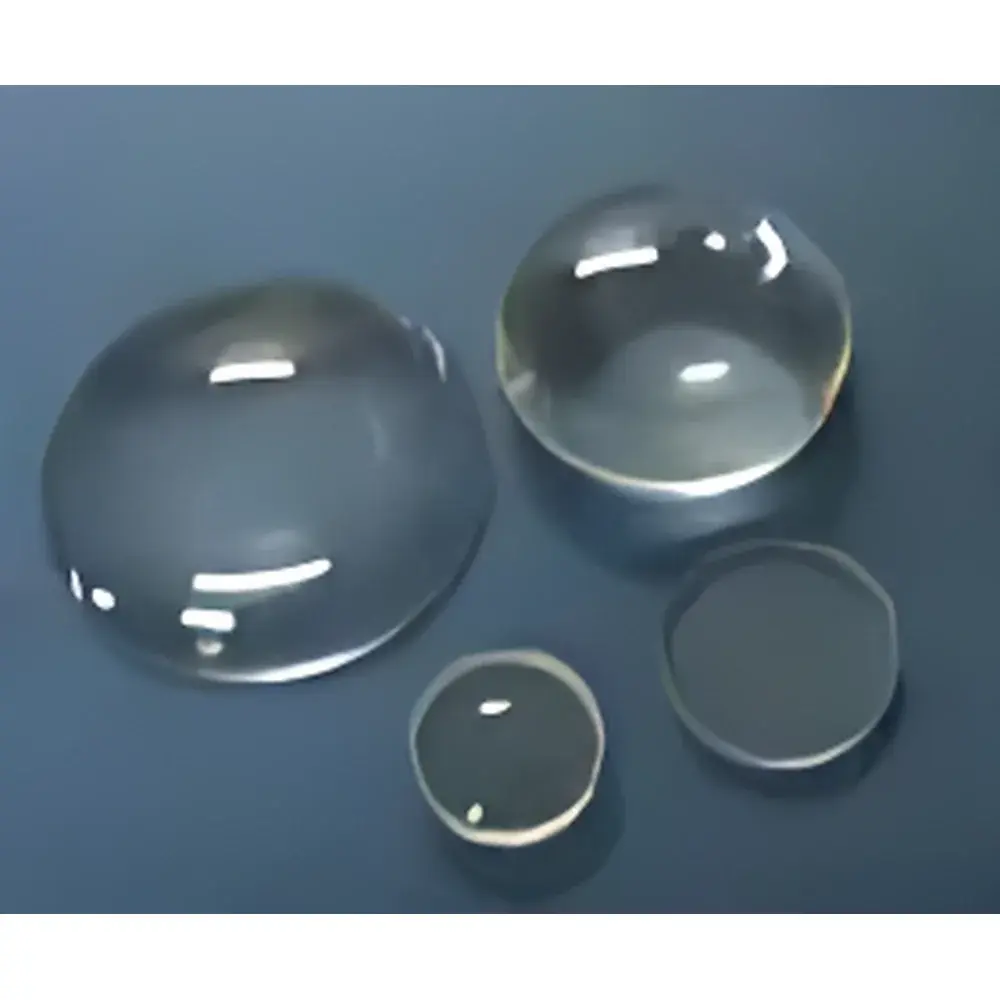
ZOLIX Plano-Concave and Bi-Concave Optical Lenses
| Brand | ZOLIX |
|---|---|
| Origin | Beijing, China |
| Manufacturer Type | OEM/ODM Manufacturer |
| Product Origin | Domestic (China) |
| Models | Comprehensive Range of Standard & Custom Sizes |
| Pricing | Available Upon Request |
| Material Options | BK7 (K9) Optical Glass, UV Fused Silica |
| Design Wavelength | 587.6 nm |
| Diameter Tolerance | +0.0 / −0.1 mm (Plano-Concave), +0.0 / −0.2 mm (Cylindrical) |
| Center Thickness Tolerance | ±0.2 mm |
| EFL Tolerance | ±2% |
| Edge Finishing | 0.2 mm × 45° chamfer |
| Coating | Uncoated (AR coating available on request) |
Overview
ZOLIX plano-concave and bi-concave lenses are precision optical components engineered for beam expansion, divergence control, laser cavity design, and aberration correction in demanding research and industrial optical systems. These negative focal length lenses operate on the principle of refraction governed by the lensmaker’s equation, with surface curvature and refractive index dictating focal power. Manufactured to ISO 10110–1 and ISO 10110–3 standards for surface quality and dimensional accuracy, each lens undergoes rigorous metrological verification—including interferometric wavefront testing and mechanical dimension inspection—ensuring high reproducibility across batches. The standard design wavelength is 587.6 nm (d-line), aligning with common calibration practices in optical alignment and spectroscopic instrumentation.
Key Features
- Precision-ground and polished surfaces with λ/4 surface flatness (typical) and scratch-dig specification of 40–20 per MIL-PRF-13830B
- Two primary substrate options: high-homogeneity BK7 (K9) optical glass for visible–NIR applications (350–2000 nm), and UV-grade fused silica for deep-UV transmission (185–2100 nm)
- Comprehensive catalog covering diameters from Φ12.7 mm to Φ50.8 mm and focal lengths ranging from −25 mm to −1000 mm
- Standard edge treatment: 0.2 mm × 45° protective chamfer to mitigate chipping during handling and mounting
- Uncoated surfaces provide baseline performance; optional broadband or laser-line anti-reflection (AR) coatings available upon specification (e.g., R<0.25% @ 400–700 nm or R<0.15% @ 1064 nm)
- Dedicated cylindrical variants (OLBCY series) enable astigmatic correction and line generation in scanning and shaping optics
Sample Compatibility & Compliance
These lenses are compatible with standard kinematic mounts (e.g., SM1-threaded lens tubes, cage systems, and post holders) and integrate seamlessly into OEM optomechanical assemblies. All BK7 and fused silica substrates comply with RoHS Directive 2011/65/EU and REACH Regulation (EC) No. 1907/2006. Dimensional tolerances adhere to ISO 10110–1 (surface form) and ISO 10110–2 (surface imperfections). For regulated environments—including ISO/IEC 17025-accredited laboratories and GxP-compliant optical test stations—full traceable calibration reports and material certificates of conformance (CoC) can be supplied upon order.
Software & Data Management
While passive optical elements do not incorporate embedded firmware or software interfaces, ZOLIX provides comprehensive digital asset support: downloadable STEP and Zemax-compatible .zmx files for all standard models, enabling rapid integration into optical design workflows (e.g., Zemax OpticStudio, CODE V, FRED). Lens specifications are published in machine-readable JSON and CSV formats via the ZOLIX Optical Component Portal, supporting automated BOM generation and procurement system integration. For customers operating under FDA 21 CFR Part 11 or EU Annex 11 requirements, documentation packages include revision-controlled spec sheets, batch-specific inspection records, and audit-ready manufacturing logs.
Applications
- Laser resonator design: stabilizing transverse modes and controlling cavity stability parameters (g-parameter optimization)
- Beam collimation and expansion: paired with positive lenses in Galilean or Keplerian telescopic configurations
- Optical coherence tomography (OCT): dispersion compensation and reference arm path tuning
- UV lithography and photomask inspection: fused silica variants maintain low birefringence and high thermal stability at 193 nm and 248 nm
- Educational optics labs: demonstrating Gaussian beam propagation, ray tracing principles, and thin-lens approximation validation
- Machine vision illumination: cylindrical plano-concave lenses generate uniform line profiles for structured light projection
FAQ
Are these lenses suitable for high-power laser applications?
Yes—fused silica variants are rated for continuous-wave (CW) laser operation up to 500 W/cm² at 1064 nm (tested per ISO 21254–1); BK7 versions are qualified for ≤100 W/cm² in the visible spectrum.
Can custom focal lengths or diameters be manufactured?
Yes—ZOLIX supports custom geometries including non-standard diameters, aspheric corrections, and hybrid (spherical + cylindrical) surfaces under NRE-supported development contracts.
What is the typical lead time for uncoated standard stock items?
In-stock BK7 plano-concave lenses ship within 3–5 business days; fused silica and bi-concave variants typically require 2–3 weeks due to extended annealing cycles.
Do you provide mounting hardware or alignment fixtures?
Standard SM1-threaded lens cells, retaining rings, and kinematic lens mounts are available separately through the ZOLIX Mechanical Components Catalog.
Is ISO 17025 calibration data available for individual lenses?
Yes—certified interferometric wavefront maps and focal length verification reports are available as optional add-ons, traceable to NIM (National Institute of Metrology, China).




