
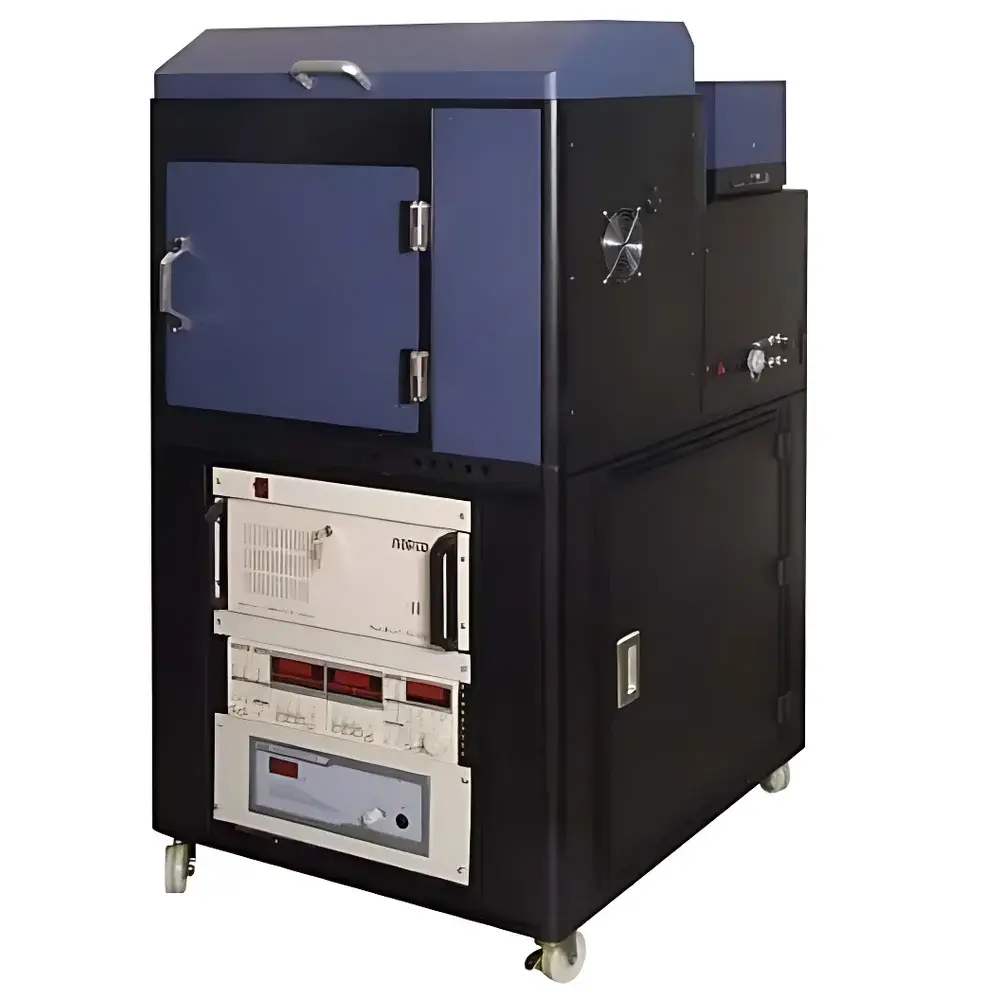
ZOLIX PMEye-3000 Series Photoluminescence Mapping System
| Brand | ZOLIX |
|---|---|
| Model | PMEye-3000 Series |
| Origin | Beijing, China |
| Manufacturer | ZOLIX (Producer) |
| Laser Options | 266 nm, 405 nm, 442 nm, 532 nm, 785 nm (internal) |
| Mapping Speed | >20 points/sec |
| Spatial Resolution | 10 µm (objective mode), 50 µm (lens mode) |
| Spectral Resolution | 0.1 nm @ 1200 grooves/mm |
| Max Sample Size | 8-inch wafer |
| Spectrometer | 500 mm focal length, triple-grating DSP-scanning monochromator |
| Detector Options | Si photodiode (200–1100 nm), R1527 PMT (200–680 nm), CR131 PMT (200–900 nm), DSi300 Si detector (200–1100 nm), DInGaAs1700 RT InGaAs (800–1700 nm), DInGaAs1900 cooled InGaAs (800–1900 nm), DInGaAs2200 cooled InGaAs (800–2200 nm), DInGaAs2600 cooled InGaAs (800–2600 nm) |
| Wavelength Accuracy | ±0.2 nm (@ 300 nm, 1200 g/mm), ±0.6 nm (@ 500 nm, 600 g/mm), ±0.8 nm (@ 1250 nm, 300 g/mm) |
| XY Stage | 200 × 200 mm travel, <3 µm repeatability |
| Minimum Step Size | 1 µm |
| Data Acquisition | DCS300PA digitizer with preamplifier |
Overview
The ZOLIX PMEye-3000 Series Photoluminescence (PL) Mapping System is a high-precision, research-grade instrumentation platform engineered for spatially resolved optical characterization of semiconductor materials and epitaxial wafers. It operates on the fundamental principle of photoluminescence — a radiative recombination process wherein photoexcited charge carriers relax from higher-energy states to lower-energy states, emitting photons whose spectral distribution reflects the material’s electronic band structure, defect density, compositional uniformity, and strain distribution. Unlike conventional single-point PL spectrometers, the PMEye-3000 integrates a motorized X-Y stage, multi-laser excitation architecture, high-throughput spectrograph, and intensity-stabilized detection to deliver quantitative, position-correlated spectral data across large-area substrates up to 200 mm (8-inch) diameter. Its modular design supports both ambient and cryogenic operation (25–300 K), enabling temperature-dependent studies essential for interpreting carrier localization, exciton binding energies, and thermal quenching behavior in wide-bandgap semiconductors such as GaN, AlGaN, and perovskite thin films.
Key Features
- Multi-wavelength laser excitation: Up to two internal lasers (e.g., 405 nm standard, optional 266/442/532/785 nm) plus one external port for wavelength flexibility across UV–NIR spectral ranges
- Real-time excitation intensity monitoring: Integrated photodiode feedback loop enables automatic correction of PL intensity against laser power drift, ensuring quantitative comparability across time and spatial positions
- High-speed mapping: >20 measurement points per second with programmable step size down to 1 µm, supporting rapid homogeneity assessment of production wafers
- Dual optical paths: Objective-based configuration (10 µm spatial resolution) for high-magnification micro-PL; lens-coupled mode (50 µm resolution) for macro-scale uniformity screening
- Cryogenic compatibility: Optional low-temperature sample chamber (25–300 K) with vacuum interface, enabling variable-temperature PL to resolve phonon replicas, free-to-bound transitions, and localized emission centers
- Modular detector selection: Interchangeable detectors including Si photodiodes, bialkali PMTs, and thermoelectrically cooled InGaAs arrays covering 200–2600 nm, optimized for quantum efficiency and dark-current performance
- DC and lock-in AC detection modes: SR830-compatible lock-in amplification for enhanced signal-to-noise ratio in weak-emission regimes (e.g., low-carrier-density regions or deep-level defects)
Sample Compatibility & Compliance
The PMEye-3000 accommodates standard semiconductor wafers (3″, 4″, 5″, 6″, and 8″) via precision-engineered vacuum chucks with sub-micron flatness control and automated centering routines. Sample mounting preserves surface integrity without mechanical clamping or adhesive residues. The system supports ISO 14644-1 Class 5 cleanroom integration and is compatible with nitrogen-purged or vacuum environments for oxygen-sensitive measurements. All optical and electronic subsystems comply with IEC 61000-6-3 (EMC emissions) and IEC 61010-1 (safety for laboratory equipment). Software logging adheres to ALCOA+ principles (Attributable, Legible, Contemporaneous, Original, Accurate, Complete, Consistent, Enduring, Available) and supports audit trails required under GLP and GMP frameworks. While not FDA 21 CFR Part 11-certified out-of-the-box, the software architecture permits configuration for electronic signature and access control implementation in regulated QC environments.
Software & Data Management
The proprietary PMEye Control Suite is built on a Windows-native C++ framework with real-time multithreaded acquisition, offering intuitive workflow-driven operation without scripting prerequisites. Core functionalities include: single-point spectral acquisition with baseline subtraction and peak deconvolution; wavelength-specific X-Y intensity mapping; integrated peak-wavelength and integrated-intensity mapping; 3D surface visualization with customizable colormaps and contour overlays; batch processing of spectral libraries using Savitzky-Golay smoothing, derivative analysis, and Gaussian/Lorentzian fitting. Raw data are stored in HDF5 format with embedded metadata (wavelength calibration, grating position, detector gain, laser power, temperature, stage coordinates), ensuring full traceability. Export options include CSV, ASCII, and MATLAB-compatible .mat files. The software supports instrument interconnection via TCP/IP and LabVIEW drivers, facilitating integration into automated metrology lines or multi-instrument correlation platforms.
Applications
- LED and laser diode epitaxy: Quantitative assessment of quantum well thickness uniformity, indium composition gradients, and defect-related non-radiative recombination zones
- GaN-on-silicon or GaN-on-sapphire wafer qualification: Spatial mapping of yellow luminescence (YL) band intensity to identify threading dislocation density variations
- Perovskite thin-film solar cells: Correlation of PL lifetime heterogeneity with grain boundary distribution and ion migration kinetics
- 2D materials (MoS₂, WS₂, h-BN): Identification of layer-number-dependent emission shifts and strain-induced bandgap modulation at micron scale
- Quantum dot arrays and nanowire ensembles: Statistical analysis of emission wavelength dispersion and quantum confinement effects across device arrays
- Film thickness metrology: Reflectance-based modeling using the optional 150 W tungsten-halogen broadband source for transparent dielectrics and compound semiconductor layers
FAQ
What excitation wavelengths are supported, and how many lasers can be installed simultaneously?
The system supports up to two internally mounted lasers (e.g., 405 nm + 532 nm) and one externally coupled laser via fiber input. Standard internal options include 266 nm, 405 nm, 442 nm, 532 nm, and 785 nm; external ports accept 325 nm HeCd and 632.8 nm HeNe sources.
Is spectral calibration traceable to NIST standards?
Yes — wavelength calibration uses Hg/Ar/Ne emission line references, with accuracy validated against NIST-traceable spectral lamps. Calibration files are user-editable and persist across instrument restarts.
Can the system perform time-resolved PL (TRPL) measurements?
Not natively — the PMEye-3000 is optimized for steady-state and modulated (lock-in) PL. For TRPL, users may integrate an external pulsed laser and TCSPC module via TTL synchronization signals.
How is vacuum sample handling implemented, and what vacuum level is achieved?
A dedicated vacuum manifold interfaces with a scroll pump to achieve ≤10⁻² mbar at the sample stage, sufficient for eliminating air fluorescence background and preventing oxidation during low-temperature measurements.
Does the software support automated pass/fail criteria for wafer-level screening?
Yes — custom thresholding rules can be defined per map parameter (e.g., peak wavelength deviation > ±2 nm, integrated intensity < 85% of nominal), with pass/fail flags overlaid on 3D renderings and exported to CSV reports.




