
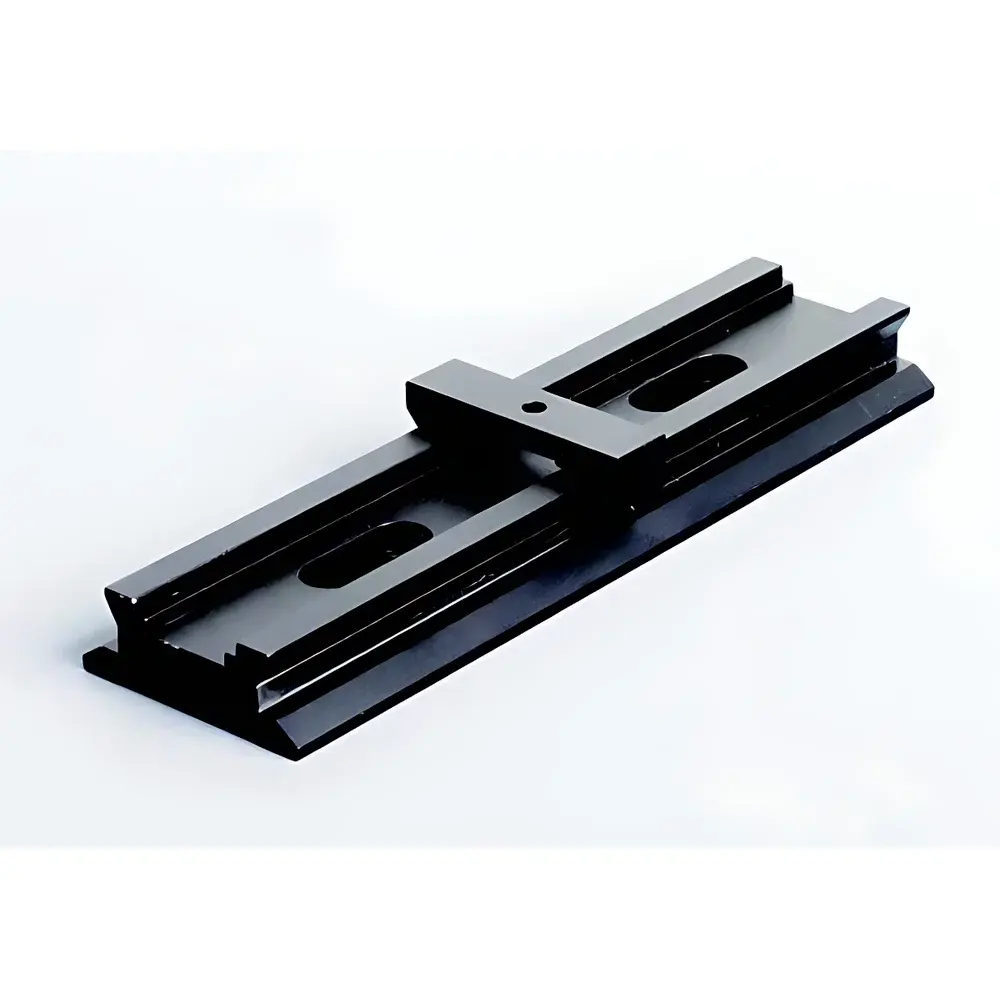
ZOLIX RAOB-M Miniature Optical Rail and Sliding Carriage
| Brand | ZOLIX |
|---|---|
| Origin | Beijing, China |
| Manufacturer Type | Direct Manufacturer |
| Country of Origin | China |
| Model | RAOB-M |
| Rail Width Options | 22 mm (RACA-M1), 35 mm (RACA-M2), 56 mm (RACA-M3) |
| Mounting Interface | Precision Machined Dovetail (Miniature燕尾) |
| Load Capacity | Designed for Light-Duty Optical Components (e.g., Mirrors, Lenses, Diode Mounts, Fiber Couplers) |
| Material | Anodized Aluminum Alloy (6061-T6) |
| Surface Finish | Hard-Anodized, Class II, Black |
| Tolerance | ±0.02 mm Linear Dimensional Accuracy |
| Compatibility | Standard 1/4"-20 and M6 threaded mounting holes on carriage base |
Overview
The ZOLIX RAOB-M Miniature Optical Rail and Sliding Carriage system is an engineered solution for compact, high-stability optical alignment in confined laboratory spaces, teaching labs, prototyping benches, and OEM integration platforms. Built upon a precision-machined miniature dovetail rail profile, the RAOB-M series enables repeatable, low-backlash linear positioning of optical components with sub-millimeter resolution via manual micrometer-driven or friction-lock adjustment. Unlike standard extruded rails, the RAOB-M’s integral dovetail geometry provides inherent lateral and rotational constraint—eliminating parasitic tilt or yaw during translation—making it especially suitable for collimation-sensitive setups such as laser beam steering, interferometric path balancing, and fiber-optic coupling alignment. Each rail segment features precisely spaced 1/4″-20 and M6 tapped holes along its length, allowing rigid anchoring to optical tables, breadboards, or custom fixtures without intermediate adapters.
Key Features
- Precision miniature dovetail interface (±0.02 mm profile tolerance) ensures consistent carriage engagement and minimal play over extended use
- Three standardized rail widths—22 mm (RACA-M1), 35 mm (RACA-M2), and 56 mm (RACA-M3)—support scalable rigidity and component footprint requirements
- Anodized 6061-T6 aluminum construction offers optimal stiffness-to-weight ratio, thermal stability (CTE ≈ 23.6 × 10⁻⁶ /°C), and corrosion resistance
- Carriages include dual-axis locking capability: primary longitudinal lock plus optional orthogonal fine-adjustment setscrew (compatible with 2 mm hex key)
- Modular design permits end-to-end rail extension, right-angle junctions using RAOB-M-compatible corner brackets, and vertical stacking via riser plates
- No tools required for basic carriage repositioning; full lock-down achieved with two-point clamping for vibration-damped operation
Sample Compatibility & Compliance
The RAOB-M system accommodates standard optomechanical components up to 150 g per carriage, including Ø12.7 mm and Ø25.4 mm lens mounts, kinematic mirror mounts (e.g., KM100 series), fiber launchers, and photodetector carriers. All rails and carriages conform to ISO 2768-mK general tolerances for machined parts and comply with RoHS Directive 2011/65/EU for hazardous substance restrictions. Surface hardness meets ASTM B580 Type II Class 2 specifications (≥500 HV). While not certified to ISO 10110 or MIL-STD-810G, the system is routinely deployed in GLP-aligned academic and industrial R&D environments where mechanical repeatability—not environmental ruggedness—is the primary performance criterion.
Software & Data Management
The RAOB-M is a purely mechanical positioning platform with no embedded electronics, firmware, or digital interfaces. As such, it requires no drivers, configuration software, or cybersecurity protocols. Position tracking and documentation are performed externally using calibrated rulers, dial indicators, or coordinate measuring systems (e.g., Mitutoyo Quick Vision or Keyence IM Series). For automated applications, third-party motorized carriages (e.g., Thorlabs K10CR1-compatible actuators) may be retrofitted using the standard M4 threaded access ports on carriage undersides—enabling integration into LabVIEW, Python (PyVISA), or MATLAB-controlled optical alignment workflows. Audit trails for positional settings remain manual or spreadsheet-based unless paired with external motion controllers supporting IEC 62304-compliant firmware logging.
Applications
- Educational optics laboratories: Demonstrating wavefront manipulation, interference fringe control, and Gaussian beam propagation with minimal bench space
- Laser diode characterization benches: Aligning collimating lenses, isolators, and polarization optics in compact free-space coupling paths
- Fiber-to-free-space transition stations: Stabilizing input/output coupling positions for single-mode fiber pigtails in photonic integrated circuit testing
- Interferometer breadboarding: Constructing Michelson, Mach–Zehnder, or Sagnac configurations with sub-5 µrad angular stability over 24-hour thermal cycles
- OEM subsystem integration: Embedding adjustable optical paths within portable spectrometers, OCT probe heads, or handheld Raman analyzers
FAQ
What is the maximum recommended load per RAOB-M carriage?
For optimal repeatability and long-term dovetail integrity, static loads should not exceed 150 g. Dynamic loads (e.g., during manual adjustment) must remain below 80 g to prevent micro-slip.
Can RAOB-M rails be cut to custom lengths?
Yes—rails are supplied uncut and may be machined using carbide-tipped saws and proper coolant; however, end-finish machining (dovetail profiling and hole tapping) must be performed post-cutting by qualified machine shops.
Are metric and imperial mounting accessories included?
All carriages feature both 1/4″-20 and M6 threaded holes; no additional adapters are required for compatibility with Thorlabs, Newport, or Standa components.
Is thermal expansion compensated in the rail design?
No active compensation is implemented; users operating across >10 °C ambient shifts should account for ~24 µm/m/°C expansion in alignment-critical multi-rail assemblies.
Does ZOLIX provide calibration certificates for RAOB-M units?
Calibration is not provided as a standard offering since the system relies on mechanical interchangeability rather than traceable dimensional metrology; however, dimensional inspection reports are available upon request for batch-qualified production lots.



