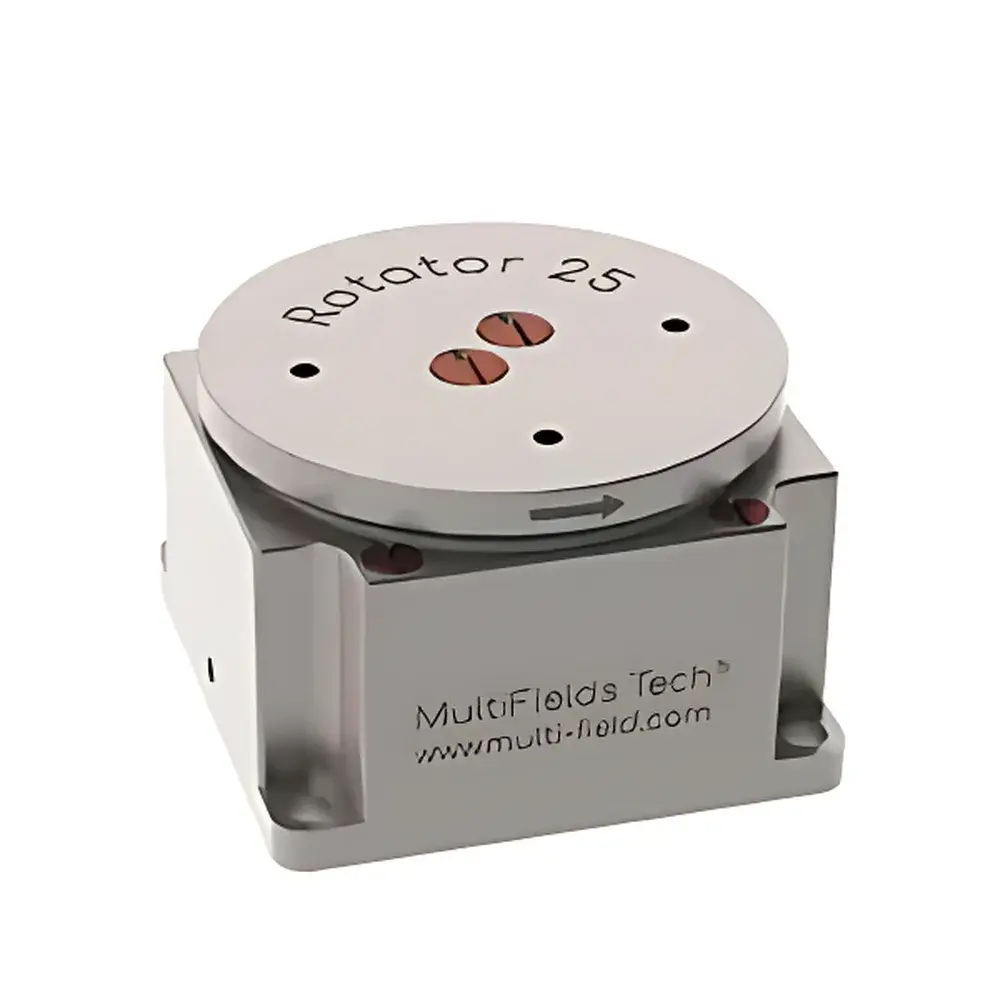
ZOLIX Rotator25 Piezo-Driven Rotary Translation Stage
| Brand | ZOLIX |
|---|---|
| Model | Rotator25 |
| Type | Motorized Rotary Translation Stage |
| Origin | Beijing, China |
| Manufacturer | ZOLIX (Producer) |
| Vacuum Compatibility | UHV up to 2 × 10⁻¹¹ mbar |
| Cryogenic Compatibility | Down to 30 mK |
| Magnetic Field Tolerance | Up to 18 T |
| Body Material | Pure Titanium & Beryllium Copper |
| Dimensions | 25 × 25 × 16.5 mm |
| Mass | 24 g |
| Travel Range | Continuous 360° |
| Max. Load | 250 g |
| Max. Torque | 1.5 N·cm |
| Drive Voltage | ≤ 200 V |
| Max. Speed @ 300 K | ~3 °/s |
| Sensor Type | Resistive Position Sensor |
| Sensor Range | 320° |
| Sensor Resolution | 10 m° (0.01°) |
| Repeatability | ~50 m° (0.05°) |
| Cable | Phosphor Bronze Twisted Pair, 20 cm |
| Connector Pins | 2 for drive, 3 for sensing |
| Housing Material Options | Standard HV, ULT (≤30 mK), UHV (≤2×10⁻¹¹ mbar) |
Overview
The ZOLIX Rotator25 is a high-precision, piezo-driven rotary translation stage engineered for demanding optical and quantum experimental environments where extreme physical conditions coexist—ultra-high vacuum (UHV), cryogenic temperatures down to 30 mK, and intense magnetic fields up to 18 Tesla. Unlike conventional stepper- or servo-motor-based rotation stages, the Rotator25 employs direct piezoelectric actuation coupled with resistive position feedback, eliminating gear backlash, hysteresis-prone mechanisms, and electromagnetic interference. Its measurement principle relies on controlled electrostrictive deformation of piezoceramic elements, translating voltage input into precise angular displacement via a friction-based inertial drive mechanism optimized for sub-degree resolution and continuous 360° motion. Designed explicitly for integration into dilution refrigerators, He-3 cryostats, and UHV surface science chambers, the Rotator25 maintains mechanical stability and positional fidelity across thermal contractions spanning 1.4 K to 400 K and pressure gradients from atmospheric to 2 × 10⁻¹¹ mbar.
Key Features
- Compact monolithic architecture: 25 × 25 × 16.5 mm footprint, 24 g mass—ideal for space-constrained optical tables, multi-axis goniometers, and cryostat feedthrough modules.
- Full UHV compatibility: All wetted surfaces fabricated from ultra-clean, low-outgassing pure titanium (Ti) and beryllium copper (BeCu); certified for operation at pressures as low as 2 × 10⁻¹¹ mbar.
- Cryogenic resilience: Mechanically validated from 1.4 K to 400 K; ULT-configured units undergo thermal cycling verification at ≤30 mK in He-3 and dilution refrigerator environments.
- Non-magnetic construction: Zero ferromagnetic content ensures undisturbed operation inside superconducting magnets, NMR probes, and spin-polarized STM setups.
- Closed-loop angular control: Integrated resistive position sensor provides real-time feedback over 320° range with 10 m° (0.01°) resolution and ±50 m° repeatability.
- High-torque, low-inertia actuation: Delivers 1.5 N·cm holding torque while supporting axial loads up to 250 g—enabling stable mounting of optical mounts, fiber couplers, or miniature spectrometer slits.
Sample Compatibility & Compliance
The Rotator25 complies with internationally recognized standards for vacuum integrity and cryogenic reliability. Its UHV variant meets ISO 10107-2 (vacuum component cleanliness) and ASTM E595 (total mass loss and collected volatile condensable materials). For low-temperature applications, it adheres to the thermal contraction coefficients defined in NIST IR 6635 for Ti–6Al–4V and BeCu alloys, ensuring alignment stability during cooldown. All electrical interfaces are rated for operation under IEC 61000-4-2 (ESD immunity) and IEC 61000-4-4 (electrical fast transient robustness), critical when deployed near RF sources or pulsed laser systems. The device contains no adhesives, epoxies, or organic sealants—only mechanically fastened, vacuum-brazed, or electron-beam welded joints—making it fully compatible with GLP/GMP-aligned cleanroom assembly protocols and post-fabrication bake-out procedures (up to 150°C for HV versions, 100°C for ULT/UHV).
Software & Data Management
The Rotator25 operates via analog voltage control (0–200 V DC) and supports seamless integration with standard motion control ecosystems including Thorlabs Kinesis, Newport APT, and LabVIEW-based DAQ platforms. Optional digital interface modules provide USB-C or RS-485 connectivity with ASCII command protocol (e.g., “POS?”, “MOVE 120.5”) enabling full traceability and audit-ready logging. When used in regulated environments, the system supports time-stamped position records compliant with FDA 21 CFR Part 11 requirements when paired with validated third-party software (e.g., Keysight PathWave, MATLAB Production Server). Sensor output is ratiometric and linearized in firmware, minimizing drift-induced calibration drift over extended thermal cycles.
Applications
- Precision angular alignment of polarization optics, waveplates, and QWP mounts in quantum optics experiments.
- Rotational scanning of micro-optical components inside scanning tunneling microscope (STM) and atomic force microscope (AFM) heads.
- Beam steering and wavelength selection in compact, cryo-cooled Raman and photoluminescence spectrometers.
- In-situ sample orientation control for angle-resolved photoemission spectroscopy (ARPES) and low-energy electron diffraction (LEED) chambers.
- Multi-axis positioning in quantum computing testbeds requiring simultaneous magnetic field, temperature, and angular parameter sweeps.
FAQ
Is the Rotator25 compatible with dilution refrigerators?
Yes—the ULT version is qualified for operation at base temperatures ≤30 mK and integrates with standard CF-16 and CF-20 flange feedthroughs.
What vacuum level does the standard HV version support?
The default HV configuration is rated for continuous operation at ≤2 × 10⁻⁷ mbar; optional UHV variants extend this to 2 × 10⁻¹¹ mbar.
Can the stage be operated without closed-loop feedback?
Open-loop operation is possible using analog voltage input only, but closed-loop mode is recommended for repeatable positioning and long-term stability.
Are custom cable lengths or connector types available?
Yes—custom phosphor bronze twisted-pair cables up to 1 m and alternative pin configurations (e.g., LEMO, Sub-D) are offered upon request.
Does the device require external cooling or heat sinking?
No active cooling is required; however, thermal anchoring to the cold stage via the titanium body is strongly advised for sub-4 K applications to minimize thermal drift.