
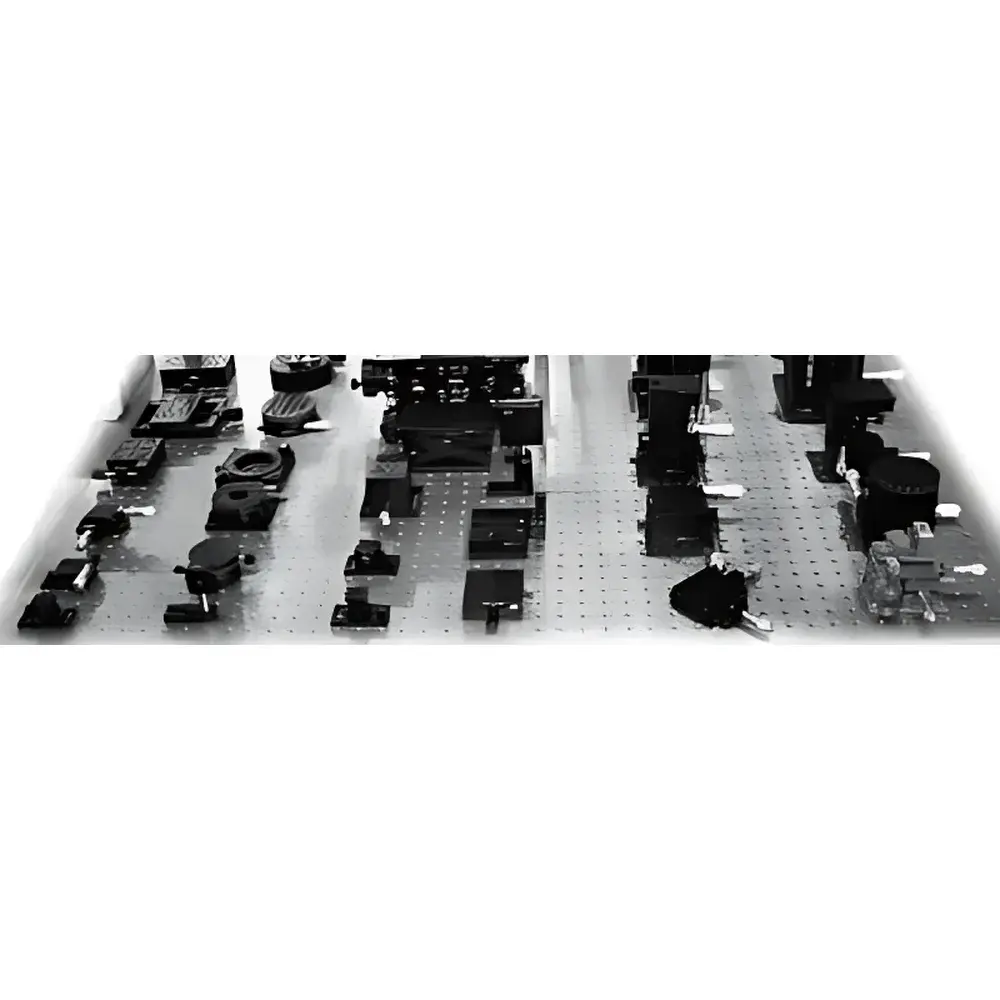
Zolix RSM/KSM/PSM Series Manual Translation Stages
| Origin | Beijing, China |
|---|---|
| Manufacturer Type | Authorized Distributor |
| Origin Category | Domestic (China) |
| Model Variants | RSM (Rotation Stage), KSM (High-Precision Linear Stage), PSM (Precision Linear Stage), TSM (Standard Linear Stage), TSMV (Vertical Lift Stage), TSMT (Tilt Stage), TASMG (Angular Positioning Stage), TSMW (Integrated Multi-Axis Stage), APFP (Fiber Alignment Mount), ASM (Modular Composite Stage) |
| Pricing | Available Upon Request |
| Unit Convention | All dimensional specifications expressed in millimeters (mm) unless otherwise noted |
Overview
Zolix Manual Translation Stages are precision-machined mechanical positioning platforms engineered for stable, repeatable, and drift-free manual adjustment of optical components and experimental samples in laboratory and industrial optical setups. These stages operate on fundamental principles of mechanical translation—utilizing high-tolerance lead screws, crossed-roller or dovetail bearings, and hardened stainless steel or aluminum alloy structural components—to deliver controlled linear displacement, angular rotation, vertical elevation, or compound multi-axis alignment. Designed specifically for applications where full motorization is unnecessary—such as routine optical alignment, prototype testing, educational labs, or low-frequency calibration tasks—the RSM, KSM, PSM, and related series provide deterministic positional control without electronic complexity or software dependency. Each stage is characterized by its defined travel range, angular resolution, load capacity, and mounting interface compatibility (e.g., standard M4/M6 tapped holes per ISO 8015), ensuring seamless integration into existing optical breadboards, cage systems, or custom mechanical assemblies.
Key Features
- Modular Architecture: Individual stage types—including linear (TSM, KSM, PSM), rotational (RSM), vertical (TSMV), tilt (TSMT), angular (TASMG), and integrated multi-axis (TSMW)—are designed with standardized footprints and mounting patterns, enabling flexible stacking and orthogonal coupling without adapter plates.
- Mechanical Precision Engineering: KSM-series stages feature micrometer-driven fine-adjustment mechanisms with 10 µm minimum incremental motion; RSM rotary stages offer ±0.02° angular repeatability over 360° continuous rotation; all bearing surfaces undergo surface-hardening treatment to minimize wear under sustained static or dynamic loading.
- Material & Environmental Robustness: Structural components are fabricated from anodized 6061-T6 aluminum or 304 stainless steel, providing corrosion resistance, thermal stability (CTE ≈ 23.6 × 10⁻⁶ /°C for Al), and non-magnetic properties suitable for laser interferometry and magneto-optic environments.
- Load Capacity Range: Static load ratings span 2 kg (APFP fiber mount) to 20 kg (TSMW multi-axis base plate), validated per ISO 2768-mK general tolerances and tested under ISO 9223 atmospheric corrosion classification C2 conditions.
- Interchangeable Drive Options: Standard configurations include knurled knobs with 0.5 mm pitch lead screws; optional upgrades include vernier scales, locking thumbscrews, and backlash-compensated differential drives for sub-micron positioning confidence.
Sample Compatibility & Compliance
Zolix manual stages support a broad spectrum of optical payloads—including mirrors (up to Ø100 mm), lens mounts, fiber collimators, photodetectors, and micro-positioning sample holders—without compromising planarity or orthogonality. All stages comply with ISO 10110-7 surface flatness requirements for optical mounting interfaces (λ/10 PV over 25 mm aperture) and conform to RoHS Directive 2011/65/EU for hazardous substance restrictions. Mechanical design documentation adheres to GD&T standards per ASME Y14.5–2018, and dimensional verification reports are traceable to CNAS-accredited metrology laboratories (certificate numbers available upon request). While not inherently compliant with FDA 21 CFR Part 11 or IEC 61000-6-3 electromagnetic immunity standards—due to their passive nature—the stages are routinely deployed in GLP-compliant optical characterization workflows when paired with validated instrumentation protocols.
Software & Data Management
As purely mechanical devices, Zolix manual translation stages require no firmware, drivers, or proprietary software. Positional data is recorded manually or integrated into external lab management systems via user-defined log templates. For traceability-critical applications (e.g., ISO/IEC 17025 accredited calibration labs), users may employ third-party digital calipers or laser interferometers interfaced via USB/RS-232 to capture and timestamp positional readings. Audit trails generated through such external measurement chains satisfy documentation requirements for GMP Annex 11 and ISO 15197:2013 data integrity clauses when implemented within a formally validated procedural framework.
Applications
- Laser cavity alignment and beam steering in CW and pulsed laser systems
- Fiber-to-waveguide coupling optimization in photonic integrated circuit packaging
- Stage-based spectroscopic sample raster scanning (e.g., Raman mapping, fluorescence lifetime imaging)
- Calibration of automated stages using manual stages as reference benchmarks
- Undergraduate and graduate optics laboratory experiments requiring tactile, intuitive spatial reasoning
- Low-vibration microscopy sample positioning where motor-induced jitter must be eliminated
FAQ
Are Zolix manual stages compatible with Thorlabs or Newport optical rails and posts?
Yes—standard mounting hole patterns (M4 at 25 mm centers, M6 at 50 mm centers) align with industry-standard optical breadboard grids and accessory clamping systems.
Can multiple stages be stacked to achieve 6-axis adjustment?
Absolutely—the TSMW integrated multi-axis platform and modular ASM series are explicitly designed for XYZ + tip/tilt/rotation configurations, with orthogonal orthogonality error < 30 arcsec per interface.
Do you provide calibration certificates for individual units?
Calibration reports documenting travel linearity, angular deviation, and perpendicularity are available as optional add-ons, traceable to national metrology institutes (NIM, China).
What is the maximum recommended operating temperature range?
–10 °C to +50 °C for aluminum-bodied stages; –20 °C to +70 °C for stainless steel variants, per ISO 11358-1 polymer-free thermal expansion limits.
Is backlash compensation available on standard KSM-series linear stages?
Backlash compensation is offered as a factory-configured option on KSM models with dual-nut preloaded lead screws, reducing hysteresis to ≤ 2 µm over full travel.




