
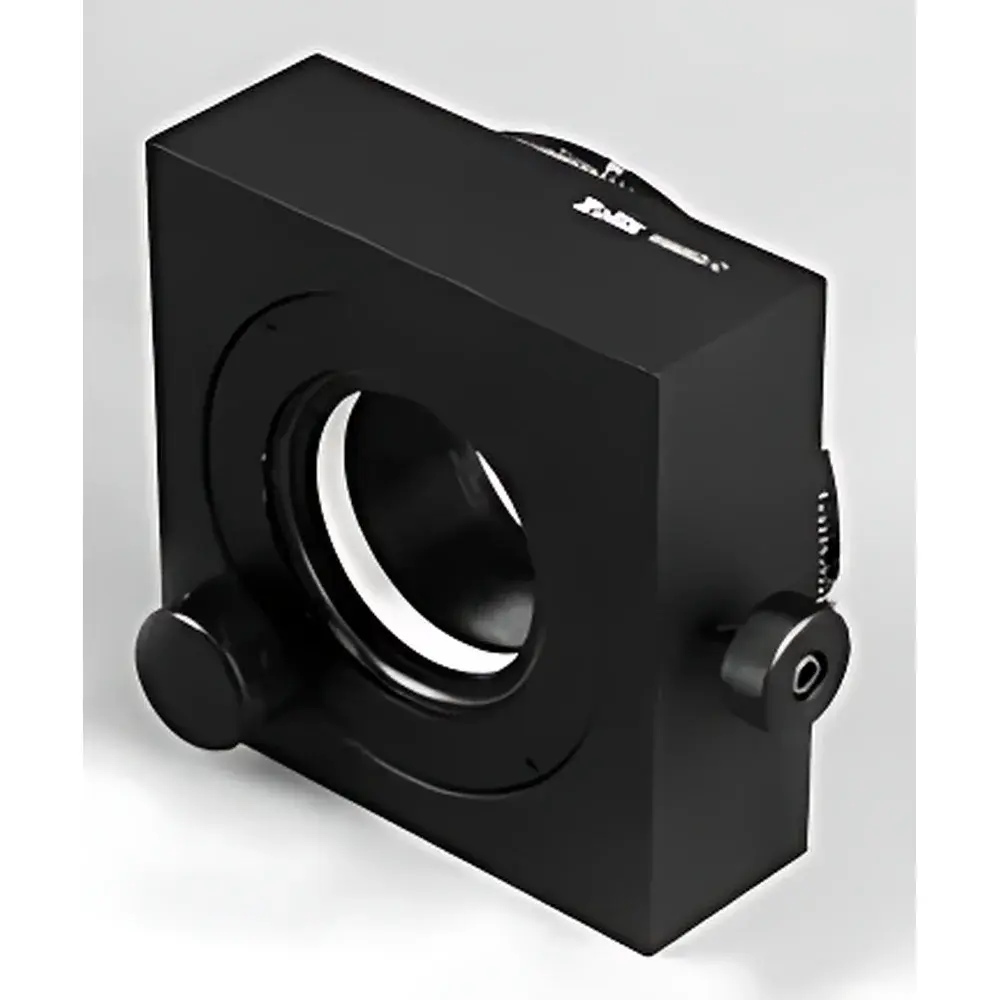
ZOLIX RSM50-C Precision Manual Rotary Stage
| Brand | ZOLIX |
|---|---|
| Model | RSM50-C |
| Stage Diameter | 50 mm |
| Angular Range | 360° (coarse), 0.001° (sensitivity) |
| Graduation | 1° |
| Load Capacity | 5 kg |
| Weight | 0.75 kg |
| Mounting Thread | M52×1 (center) |
| Orientation | Horizontal or vertical operation |
| Locking Mechanism | Ergonomic locking knob |
| Drive Type | Manual, gear-driven (spur gear train) |
| Compliance | Designed for ISO/IEC 17025-aligned optical alignment workflows |
Overview
The ZOLIX RSM50-C Precision Manual Rotary Stage is an engineered optical positioning component designed for high-stability angular adjustment in research-grade optical laboratories and industrial metrology setups. Based on a robust coaxial shaft architecture with hardened steel spur gears, the stage delivers repeatable angular positioning over its full 360° coarse rotation range. Its measurement principle relies on mechanical angular displacement via calibrated circumferential graduation and tactile feedback—enabling deterministic manual alignment without reliance on electronic encoders or external controllers. The stage is optimized for integration into multi-axis optical benches, interferometric systems, polarization characterization rigs, and laser beam steering assemblies where sub-arcminute repeatability and mechanical rigidity are critical. Its compact 50 mm diameter platform and low-mass construction (0.75 kg) minimize inertial loading while maintaining structural integrity under static loads up to 5 kg—making it suitable for both horizontal mounting on optical tables and vertical orientation in collimation or goniometric configurations.
Key Features
- Precision-machined M52×1 central threaded aperture for direct mounting of 50 mm (2-inch) optics—including lenses, mirrors, waveplates, and filter wheels—without adapters
- 360° continuously adjustable rotation with 1° engraved scale and vernier-assisted readout capability supporting 0.001° angular sensitivity
- High-rigidity aluminum alloy body with black anodized finish for thermal stability and corrosion resistance in controlled lab environments
- Integrated dual-bearing axial support system ensuring minimal wobble (< 5 µm radial runout) and consistent torque response across full travel
- Ergonomic locking knob with progressive clamping force—designed to prevent slippage during vibration-sensitive experiments while avoiding optic distortion from overtightening
- Modular compatibility: Interchangeable with ZOLIX translation stages (e.g., TS series), kinematic mounts (KM series), and optical post holders via standardized base-hole patterns (M4/M6)
Sample Compatibility & Compliance
The RSM50-C accommodates standard optical components with diameters up to 50 mm and thicknesses compatible with M52×1 thread engagement depth (≥ 4 mm recommended). It supports plano-convex lenses, metallic mirrors, dichroic filters, and quartz retarders when mounted using appropriate retaining rings. The stage complies with mechanical interface standards defined in ISO 10110-7 (optical element mounting) and aligns with general laboratory safety practices per IEC 61000-6-2 (immunity to electromagnetic interference in non-industrial settings). While not certified to GLP or FDA 21 CFR Part 11 (as it is a passive mechanical device), its design facilitates traceable manual alignment procedures required under ISO/IEC 17025 calibration management frameworks—particularly when used in conjunction with calibrated autocollimators or digital theodolites for angle verification.
Software & Data Management
As a purely manual stage, the RSM50-C does not incorporate embedded electronics, firmware, or software interfaces. All angular positioning is performed mechanically and documented manually within experimental logs or LIMS entries. However, its physical design enables seamless integration into motorized systems: the stage can be retrofitted with ZOLIX-compatible stepper motor modules (e.g., SMR-28 series) via optional adapter plates, enabling computer-controlled rotation through standard RS-485 or USB-to-serial protocols. When upgraded, full audit trails—including timestamped position commands, motor current logs, and encoder feedback—are supported under ZOLIX StageControl v3.x software, which maintains compliance with data integrity requirements outlined in ALCOA+ principles for regulated environments.
Applications
- Laser cavity alignment and resonator mode optimization in DPSS and Ti:sapphire systems
- Polarization state analysis using rotating half-wave plates paired with fixed polarizers
- Angle-resolved reflectance and transmittance measurements in thin-film characterization
- Calibration of goniometric sensors and angular encoders using reference artifacts
- Multi-axis optical path folding in compact spectrometer and ellipsometer designs
- Education and training platforms for undergraduate optics laboratories emphasizing hands-on alignment fundamentals
FAQ
Can the RSM50-C be used in vacuum environments?
No—standard units are not vacuum-rated due to lubricant outgassing and lack of vacuum-compatible sealing. Custom versions with dry-film lubricants and stainless-steel hardware are available upon request.
Is the M52×1 thread compatible with Thorlabs or Newport optics mounts?
Yes—the M52×1 thread conforms to DIN 13-1 metric thread standards and is mechanically interchangeable with many third-party 2-inch optic retention systems, though users should verify thread pitch tolerance (±0.02 mm) before mating.
What is the typical angular repeatability after repeated locking/unlocking cycles?
Under controlled conditions (23 ± 1°C, no shock loading), angular repeatability remains within ±0.005° over 10,000 operational cycles when maintained per ZOLIX Technical Note TN-RS-02.
Does the stage include mounting hardware for optical tables?
No—base mounting requires user-supplied M4 or M6 cap screws matching the stage’s bottom-hole pattern (8 × M4, 25 mm spacing, per ANSI/BHMA A156.13).
Can the graduation ring be re-zeroed for relative angle measurements?
Yes—the engraved aluminum ring is indexed via two set screws; users may loosen, rotate, and re-tighten the ring to establish custom zero references aligned with system-specific coordinate frames.




