
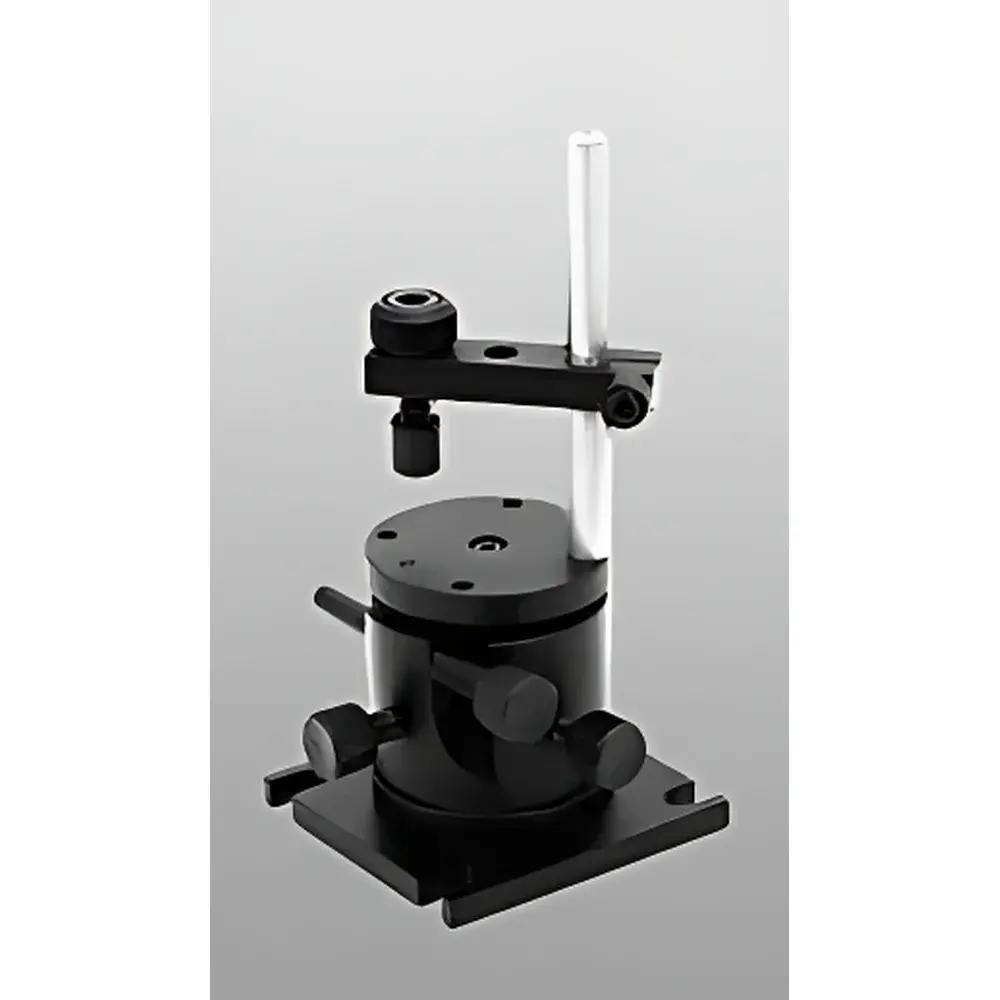
ZOLIX RSMT-1 Precision Tilt-Rotation Mount
| Brand | ZOLIX |
|---|---|
| Model | RSMT-1 |
| Type | Precision Optical Tilt-Rotation Mount |
| Adjustment Axes | θz (rotation about Z-axis), θy (tilt about Y-axis), θx (tilt about X-axis) |
| θz Range | ±7.5° |
| θy Range | ±7° (independent) |
| θx Range | ±7° (independent) |
| Drive Mechanism | M6×0.25 ultra-fine-pitch stainless steel adjustment screws with integrated compression springs |
| Mounting Interface | Top rigid-elastic clamping mechanism for prisms and other optical components |
| Mass | 0.85 kg |
| Origin | Beijing, China |
| Manufacturer | ZOLIX (OEM/ODM capable) |
Overview
The ZOLIX RSMT-1 Precision Tilt-Rotation Mount is an engineered optical positioning stage designed for high-stability angular alignment of optical elements in laboratory and industrial metrology setups. Operating on a Cartesian coordinate framework—where the vertical axis defines the Z-direction—the RSMT-1 provides three independent, orthogonal angular degrees of freedom: continuous rotation about the Z-axis (θz), and bidirectional tilt adjustments about the Y- and X-axes (θy and θx). Its mechanical architecture follows classical optomechanical principles, utilizing coupled kinematic constraints and elastic preloading to minimize hysteresis and thermal drift. Unlike motorized goniometers or piezo-actuated stages, the RSMT-1 relies on manual, tactile fine adjustment via ultra-fine-pitch M6×0.25 stainless steel screws, each integrated with calibrated compression springs to ensure repeatable zero-return behavior and backlash-free motion. This passive, non-electronic design ensures electromagnetic immunity, vacuum compatibility (with optional stainless-steel hardware), and long-term stability under static loading—critical for interferometric alignment, laser cavity construction, and polarization-sensitive experiments.
Key Features
- Three-axis independent angular control: ±7.5° rotation about Z-axis (θz), ±7° tilt about Y-axis (θy), and ±7° tilt about X-axis (θx), all decoupled mechanically to prevent cross-coupling errors
- Ultra-fine-pitch M6×0.25 stainless steel adjustment screws with integrated helical compression springs—enabling sub-arcminute resolution and consistent spring-return repeatability
- Rigid-elastic top clamping mechanism: A hybrid fixture combining hardened steel jaws with elastomeric contact pads to secure prisms, waveplates, mirrors, and other fragile optical components without inducing stress birefringence or surface deformation
- Compact monolithic aluminum alloy base (6061-T6) with black anodized finish—optimized for thermal mass balance and minimized coefficient of thermal expansion mismatch with standard optical tables
- Standard 1/4″-20 and M6 threaded mounting holes on base and top plate—compatible with Thorlabs, Newport, and Standa accessory rails and posts
- No electronic components or power requirements—ideal for use in EMI-sensitive environments, ultra-high vacuum chambers (UHV-ready with optional hardware), and Class 100 cleanrooms
Sample Compatibility & Compliance
The RSMT-1 accommodates optical components up to 50 mm in diameter and 25 mm in thickness, including right-angle prisms, Brewster-angle windows, λ/4 and λ/2 waveplates, and small-diameter collimating lenses. Its clamping force is empirically calibrated to remain below 1.2 N—sufficient to resist 5g inertial loads during table vibration, yet low enough to avoid micro-fracture risk in fused silica or CaF₂ substrates. The mount conforms to ISO 10110-7 (surface imperfection tolerances for optical elements) handling guidelines and supports GLP-compliant alignment documentation when used with calibrated autocollimators or digital theodolites. While not certified to a specific IEC or UL standard (as it contains no electrical circuitry), its mechanical design aligns with ISO 9001 manufacturing controls applied at ZOLIX’s Beijing facility, which maintains traceable calibration of all dimensional and torque-testing equipment per ISO/IEC 17025.
Software & Data Management
As a purely mechanical alignment device, the RSMT-1 does not interface with software or generate digital data streams. However, it is routinely integrated into instrument control workflows where angular position is recorded externally—e.g., via USB-connected autocollimators (e.g., Trioptics OptiCentric®), laser tracker systems (e.g., API Radian), or vision-based metrology platforms (e.g., Keyence IM Series). When deployed in regulated environments (e.g., ISO 13485 medical device labs or FDA-regulated optical test benches), users may document angular settings manually in controlled logbooks or import positional metadata into LIMS or ELN systems using standardized CSV templates. No firmware, drivers, or API support is provided or required.
Applications
- Laser cavity mirror alignment in DPSS and Ti:sapphire oscillators, where sub-arcsecond angular stability directly impacts mode-locking threshold and beam pointing jitter
- Polarization state control in ellipsometry and Mueller matrix spectroscopy setups—using sequential θy/θx tilts to isolate retardance contributions from sample birefringence
- Interferometer arm balancing in Michelson and Mach–Zehnder configurations, particularly when compensating for path-length differences induced by wedge-angle deviations in beam splitters
- Calibration of angle-sensitive detectors (e.g., quadrant photodiodes, position-sensitive detectors) using known angular dithers generated by controlled θz rotation
- Alignment of fiber-optic collimators and free-space-to-fiber coupling optics in telecom component testing stations
- Teaching laboratories for undergraduate optics courses—demonstrating gimbal lock avoidance, Euler angle decomposition, and the distinction between rotation and tilt kinematics
FAQ
What is the angular resolution achievable with the M6×0.25 adjustment screws?
The theoretical resolution is ~0.025° per full screw turn (360° ÷ 144 threads per 36 mm travel), though practical resolution depends on operator technique, screw preload, and frictional hysteresis—typically 0.05°–0.1° under controlled lab conditions.
Can the RSMT-1 be mounted vertically or inverted?
Yes—the base plate features symmetrically distributed tapped holes and balanced mass distribution; however, gravitational sag must be accounted for when holding heavy optics (>20 g) in inverted orientation—use of retention clips is recommended.
Is the clamping mechanism compatible with AR-coated or metallic-dielectric mirrors?
Yes—the elastomeric contact pads are chemically inert fluorosilicone (FKM), rated for use with MgF₂, Ta₂O₅/SiO₂ multilayer coatings and protected silver/aluminum films; no solvent exposure or abrasive cleaning is required.
Does ZOLIX provide calibration certificates for individual units?
Standard units ship without NIST-traceable angular calibration; however, ZOLIX offers optional third-party calibration services through CNAS-accredited metrology labs in Beijing, delivering ISO 17025-compliant reports with uncertainty budgets for θx, θy, and θz axes.
Are replacement screws or clamping pads available as spare parts?
Yes—ZOLIX maintains inventory of M6×0.25 stainless steel screws (PN: RSMT-SCREW-01), fluorosilicone clamping pads (PN: RSMT-PAD-FKM), and base-mounting adapters (PN: RSMT-ADP-M6); all are orderable with lead times under 5 business days.



