
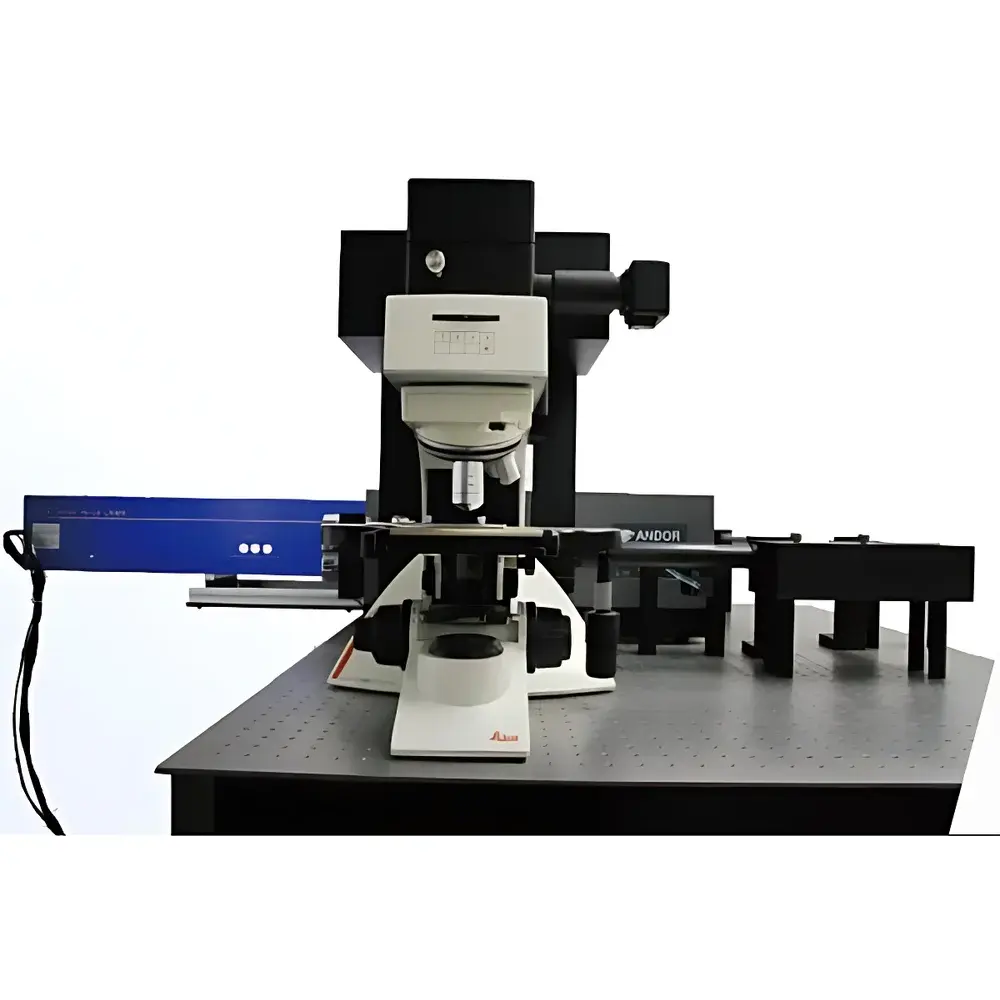
ZOLIX RTS-II Multifunctional Laser Confocal Micro-Raman Spectroscopy System
| Brand | ZOLIX |
|---|---|
| Origin | Beijing, China |
| Manufacturer Type | Direct Manufacturer |
| Instrument Type | Confocal Micro-Raman Spectrometer |
| Model | RTS-II |
| Spectral Range | 300–1100 nm |
| Spectral Resolution | 1 cm⁻¹ |
| Spatial Resolution | Lateral 1 µm, Axial 2 µm |
| Minimum Wavenumber | 10 cm⁻¹ |
| Spectral Reproducibility | ±0.1 cm⁻¹ |
| Integrated Lasers | 532 nm, 638 nm, 785 nm (fixed alignment, fiber-coupled) |
| Detector | Deep-cooled Raman-optimized CCD (QE >90% peak), expandable to EMCCD, ICCD, sCMOS, InGaAs array, or PMT |
| Optional Upgrades | Tunable CW laser (275–1100 nm), triple-stage spectrometer, TCSPC, fast-gating ICCD (25 kfps, ~40 µs time resolution), dark-field scattering, micro-transmission/reflection, FLIM |
Overview
The ZOLIX RTS-II Multifunctional Laser Confocal Micro-Raman Spectroscopy System is a research-grade, modular confocal Raman platform engineered for high-fidelity molecular fingerprinting at diffraction-limited spatial resolution. Built upon a fully unmodified Leica upright research microscope, the system preserves all native optical functionalities—including Köhler illumination, DIC, phase contrast, and fluorescence—while integrating a rigid, compact confocal Raman optical path optimized for minimal beam walk and thermal drift. Its core measurement principle relies on inelastic scattering of monochromatic laser light, with spectral analysis performed via a state-of-the-art four-grating spectrometer enabling precise wavenumber calibration and long-term stability. The system operates across 300–1100 nm excitation wavelengths and delivers Raman shifts from 10 cm⁻¹ to >4000 cm⁻¹, supporting low-frequency phonon studies, carbon nanomaterial characterization, and soft-matter vibrational analysis under ambient or controlled-environment conditions.
Key Features
- Native Leica upright microscope integration—no optical compromise; full compatibility with standard objectives, filter cubes, and motorized stages
- Fixed-alignment, fiber-coupled laser architecture with pre-aligned 532 nm, 638 nm, and 785 nm diode lasers—eliminates daily realignment and ensures inter-day reproducibility
- Patented auto-focus and on-axis scanning mechanism for consistent confocal plane maintenance during Z-stack acquisition and large-area mapping
- Four-grating monochromator with motorized grating selection—enables rapid switching between resolution/sensitivity trade-offs without manual intervention
- Deep-cooled, back-illuminated CCD detector with >90% peak quantum efficiency and thermoelectric stabilization to –70°C—minimizes dark current and enables sub-second integrations with high signal-to-noise ratio (e.g., 62.9:1 demonstrated on Si third-order peak)
- Open mechanical and software architecture—supports detector swaps (EMCCD, ICCD, sCMOS, InGaAs, PMT), laser upgrades, and third-party stage or environmental chamber integration
Sample Compatibility & Compliance
The RTS-II accommodates diverse sample geometries—from bulk crystals and thin films to biological tissues, polymer blends, and 2D materials—via standard microscope slides, petri dishes, cryo-holders, or custom vacuum/temperature stages. Its confocal design provides inherent depth discrimination, reducing fluorescence background and enabling layer-specific analysis in stratified samples. The system complies with ISO/IEC 17025 requirements for analytical instrument qualification when deployed in GLP/GMP environments. While not FDA-cleared as a medical device, its hardware and data handling protocols support 21 CFR Part 11-compliant configurations when paired with validated LIMS or ELN platforms (audit trail, electronic signature, and role-based access control implemented at the software layer).
Software & Data Management
Control and analysis are performed using ZOLIX’s proprietary RamanStudio software—a Windows-based application developed in accordance with scientific computing best practices. It supports real-time spectral preview, automated multi-point mapping, batch processing with customizable ROI definitions, and export to industry-standard formats (JCAMP-DX, ASCII, HDF5). Calibration routines include polynomial fitting with NIST-traceable standards (e.g., silicon, cyclohexane), and spectral reproducibility is continuously monitored via internal reference lines. Raw data files retain full metadata (laser power, grating position, slit width, integration time, objective magnification, Z-position), ensuring full traceability for peer-reviewed publication or regulatory submission. API access allows integration with Python-based automation frameworks (e.g., PyVISA, SciPy) for high-throughput screening or closed-loop experimental control.
Applications
- Materials science: Strain mapping in graphene and transition metal dichalcogenides; crystallinity assessment in perovskite thin films; phase identification in battery electrode composites
- Pharmaceuticals: Polymorph screening and distribution mapping in tablet cross-sections; API-excipient interaction analysis via spectral unmixing
- Life sciences: Label-free cellular imaging of lipid droplets, nucleic acids, and protein aggregates; time-resolved Raman of photosensitive biomolecules using ICCD gating
- Nanotechnology: Plasmon-enhanced Raman (SERS) substrate characterization; tip-enhanced Raman spectroscopy (TERS) coupling readiness
- Geosciences & catalysis: In situ Raman monitoring of mineral transformations under hydrothermal conditions or catalytic reaction intermediates on supported metal oxides
FAQ
Is the Leica microscope modified in any way during integration?
No—the microscope remains entirely unaltered. All optical paths, focusing mechanisms, and accessory ports retain full factory functionality.
Can the system be upgraded to perform time-resolved measurements?
Yes. By coupling with a picosecond/nanosecond pulsed laser and an ICCD detector equipped with fast kinetic mode, the system achieves temporal resolution down to ~40 µs and frame rates up to 25,000 fps.
What environmental chambers or stages are compatible?
Standard XYZ motorized stages with 100 mm travel and 100 nm repeatability are supported. Cryostats (e.g., Janis ST-500), heating stages (up to 800°C), and humidity-controlled enclosures integrate via TTL/RS-232 or Ethernet interfaces.
Does the system support fluorescence lifetime imaging (FLIM)?
Yes—when configured with a tunable supercontinuum laser and TCSPC module, the platform enables microscale fluorescence lifetime mapping and intensity-decay analysis.
Is remote operation and data sharing possible?
RamanStudio supports networked acquisition and centralized data storage. Exported spectra and maps are fully compatible with open-source tools (e.g., HyperSpy, RAMANtools) and commercial platforms (OriginLab, MATLAB, Thermo Fisher OMNIC).



