
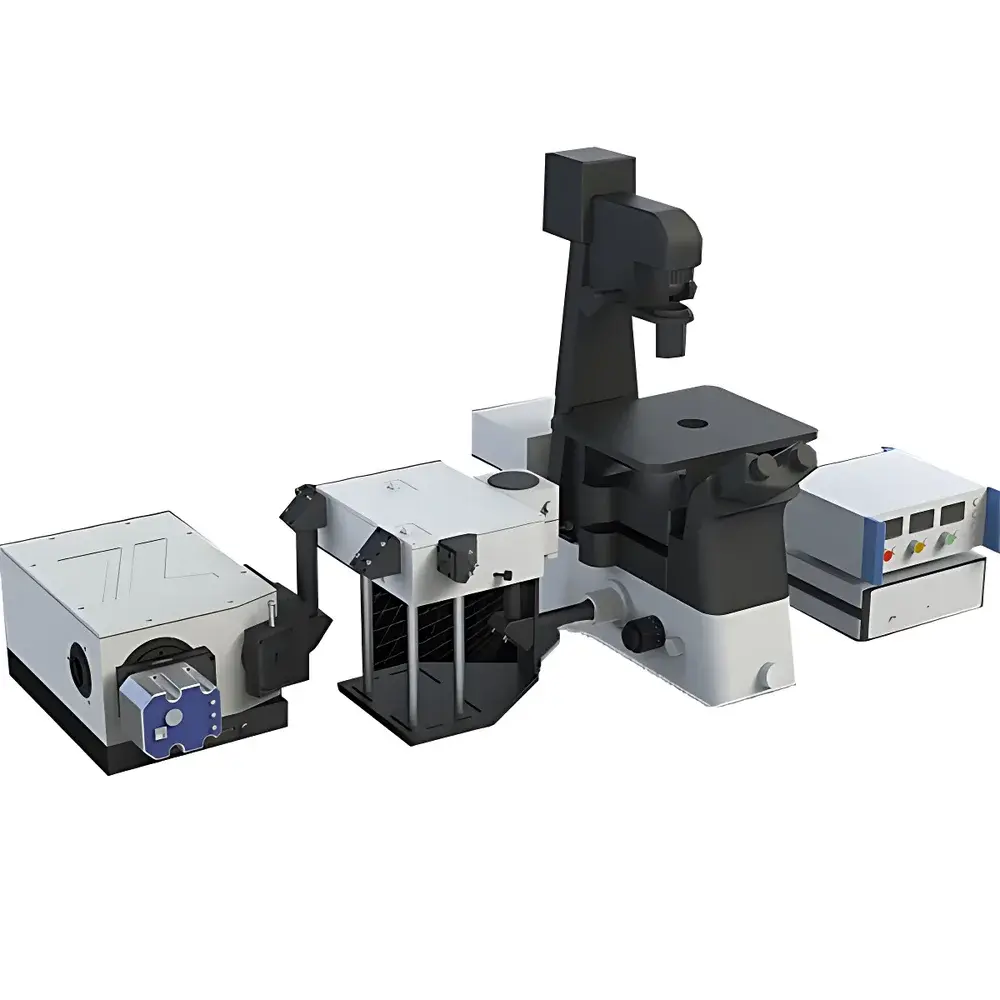
ZOLIX RTS-LTRS Laser Tweezers–Raman Spectroscopy Coupling System
| Brand | ZOLIX |
|---|---|
| Origin | Beijing, China |
| Manufacturer Type | Original Equipment Manufacturer (OEM) |
| Product Category | Domestic |
| Model | RTS-LTRS |
| Spectral Resolution | <2 cm⁻¹ |
Overview
The ZOLIX RTS-LTRS Laser Tweezers–Raman Spectroscopy Coupling System is an integrated optical platform engineered for label-free, non-invasive, single-particle and single-cell analysis in suspension media. It synergistically combines holographic or acousto-optic dynamic optical trapping with confocal Raman microspectroscopy to enable simultaneous 3D manipulation and molecular fingerprinting of microscopic targets ranging from nanoparticles (~50 nm) to aerosol droplets (>100 µm). Unlike conventional Raman microscopy—where Brownian motion, convection, or sedimentation impede stable spectral acquisition—the RTS-LTRS employs a high-stability, multi-point optical trapping architecture to immobilize and position targets with sub-nanometer positional stability. The system operates on gradient-force-based optical confinement within a dual-infinite-conjugate inverted microscope, allowing full access to the sample plane from both top (trapping) and bottom (Raman excitation/collection) optical paths. This dual-path design supports flexible laser coupling (internal or external), wavelength-agnostic Raman detection, and seamless integration of complementary detectors including deep-cooled CCD, EMCCD, ICCD, and InGaAs arrays.
Key Features
- Multi-trap optical tweezers based on 100 kHz acousto-optic deflectors (AODs), enabling real-time generation and reconfiguration of ≥200 independent optical traps
- Independent, digitally controlled trap intensity (0–100%) and spatiotemporal trajectory programming (step size, velocity, dwell time)
- Sub-0.05 nm/min trap positional drift over 2-hour operation—achieved via active thermal stabilization and vibration-isolated optical architecture
- Dual-path optical design: upper path for AOD-driven multi-trap formation; lower path optimized for Raman excitation and signal collection via fiber or free-space coupling
- Standard 320 mm focal-length imaging-corrected spectrometer with high-throughput Czerny–Turner configuration and aberration-compensated optics
- XYZ-precision alignment stage for co-registration of trap center and Raman excitation focus—enabling spatially resolved spectroscopic mapping across trapped ensembles
- Non-contact, force-uniform manipulation compatible with live biological specimens, organelles, colloids, and atmospheric aerosols without mechanical perturbation or surface contamination
Sample Compatibility & Compliance
The RTS-LTRS accommodates diverse sample formats including aqueous suspensions, air–liquid interfaces, microfluidic chambers, and ambient aerosol streams. It supports direct interrogation of spherical and non-spherical particles (e.g., polystyrene beads, silica nanoparticles, lipid vesicles, bacterial cells, and salt-derived aerosols), as well as irregular biological aggregates and phase-separated liquid droplets. All optical components comply with ISO 10110 surface quality standards; mechanical stages meet ISO 230-2 positioning repeatability specifications. The system architecture facilitates GLP/GMP-aligned workflows: data acquisition timestamps, instrument parameter logs, and user authentication are embedded in raw spectral metadata. Optional software modules support 21 CFR Part 11-compliant electronic signatures, audit trails, and secure data archiving—essential for regulated pharmaceutical or environmental testing laboratories.
Software & Data Management
Control and analysis are unified under ZOLIX’s proprietary LTS-Raman Suite—a modular, Python-extendable platform supporting synchronized trap control, Raman acquisition, and quantitative spectral processing. Real-time force calibration is performed using power-spectrum analysis of trap-induced particle fluctuations (via back-focal-plane interferometry), yielding piconewton-scale resolution (±1 pN) and femtonewton sensitivity (~100 fN). Spectral processing includes cosmic-ray removal, baseline correction (asymmetric least squares), peak deconvolution (Voigt fitting), and multivariate analysis (PCA, PLS-DA). All raw spectra, trap coordinates, force traces, and metadata are stored in HDF5 format—ensuring FAIR (Findable, Accessible, Interoperable, Reusable) data principles. Export options include ASTM E131-compliant .spa files and CSV-compatible structured tables for LIMS integration.
Applications
- Single-cell metabolic phenotyping via time-resolved Raman monitoring of intracellular biomolecules (e.g., lipids, proteins, nucleic acids) under controlled mechanical stimulation
- Aerosol phase-state and composition analysis—measuring radius, refractive index, and solute concentration of levitated NaCl/H₂O droplets with <1 nm radius precision and 0.015% RI stability
- Nanoparticle–biomolecule interaction kinetics, including binding affinity quantification via trap stiffness modulation and Raman spectral shift tracking
- Micro-rheology of soft matter: simultaneous measurement of local viscoelastic moduli (via probe particle diffusion analysis) and chemical composition (via Raman fingerprinting)
- Environmental particulate analysis—real-time identification of organic/inorganic components in airborne PM₂.₅/PM₁₀ fractions without filtration or drying artifacts
FAQ
What laser wavelengths are supported for Raman excitation?
The system accepts internal or external lasers at 532 nm, 638 nm, 785 nm, and 1064 nm—each selectable via motorized filter wheels and optimized coupling optics.
Can the system perform simultaneous trapping and Raman acquisition on multiple particles?
Yes—up to 200+ particles can be stably trapped while Raman spectra are acquired sequentially or in parallel (using multi-channel detector configurations) with user-defined dwell times per target.
Is the system compatible with live-cell imaging modalities such as phase contrast or DIC?
Yes—the dual-infinite-conjugate microscope supports simultaneous transmission imaging and optical trapping/Raman spectroscopy without optical crosstalk.
What is the minimum detectable Raman shift uncertainty under standard operating conditions?
With spectral calibration using neon/argon emission lines and temperature-stabilized grating mounts, wavenumber accuracy is ±0.15 cm⁻¹ RMS over 24 hours.
Does the system support third-party software integration (e.g., MATLAB, LabVIEW)?
Yes—ZOLIX provides documented TCP/IP and DLL-based APIs for custom automation, real-time feedback control, and integration into larger experimental ecosystems.





