

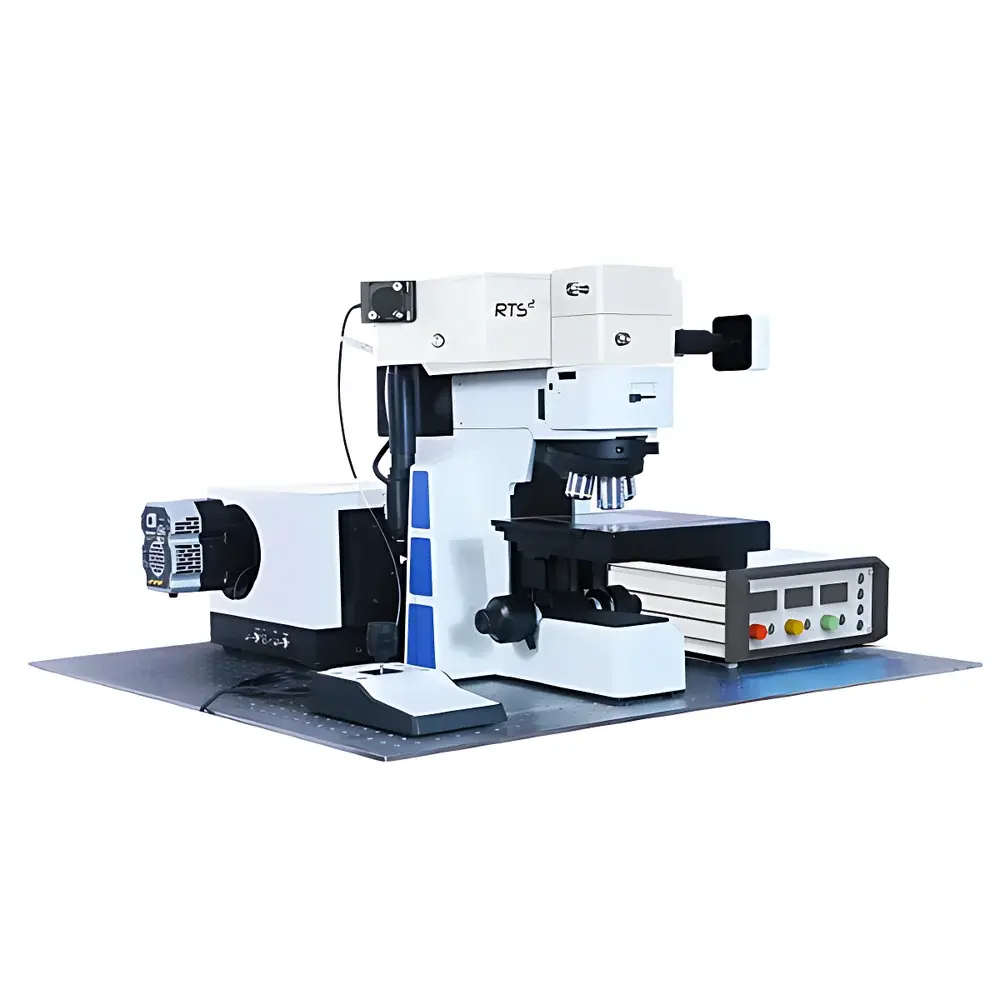
ZOLIX RTS Ultra High-Speed High-Resolution Confocal Micro-Raman Spectrometer
| Brand | ZOLIX |
|---|---|
| Model | RTS Ultra |
| Instrument Type | Confocal Micro-Raman Spectrometer |
| Spectral Resolution | <0.65 cm⁻¹ @ 750 mm focal length spectrometer with 1800 grooves/mm grating |
| Spatial Resolution | ≤500 nm @ 532 nm laser excitation |
| Minimum Wavenumber | ≤10 cm⁻¹ (enabled by reflective volume holographic grating technology) |
| Excitation Wavelengths | 488 nm, 514 nm, 532 nm, 633 nm, 785 nm (wavelength-specific optical configurations required) |
| Detector Options | Back-illuminated deep-depletion CCD (−60 °C cooling), EMCCD, ICCD |
| Imaging Modes | Galvo-scanning and high-precision motorized stage scanning |
| Auto-focusing | Real-time hardware-synchronized focus tracking during spectral acquisition |
| Maximum Mapping Area | 80 mm × 60 mm with automated mosaic stitching and post-hoc ROI selection |
Overview
The ZOLIX RTS Ultra is a research-grade confocal micro-Raman spectrometer engineered for high-fidelity vibrational spectroscopy at the diffraction limit. It integrates a 750 mm focal length Czerny–Turner spectrometer with a reflective volume holographic grating (RVHG) to achieve sub-0.65 cm⁻¹ spectral resolution and low-wavenumber capability down to 10 cm⁻¹ — critical for probing lattice modes, interlayer vibrations in 2D materials, and phonon softening in perovskites. Its confocal architecture employs either pinhole-based or fiber-coupled spatial filtering, enabling rigorous rejection of out-of-focus Raman scattering while preserving signal integrity across heterogeneous samples. The system operates on the principle of inelastic light scattering: monochromatic laser photons interact with molecular vibrations, generating Stokes/anti-Stokes shifts that serve as fingerprint signatures of chemical composition, crystallinity, strain, and phase distribution. Designed for integration into cleanroom-compatible lab environments, the RTS Ultra meets mechanical stability requirements for long-duration mapping (≥8 h continuous operation) without beam drift — validated via interferometric monitoring of laser spot position over thermal cycles.
Key Features
- Ultra-high spectral fidelity: <0.65 cm⁻¹ resolution achieved with 1800 grooves/mm grating in a thermally stabilized 750 mm spectrometer; optional 2400 grooves/mm grating available for enhanced dispersion.
- Sub-diffraction spatial resolution: ≤500 nm lateral resolution at 532 nm excitation, enabled by high-NA objective coupling and precision XYZ piezo-stage control (Z-resolution: 2 µm).
- Multi-wavelength flexibility: Up to eight independently switchable laser lines (325–785 nm), including UV (325 nm), visible (473/532/638 nm), and NIR (785 nm); each path optimized for minimal chromatic aberration and power stability (<±0.5% RMS over 4 h).
- Dual scanning paradigms: Galvo-mirror scanning enables >100× faster point-by-point mapping versus conventional motorized stages; synchronized stage-scan mode supports step-and-integrate acquisition with real-time encoder feedback to eliminate grating repositioning delays.
- Real-time adaptive focusing: Closed-loop autofocus uses reflected broadband illumination and centroid-tracking algorithms to maintain optimal focal plane during spectral acquisition — essential for rough, tilted, or multilayered specimens.
- Modular spectral expansion: Native compatibility with time-resolved Raman (via ICCD/EMCCD gating), polarization-resolved measurements (motorized half-wave plates + polarizers), dark-field scattering, transmission/reflection spectroscopy, and hyperspectral imaging.
Sample Compatibility & Compliance
The RTS Ultra accommodates solid, thin-film, powder, and liquid-phase samples mounted on standard microscope slides or custom holders. Its open optical architecture supports vacuum-compatible stages (≤10⁻⁵ mbar), cryogenic sample chambers (4–300 K), and electrochemical cells with quartz windows. All optical components comply with ISO 10110 surface quality standards; grating coatings meet MIL-C-48497A reflectivity specifications. The system satisfies key regulatory expectations for analytical instrumentation: full audit trail logging (user actions, parameter changes, acquisition metadata), electronic signature support per FDA 21 CFR Part 11, and traceable calibration protocols aligned with ISO/IEC 17025. It contributes to compliance with ASTM E1840 (Raman microscopy practice), USP (vibrational spectroscopy), and ICH Q5E (structural characterization of biologics).
Software & Data Management
Control and analysis are performed via ZOLIX SpectraSuite™ v5.x — a Qt-based platform supporting multi-threaded acquisition, batch processing, and Python API integration (PyZOLIX SDK). Raw spectra are stored in HDF5 format with embedded metadata (excitation wavelength, grating position, detector temperature, objective ID). Quantitative analysis modules include peak deconvolution (Voigt fitting), PCA/MCR-ALS multivariate decomposition, stress/strain mapping from band shifts, and crystallinity indexing via FWHM correlation. Data export complies with Andi/NetCDF standards for LIMS interoperability. Software validation documentation (IQ/OQ/PQ templates) and 21 CFR Part 11 configuration files are provided for GxP environments.
Applications
- 2D materials science: Layer counting in graphene, MoS₂, and black phosphorus via E₂g/A₁g mode splitting and polarization-dependent intensity ratios.
- Perovskite photovoltaics: In situ degradation monitoring through PbI₂ formation signatures (95–110 cm⁻¹), organic cation disorder (δ(N–H) modes), and halide segregation dynamics.
- Pharmaceutical solid-state analysis: Polymorph identification (e.g., ritonavir Forms I vs II), hydrate/anhydrate differentiation, and API-excipient interaction mapping at 1 µm scale.
- Geological mineralogy: Non-destructive phase discrimination in thin sections (e.g., quartz vs cristobalite vs coesite) using ν(Si–O) band profiles below 600 cm⁻¹.
- Nanomaterial metrology: Diameter-dependent radial breathing mode (RBM) mapping in carbon nanotubes and plasmon-enhanced hotspot localization in SERS substrates.
FAQ
What laser wavelengths are factory-aligned and certified for spectral calibration?
488 nm, 532 nm, and 785 nm lasers are fully aligned and calibrated at shipment; 473 nm, 633 nm, and 325 nm require post-installation alignment verification using NIST-traceable silicon reference.
Can the system perform simultaneous multi-laser excitation?
No — the optical design supports sequential, not concurrent, laser activation to prevent spectral crosstalk and detector saturation; however, rapid switching (<100 ms) enables quasi-simultaneous multi-wavelength comparison.
Is the low-wavenumber module compatible with all excitation wavelengths?
The ≤10 cm⁻¹ performance is only guaranteed with 532 nm and 785 nm excitations due to RVHG efficiency constraints; 488 nm and 633 nm configurations achieve ≥15 cm⁻¹ cutoff.
Does the software support automated baseline correction for fluorescence-subtracted spectra?
Yes — SpectraSuite includes asymmetric least-squares (ALS) and polynomial rolling-ball algorithms with user-adjustable stiffness parameters, validated against NIST SRM 2241.
What is the maximum unattended mapping duration supported by the thermal management system?
With ambient temperature stability ±0.5 °C and active chiller cooling (±0.1 °C setpoint), continuous mapping up to 12 hours is achievable without recalibration or focus drift exceeding ±0.3 µm.
Related Products





