
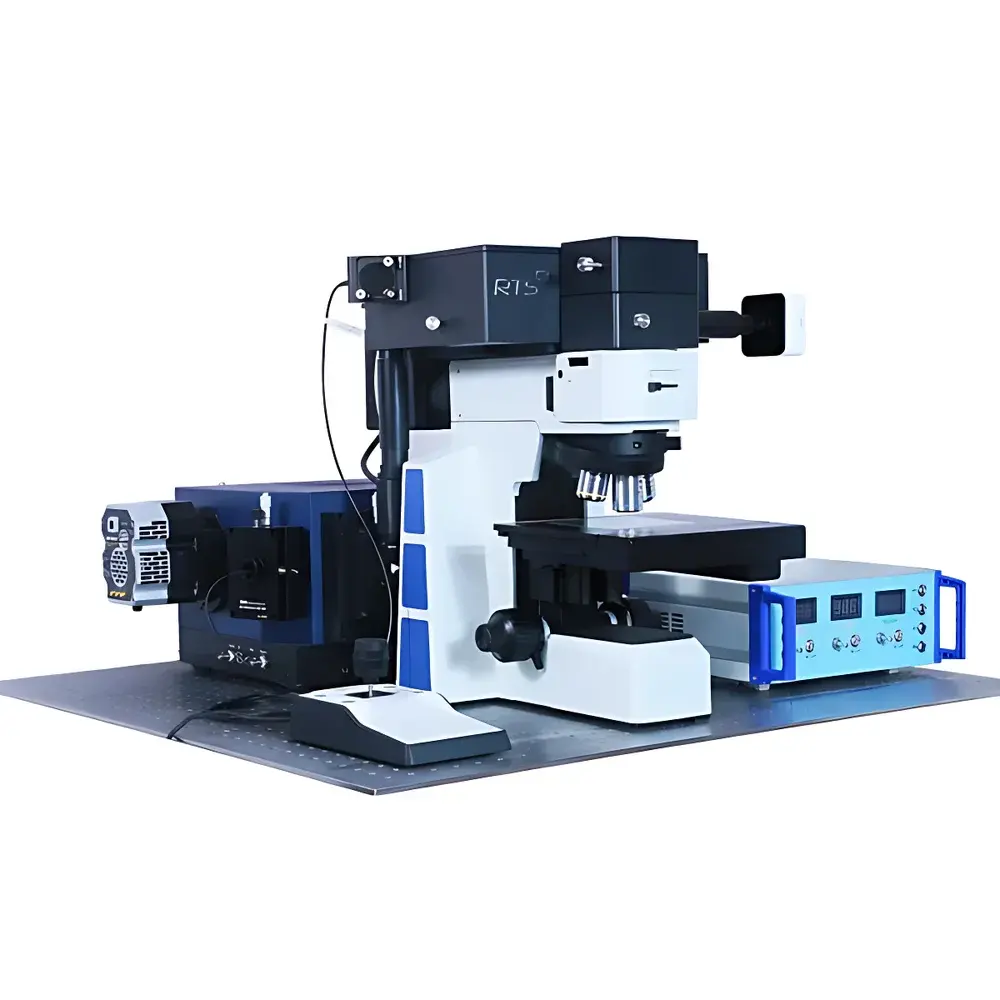
ZOLIX RTS2 Confocal Raman Spectroscopy System
| Brand | ZOLIX |
|---|---|
| Origin | Beijing, China |
| Manufacturer Type | Direct Manufacturer |
| Product Category | Domestic |
| Model | RTS2 |
| Instrument Type | Confocal Micro-Raman Spectrometer |
| Spectral Range | 80–9000 cm⁻¹ (532 nm excitation), 80–6000 cm⁻¹ (638 nm excitation), 80–3500 cm⁻¹ (785 nm excitation) [typical] |
| Spectral Resolution | <1.5 cm⁻¹ FWHM @ 585 nm (1800 l/mm grating) |
| Spatial Resolution | <1 μm (XY), <2 μm (Z) |
| Minimum Wavenumber | 50 cm⁻¹ |
| Spectral Reproducibility | ±0.2 cm⁻¹ |
Overview
The ZOLIX RTS2 Confocal Raman Spectroscopy System is a research-grade, modular confocal micro-Raman platform engineered for high-fidelity vibrational spectroscopy at the micrometer scale. Based on true confocal optical architecture—employing either pinhole-based fiber coupling or slit-CCD coupling—the system achieves depth-resolved spectral acquisition by rejecting out-of-focus signal through spatial filtering. This enables precise micro-volume sampling with minimal fluorescence interference and enhanced signal-to-background ratio. The RTS2 integrates a fully unmodified, upright research-grade metallurgical microscope, preserving native imaging functionality (brightfield/darkfield, Köhler illumination, infinity-corrected optics) while delivering diffraction-limited spatial resolution (<1 μm lateral, <2 μm axial). Its optomechanically stabilized Raman path minimizes thermal drift and alignment sensitivity, ensuring long-term measurement repeatability (±0.2 cm⁻¹ wavenumber stability over 8-hour sessions under ambient lab conditions).
Key Features
- Triple-integrated solid-state lasers (532 nm, 638 nm, 785 nm) with factory-aligned, rigid light paths—no manual realignment required between wavelengths
- Dual coupling modes: switchable between free-space slit-CCD configuration (for high-throughput spectral imaging) and single-mode fiber confocal coupling (for optimal axial sectioning)
- 320 mm focal-length, f/4.2 imaging-corrected spectrometer with <1×10⁻⁵ stray light suppression; optimized for low-wave-number performance (guaranteed ≤100 cm⁻¹, typical 80 cm⁻¹)
- Back-illuminated, deep-depletion CCD detector (200–1100 nm), >90% peak quantum efficiency, thermoelectrically cooled to –60 °C
- High-precision motorized XYZ stage (75 × 50 mm travel, 1 μm positioning accuracy) supporting automated Raman mapping and multi-point acquisition
- Modular interface architecture: forward-facing optical ports support direct integration with AFM, cryostats, probe stations, and hyperspectral systems
- Expandable detection: compatible with EMCCD, ICCD, and InGaAs array detectors for time-resolved, ultra-low-light, or NIR-extended measurements
Sample Compatibility & Compliance
The RTS2 accommodates diverse sample geometries—including bulk solids, thin films, powders, biological tissues, and semiconductor wafers—without requiring conductive coating or vacuum environments. Its open optical design permits simultaneous transmission/reflection/hyperspectral modalities via dedicated beam-splitting interfaces. The system complies with ISO/IEC 17025 calibration traceability requirements for spectroscopic instrumentation. All spectral data files include embedded metadata (laser wavelength, power, grating position, slit width, integration time, objective NA) in accordance with ASTM E1840 and ISO 17926 standards for Raman spectral reporting. Optional hardware upgrades support GLP-compliant operation, including electronic audit trails, user-access controls, and 21 CFR Part 11–ready software modules.
Software & Data Management
Acquisition and analysis are performed using ZOLIX’s proprietary SpectraView Suite—a platform-independent application built on Qt/C++ with Python API support. It provides real-time spectral preview, automatic cosmic-ray removal, baseline correction (asymmetric least squares), peak fitting (Voigt/Lorentzian/Gaussian models), and multivariate analysis (PCA, cluster mapping). Data export adheres to JCAMP-DX v6.00 format for cross-platform interoperability with commercial chemometrics tools (e.g., Unscrambler, MATLAB, Python SciPy). Raw spectra are stored in HDF5 containers with hierarchical metadata tagging, enabling FAIR (Findable, Accessible, Interoperable, Reusable) data management practices. Batch processing pipelines support automated QA/QC checks—including spectral reproducibility validation against internal silicon reference peaks (520.7 cm⁻¹) and wavenumber calibration drift monitoring.
Applications
The RTS2 serves as a core analytical tool across materials science, nanotechnology, pharmaceutical development, and geosciences. Typical use cases include: stress/strain mapping in 2D materials (graphene, MoS₂); polymorph identification and crystallinity assessment in active pharmaceutical ingredients (APIs); defect characterization in SiC and GaN power electronics; carbon speciation (D/G band ratios) in battery anodes; and label-free cellular biochemistry profiling (e.g., lipid/protein/nucleic acid distribution in fixed tissue sections). Its compatibility with variable-temperature stages (–196 °C to +600 °C) enables in situ phase-transition studies, while synchronized acquisition with hyperspectral dark-field scattering supports correlative plasmonic and phononic analysis.
FAQ
What laser excitation wavelengths are pre-installed?
The system ships with three permanently aligned lasers: 532 nm (DPSS), 638 nm (diode), and 785 nm (diode), each with integrated edge filters and notch rejection optics.
Can the system perform low-wavenumber Raman measurements below 100 cm⁻¹?
Yes—standard configuration guarantees performance down to 100 cm⁻¹; optional ultra-low-wave-number module extends reliable detection to <30 cm⁻¹ using specialized holographic notch filters and optimized grating selection.
Is the microscope modified from its original configuration?
No—the RTS2 uses a commercially available upright metallurgical microscope without optical or mechanical modification, preserving all OEM imaging functions including DIC, polarized light, and fluorescence epifluorescence.
How is spectral calibration maintained during extended experiments?
Real-time calibration is achieved via periodic acquisition of a neon lamp spectrum (integrated into the optical path), with automated peak registration and polynomial correction applied to all subsequent Raman data.
Does the system support regulatory-compliant data handling for pharmaceutical labs?
Yes—optional GxP package includes electronic signatures, role-based access control, full audit trail logging, and 21 CFR Part 11–compliant data archiving protocols.





