
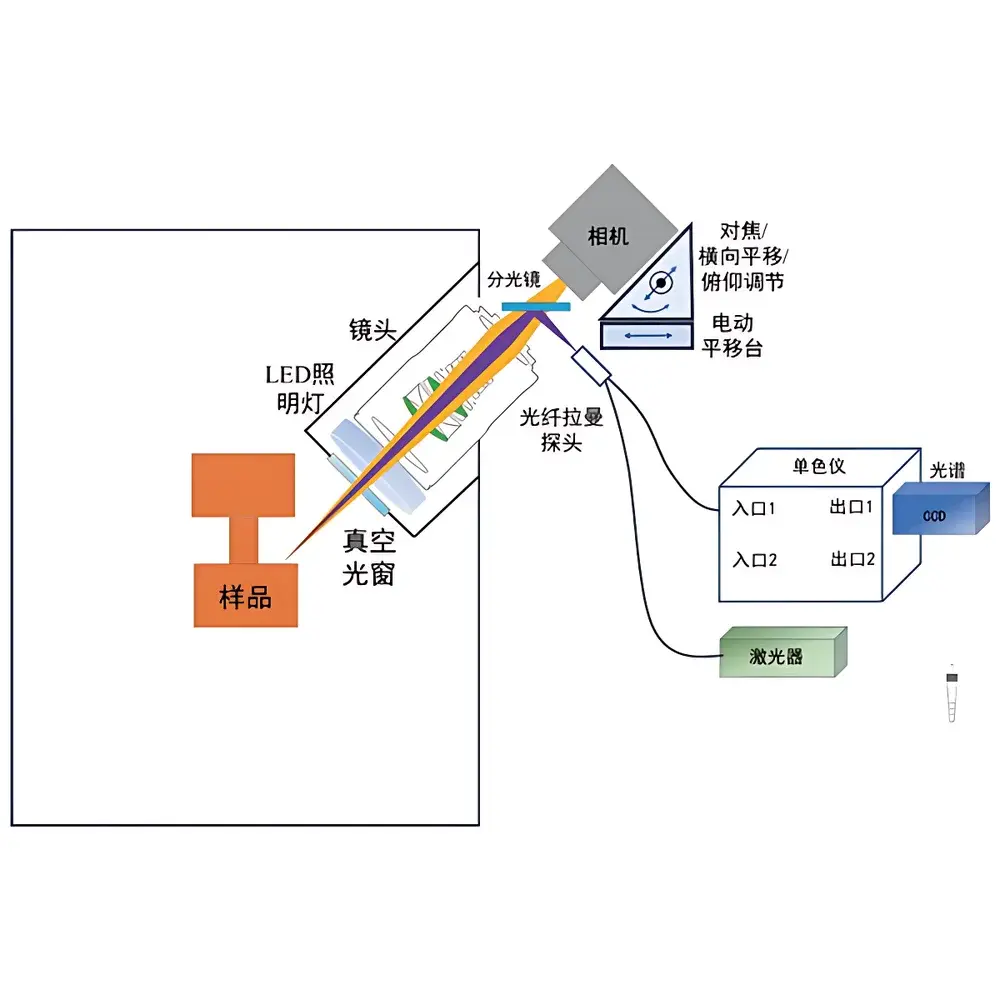
ZOLIX RTS2-L Remote Raman Spectroscopy System
| Brand | ZOLIX |
|---|---|
| Origin | Beijing, China |
| Manufacturer Type | Original Equipment Manufacturer (OEM) |
| Product Category | Domestic |
| Model | RTS2-L |
| Instrument Type | Modular Remote Raman Detection Platform |
| Laser Wavelength Options | 405, 514, 532, 633, 670, 671, 785, 808 nm (CW) |
| Raman Shift Range | 100–4000 cm⁻¹ (laser-dependent) |
| Detection Distance | 0–30 mm (micro-Raman mode), 30 mm–200 mm (fiber-coupled probe), scalable to >1000 m with telescope integration |
| Spectrometer Types | Czerny-Turner (320 mm focal length), VPH grating (85 mm focal length, F/1.8) |
| Spectral Resolution | <1.5 cm⁻¹ (C-T, 1800 grooves/mm), <5 cm⁻¹ (VPH) |
| Detector Options | Back-illuminated deep-depletion CCD (2000 × 256 px, QE >90%, -60°C cooling, 300–1100 nm), ICCD (1024 × 1024 px, 2 ns gate width, 280–810 nm, gain >200) |
| Probe NA | 0.22 (@40 mm focus), fiber core: 100/100 µm, FC/SMA interface |
| Imaging Module | 20 MP scientific CMOS, 17.6 × 11.8 mm sensor, XYZ + tip/tilt motorized stage, spatial resolution ≤6 µm (at ~200 mm WD) |
| Operating Temperature | 0–85 °C |
| Max Pressure Rating | 15 psi |
| Filter Optical Density | OD >6 |
Overview
The ZOLIX RTS2-L Remote Raman Spectroscopy System is a modular, research-grade platform engineered for stand-off and in-situ molecular characterization across diverse operational environments—from vacuum chambers and controlled gloveboxes to planetary analog field sites and industrial process lines. It operates on the fundamental principle of inelastic light scattering: when monochromatic laser light interacts with molecular vibrations or rotational modes, a small fraction undergoes energy shift (Raman shift), producing a unique spectral fingerprint between 100 cm⁻¹ and 4000 cm⁻¹. Unlike spontaneous fluorescence or elastic scattering, Raman signals are inherently weak and highly susceptible to ambient background; thus, the RTS2-L integrates time-gated detection (ICCD), high-optical-density notch filters (OD >6), and thermoelectrically cooled deep-depletion CCDs to maximize signal-to-noise ratio under low-light, high-background conditions. Its architecture supports both continuous-wave (CW) and nanosecond-pulsed excitation—enabling flexible trade-offs between spectral fidelity (CW + CCD for high-resolution lab analysis) and background rejection (pulsed + ICCD for outdoor or solar-illuminated remote sensing). The system is not a turnkey black box but a configurable instrumentation framework, designed for integration into larger analytical workflows including LIBS-Raman hybrid platforms, CVD reactor monitoring setups, or Mars-relevant mineral identification suites.
Key Features
- Modular optical path design supporting interchangeable excitation sources (CW lasers: 405–808 nm; pulsed: 532 nm, 290 mJ, 10 Hz), spectrometers (Czerny-Turner 320 mm or VPH 85 mm), and detectors (CCD or ICCD).
- Multi-scale spatial coupling: micro-Raman (0–30 mm), fiber-coupled probe (30–200 mm), and telescope-integrated long-range configuration (>100 m, compatible with Cassegrain optics per ASTM E2859-22 guidelines for planetary spectroscopy).
- High-fidelity spectral acquisition: spectral resolution <1.5 cm⁻¹ (C-T, 1800 g/mm grating), calibrated wavelength accuracy ±0.1 cm⁻¹, and photometric linearity maintained over 4 orders of magnitude dynamic range.
- Vacuum-compatible probe housing (316 stainless steel or hardened alumina), rated to 15 psi and operating from 0–85 °C—validated for integration into UHV chambers (e.g., GaN epitaxy reactors) and inert-atmosphere gloveboxes.
- Integrated imaging module with 20 MP scientific CMOS, motorized XYZ + tip/tilt stage, and diffraction-limited spatial resolution (≤6 µm at 200 mm working distance), enabling precise sample positioning and region-of-interest mapping without manual realignment.
Sample Compatibility & Compliance
The RTS2-L accommodates solid, liquid, powder, and thin-film samples—including optically opaque, highly scattering, or thermally sensitive materials—without requiring physical contact or vacuum transfer. Its fiber-coupled probe maintains consistent excitation geometry across variable working distances (20–100 mm), while the VPH spectrometer’s high throughput (F/1.8) preserves signal integrity for weak scatterers such as carbon allotropes or hydrated minerals. For regulated applications, the system supports audit-trail-enabled data acquisition compliant with FDA 21 CFR Part 11 when paired with validated third-party software (e.g., LabVIEW-based custom modules with electronic signature and version control). All optical components meet ISO 10110 surface quality standards; laser safety interlocks conform to IEC 60825-1:2014 Class 4 requirements. Calibration traceability follows NIST SRM 2241 (silicon Raman peak at 520.7 cm⁻¹) and is documented per ISO/IEC 17025:2017 calibration procedures.
Software & Data Management
Acquisition and processing are managed via ZOLIX’s cross-platform SpectraSuite Pro software (Windows/Linux/macOS), which provides real-time spectral preview, automated baseline correction (Asymmetric Least Squares), peak deconvolution (Voigt fitting), and multivariate analysis (PCA, PLS regression). Raw data is stored in HDF5 format with embedded metadata (laser power, integration time, grating position, detector temperature, filter ID), ensuring FAIR (Findable, Accessible, Interoperable, Reusable) compliance. Export options include ASCII, CSV, and JCAMP-DX for interoperability with commercial chemometrics packages (Unscrambler®, MATLAB, Python SciPy). For GLP/GMP environments, optional software validation packages include IQ/OQ documentation templates, electronic logbook functionality, and role-based user access control.
Applications
- Planetary science simulation: Validated in Mars-analog mineral identification (malachite, azurite, calcite, anhydrite) using 532 nm pulsed excitation and Cassegrain collection optics—achieving unambiguous phase discrimination at standoff distances up to 197 mm (Gnyba et al., Photonics Lett. Pol. 2009).
- In-situ CVD process monitoring: Real-time tracking of diamond film nucleation, graphene layer stacking order, and defect density evolution during liquid-metal-catalyzed growth (Jankowski et al., ACS Nano 2021), with temporal resolution down to 1 s per spectrum.
- Hazardous environment screening: Standoff detection of explosives (TNT, RDX), chemical warfare agent simulants, and volatile organic compounds (VOCs) in open-air or confined-space scenarios using gated ICCD detection to suppress solar background.
- Materials metrology: Quantitative analysis of GaN crystal quality, strain distribution, and dopant activation in semiconductor wafers under vacuum or reactive atmospheres—correlating Raman peak shifts (E₂(high) mode) with lattice parameters per ISO 21360-2:2020.
FAQ
What laser safety class applies to the RTS2-L system?
The system is configured as Class 4 per IEC 60825-1 when operated with its standard 532 nm pulsed laser (290 mJ/pulse). Full enclosure interlocks, beam shutters, and key-controlled operation are mandatory for compliance.
Can the RTS2-L be integrated into a vacuum chamber?
Yes—the probe housing and fiber feedthroughs are rated for UHV compatibility (10⁻⁹ mbar) and bake-out temperatures up to 150 °C; flange options include CF35, KF40, and ISO-KF63.
Is spectral calibration traceable to NIST standards?
Yes—each instrument ships with a certified silicon reference spectrum (NIST SRM 2241), and full calibration reports—including grating angle vs. wavelength, pixel-to-wavenumber mapping, and intensity linearity—are provided with metrological uncertainty budgets.
Does the system support time-resolved Raman measurements?
Yes—when equipped with the ICCD detector, it achieves optical gating down to <2 ns, enabling fluorescence lifetime discrimination and pump-probe Raman kinetics studies.
What level of technical support is available for method development?
ZOLIX offers application engineering support—including remote spectral optimization sessions, custom macro scripting, and joint method validation—for academic, government, and industrial users under annual service agreements.
Related Products




