
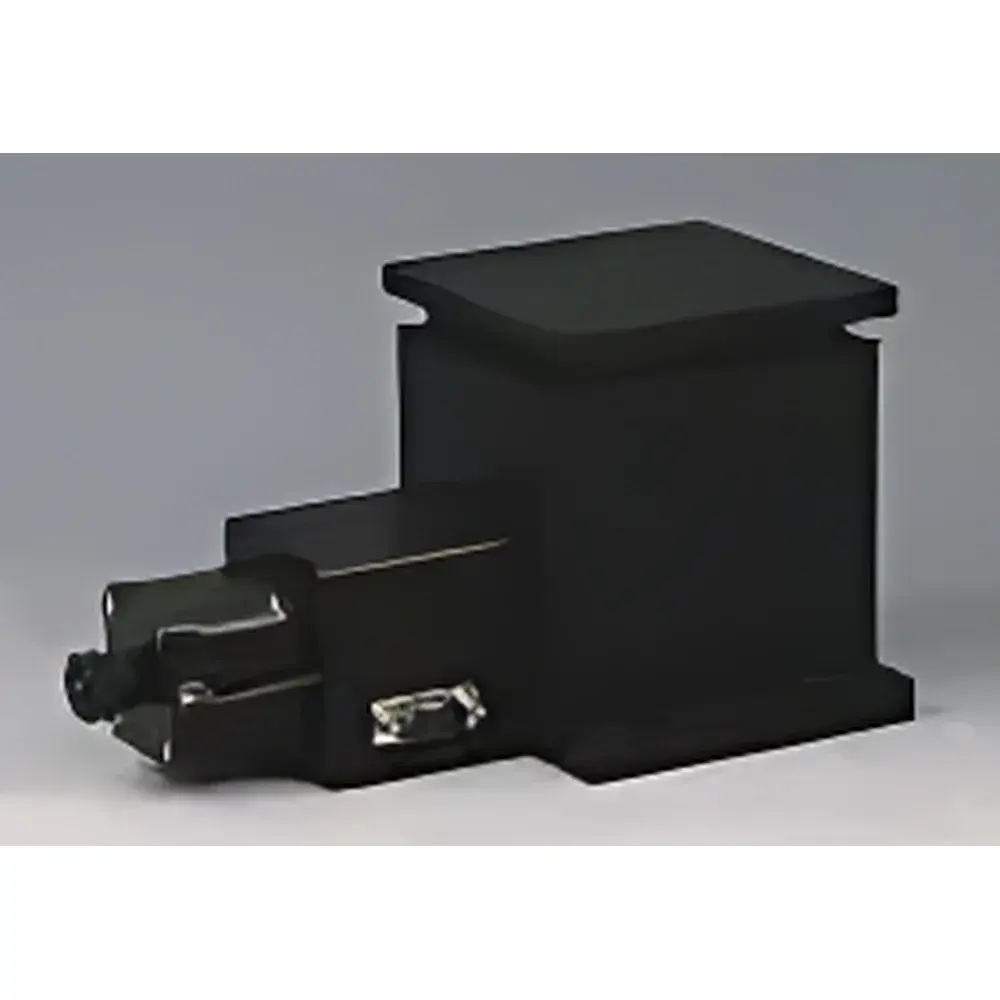
ZOLIX SAV1010/2030-ZF Precision Motorized Vertical Translation Stage
| Brand | ZOLIX |
|---|---|
| Origin | Beijing, China |
| Manufacturer Type | Direct Manufacturer |
| Model | SAV1010-ZF / SAV2030-ZF |
| Travel | 10 mm / 30 mm |
| Lead Screw Pitch | 1 mm |
| 8-Subdivision Resolution | 0.36 µm / 0.4 µm |
| Max. Speed | 6 mm/s / 6.5 mm/s |
| Repeatability | <5 µm |
| Stepper Motor | 42HS (1.8°) / 57HS (1.8°) |
| Rated Current | 1.7 A / 2.4 A |
| Central Load Capacity | 10 kg / 20 kg |
| Limit Switches | Dual (Upper & Lower) |
| Interface | Standard DB9 |
Overview
The ZOLIX SAV1010/2030-ZF is a high-precision motorized vertical translation stage engineered for demanding optical alignment, interferometry, and micro-positioning applications in research laboratories and industrial metrology environments. Unlike conventional lead-screw-driven linear stages, this stage employs a compact wedge-based mechanical amplification architecture—where rotational input from a stepper motor is converted into highly controlled vertical displacement via precision-ground inclined planes. This design delivers exceptional stiffness-to-volume ratio, minimized parasitic motion (pitch/yaw/roll), and intrinsic resistance to axial backlash. The stage integrates a finely lapped 1 mm-pitch stainless steel leadscrew coupled with cross-roller bearing guides, ensuring sub-micron trajectory fidelity over its full travel range. Its structural topology is optimized for low-profile integration into multi-axis optical benches, confocal microscope frames, and vacuum-compatible optomechanical assemblies where Z-axis repeatability and load stability are critical.
Key Features
- Wedge-driven kinematic architecture enabling high rigidity, minimal hysteresis, and excellent load-bearing capacity relative to physical footprint.
- Cross-roller linear guides with preloaded contact geometry ensure straightness deviation < 1.5 µm over full stroke and negligible lateral runout.
- High-resolution positioning achieved via 8-microstep drive mode: 0.36 µm (SAV1010-ZF) and 0.4 µm (SAV2030-ZF) effective step size, traceable to NIST-traceable calibration standards.
- Dual mechanical limit switches (top and bottom) provide hardware-level end-of-travel protection, independent of controller logic—essential for GLP-compliant system validation.
- Standard DB9 male connector supports direct integration with ZOLIX’s KSC series motion controllers or third-party RS-232/USB-to-DB9 motion control systems compliant with STEP/DIR signaling protocol.
- Stainless steel body and anodized aluminum components ensure long-term dimensional stability under thermal gradients typical in laser labs (operating range: 15–30 °C).
Sample Compatibility & Compliance
The SAV1010/2030-ZF is designed for use with standard optical components including mirror mounts (e.g., KM100, MM1), lens positioners, fiber couplers, and photodetector carriers. Its central load rating (10 kg for SAV1010-ZF; 20 kg for SAV2030-ZF) accommodates heavy-duty optics such as 100 mm diameter off-axis parabolic mirrors or multi-element objective assemblies. All mechanical interfaces conform to ISO 2093 and DIN 316, with M4 and M6 tapped holes on the top plate for universal mounting. The stage meets CE marking requirements for electromagnetic compatibility (EN 61326-1) and low-voltage directive (2014/35/EU). While not inherently vacuum-rated, optional vacuum-compatible variants (with dry-lubricated leadscrews and non-outgassing seals) are available under custom order—compliant with NASA ASTM E595 specifications upon request.
Software & Data Management
ZOLIX provides native support through the Kinesis-compatible ZMotion SDK (Windows/Linux/macOS), enabling programmatic control via Python, LabVIEW, MATLAB, and C++. The SDK includes built-in functions for trajectory planning, homing routines with soft/hard limit arbitration, and real-time position feedback polling at up to 100 Hz. All motion logs—including timestamped position, velocity, current draw, and error flags—are exportable in CSV/JSON format for audit trail generation. When used with ZOLIX’s KSC-2000 controller, the system supports 21 CFR Part 11-compliant electronic signatures and audit logging, fulfilling documentation requirements for ISO/IEC 17025-accredited calibration labs and pharmaceutical analytical instrument qualification (IQ/OQ/PQ).
Applications
- Precise Z-height adjustment of objective lenses in confocal and super-resolution microscopy systems.
- Fine focus control in laser-induced breakdown spectroscopy (LIBS) sample chambers requiring repeatable ablation plane registration.
- Vertical scanning in white-light interferometry and optical coherence tomography (OCT) reference arms.
- Dynamic alignment of free-space optical paths in quantum optics experiments involving cavity locking and mode matching.
- Automated wafer inspection stages where thermal drift compensation is implemented via closed-loop encoder feedback (optional upgrade).
FAQ
Is the SAV1010/2030-ZF compatible with third-party motion controllers?
Yes—the DB9 interface follows standard STEP/DIR + ENABLE pinout per ZOLIX datasheet Rev. 3.2; compatibility confirmed with Thorlabs KDC101, Newport ESP300, and PI C-863 controllers.
Can this stage be operated in vacuum environments?
Standard units are rated for ambient air only. Vacuum-compatible versions (10⁻⁶ mbar) are available with modified lubrication and sealing—contact ZOLIX Technical Support for part number suffix “-VAC”.
What is the maximum allowable moment load when mounting off-center optics?
Maximum permissible tip/tilt moment is 0.8 N·m (SAV1010-ZF) and 1.6 N·m (SAV2030-ZF); exceeding these values may degrade repeatability and accelerate guide wear.
Does the stage include encoder feedback for closed-loop operation?
No—open-loop stepper control is standard. An integrated optical encoder option (1 µm resolution) is available as factory-installed upgrade (model suffix “-ENC”).
How is homing performed without a dedicated home sensor?
Homing is executed via controlled deceleration into the lower mechanical limit switch, followed by precise back-off to a user-defined zero offset—fully programmable within ZMotion API.




